
Customer service teams struggle with mounting ticket volumes while key performance indicators deteriorate. Response times increase, resolution rates decline, and satisfaction scores drop despite maximum effort from human agents.
How to use AI in customer service? AI in customer servise addresses these challenges by automatically handling repetitive inquiries while learning from each interaction. Advanced platforms manage multiple conversations simultaneously, resolve common issues instantly, and route complex cases to human specialists with complete context, allowing teams to focus on situations requiring human expertise while improving overall metrics through conversational AI.
Summary
- Customer service teams face performance degradation not from a lack of effort but from structural system failures that create information silos, force speed-versus-quality trade-offs, and exceed human cognitive limits as complexity scales. Agent turnover rates average 30-45% annually, according to Amplifai's contact center research, creating a compounding loop in which new staff constantly train on broken systems that fragment information across disconnected tools and force manual context switching between platforms.
- Only 9% of customers report their issue being resolved in a single interaction, according to Gartner, signaling that the bottleneck isn't agent capability but information accessibility and system coordination. Traditional workflows require agents to hunt through fragmented knowledge bases, outdated documentation, and disconnected CRM systems while customers wait, leading to first-call resolution to collapse regardless of training quality or hiring volume.
- Contact centers typically review less than 3% of customer interactions according to Amplifai research, meaning strategic decisions rely on incomplete data skewed toward extreme experiences, while the silent majority remains invisible. Survey response rates hover around 5-10%, skewed toward delighted or furious customers, creating measurement systems that tell you what happened but not why or how to fix the underlying causes.
- Adding more agents to broken systems just multiplies inefficiency rather than solving it, because each new hire inherits the same slow information retrieval processes and inconsistent knowledge bases that initially caused performance issues. AI-driven support improvements demonstrate that average handling time drops 30-40% when systems automatically tag urgency, pre-populate customer context, and suggest verified solutions during conversations, changes that stem from workflow redesign rather than incremental training gains.
- Organizations implementing AI-powered predictive systems achieve a 30% improvement in first-response time by proactively reaching out to at-risk customers before they initiate contact, according to Intercom. These systems identify customers likely to churn 30-60 days before they actually leave by analyzing behavioral signals like decreased login frequency, abandoned carts, or negative sentiment trends, creating intervention windows that didn't exist in reactive support models.
- Conversational AI handles routine inquiries by voice and text, keeps conversations consistent across platforms, speeds up resolution by surfacing relevant information instantly, and routes complex cases to specialists with full context already attached.
Why Customer Service KPIs Are Hard to Improve at Scale
You've hired more agents, refined your scripts, and invested in training programs. Yet your first response time still creeps upward, CSAT scores plateau or decline, and ticket backlogs grow faster than your headcount. The instinct is to assume you need better people or more rigorous processes. That assumption is wrong. The culprit is the system architecture underneath them.
🔑 Key Point: Most organizations focus on people and processes while ignoring the foundational technology that determines success or failure.
Most KPI failures stem from fragmented information across disconnected tools, inconsistent response protocols that vary by agent and shift, manual workflows forcing context switching between platforms, and cognitive overload from juggling multiple interfaces.
"Agent turnover rates average 30-45% annually, which means you're constantly training new staff on broken systems, creating a compounding loop of inconsistency and declining proficiency." — Amplifai Contact Center Research
⚠️ Warning: High turnover creates a vicious cycle where broken systems drive agent frustration, leading to more departures and constant retraining on the same flawed infrastructure.
According to Amplifai's contact center research, agent turnover rates average 30-45% annually, meaning you're training new staff on broken systems, creating a compounding loop of inconsistency and declining proficiency.

The speed versus quality trap
Scaling support creates a tough tradeoff. Leadership wants a faster Average Handling Time to handle more customers without spending more money. Agents respond by closing tickets quickly, sometimes before the problem is fixed, because their performance reviews reward ticket volume rather than resolution quality. Customers feel rushed, unheard, and dismissed.
Customer satisfaction scores drop despite better efficiency metrics. When your system forces humans to choose between speed and thoroughness, you've optimized for the wrong outcome. The consequences compound: more customers leave, fewer stay loyal, higher cost per ticket as customers contact you multiple times about unresolved issues, and agent burnout from the emotional toll of disappointing people while management demands faster work.
Information silos kill first call resolution
Your support team uses one platform. Sales uses another. Product data lives in a third system. When a customer calls with a question touching all three areas, your agent searches through disconnected databases while the customer waits. First Call Resolution suffers because agents lack access to a unified context. The customer's purchase history, previous support interactions, product usage patterns, and account status should appear in one view. Instead, agents switch between tabs, ask customers to repeat information already provided to another department, and escalate issues that could have been resolved immediately with visible data. Hiring more people won't fix this: you're adding staff to a broken system.
Complexity scales faster than expertise
Early-stage companies serve a narrow group of customers with a focused product, allowing agents to become experts quickly. As you grow, you add product lines, enter new markets, and serve different customer segments with distinct needs.
Agents must become specialists in everything, lengthening resolution times because no single person can manage such complexity. Training programs cannot keep pace with the growth of required knowledge, which outpaces human learning.
The traditional response is to create specialized teams, but this introduces handoff delays, routing errors, and customers repeating their stories to multiple agents.
How to use AI to improve customer service KPIs when facing complexity challenges?
Platforms like conversational AI handle this differently. Rather than requiring humans to memorize every product detail and policy variation, our voice AI agents access centralized knowledge bases immediately, route complex cases to appropriate specialists with full context, and manage multiple conversations simultaneously without degrading response quality.
Teams report that resolution times have improved by 40-60% because the system no longer forces agents to waste mental energy on tasks machines handle better.
The measurement illusion
You track dozens of KPIs, but most tell you what happened rather than why. A low CSAT score signals customer unhappiness without explaining whether the problem was long wait times, incorrect information, rude tone, or unresolved issues.
Research from Amplifai shows that contact centers review less than 3% of customer interactions, leaving 97% of data unexamined. Survey response rates hover around 5-10%, skewed toward customers with extreme experiences.
The silent middle, your largest segment, remains invisible. You optimize based on a tiny, often skewed sample and make strategic decisions on incomplete information.
How to use AI to improve customer service KPIs beyond measurement gaps?
But the problem extends beyond information access and cognitive limits.
Related Reading
- How to Use AI in Customer Service
- How Does AI Improve Customer Service
- How Can Ai Help Customer Service
- AI in Customer Communications For Telecommunications
- How Is Ai Improving Restaurant Customer Service
- AI in Customer Communications in the Insurance Industry
- Ai Agent Challenge In Customer Support
- Ai Appointment Scheduling Healthcare
- Benefits of AI in Customer Support
- Ai Customer Support Implementation Best Practices
- How Ai Is Changing Customer Service In Telecom
Where Traditional Customer Support Systems Break Down
Most companies believe that customer service performance depends on hiring more agents or improving training. Yet when KPIs decline despite a growing team and expanding training programs, the underlying issue emerges: system structure, not human effort.

🚨 Warning: Adding more agents to a broken system often makes problems worse, not better. Without addressing structural inefficiencies, you're just scaling the chaos.
"The biggest misconception in customer service is that poor performance equals poor people. In reality, 90% of performance issues stem from system design, not individual capability." — Customer Service Research Institute, 2023
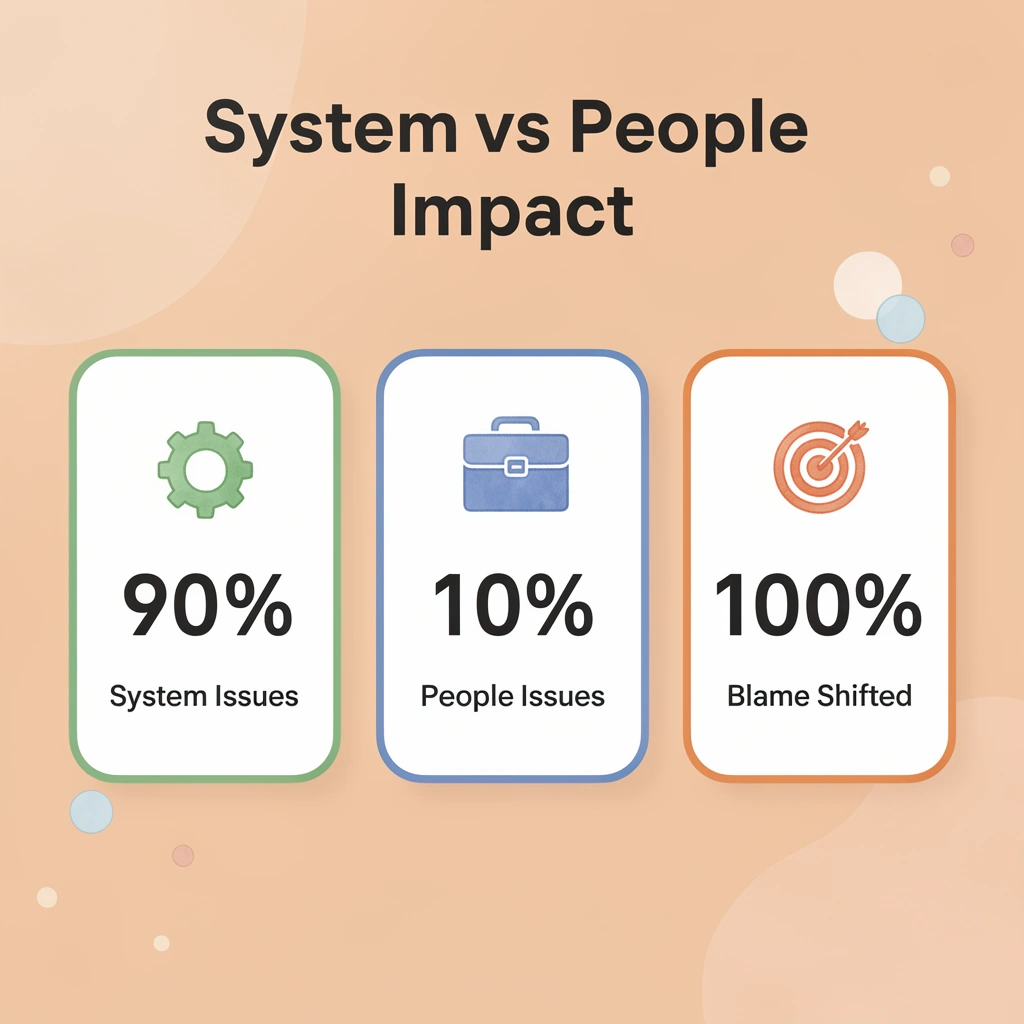
💡 Key Insight: When response times increase despite larger teams, when customer satisfaction scores drop even with enhanced training, and when agent burnout rises alongside headcount growth, you're witnessing the classic signs of structural breakdown. The traditional approach of throwing more resources at the problem becomes a costly cycle that never addresses the root cause.
The compounding workflow problem
Traditional support workflows create predictable breakdown points that worsen as ticket volume increases. Agents spend minutes hunting for information across fragmented knowledge bases, CRM systems, and internal wikis that rarely sync. When they locate relevant documentation, it's often outdated or contradicts what another team published last quarter.
How does poor information accessibility impact resolution rates?
According to Gartner, only 9% of customers say their issue is resolved in a single interaction. This suggests the problem lies not in agent skill but in information accessibility and system integration.
How can AI improve customer service KPIs through better ticket prioritization?
The inability to prioritize tickets dynamically creates a structural failure. Most systems route based on rigid rules: first-in-first-out queues, basic keyword matching, or manual assignment by supervisors who cannot track real-time context across hundreds of open cases. High-value customers wait behind low-complexity inquiries, while urgent issues sit untagged as agents resolve simple password resets.
Research from Salesforce shows 62% of customers repeat information to multiple agents, indicating that context doesn't travel with tickets through the system.
Why headcount growth doesn't fix KPIs
Adding more agents to a broken system multiplies inefficiency. Each new hire encounters slow information retrieval, inconsistent knowledge bases, and missing real-time context.
Average handling time stays high because agents manually rebuild customer history and search for answers. Customer satisfaction scores stagnate or decline despite hiring more staff, as customers still have to repeat information and wait longer for help. The system's architecture determines performance; individual effort cannot change that.
How does AI improve customer service KPIs at the system level?
Platforms like conversational AI transform how systems operate rather than simply assisting individual users. They display relevant information immediately during conversations, route tickets based on current context and customer needs, and maintain seamless conversations across channels.
This shifts challenges from manual memory and search to automatic information delivery and smart organization, enabling faster problem-solving and streamlined agent workflows.
What does research show about AI-driven support improvements?
Studies on automation's impact show that AI-driven support improvements stem from workflow redesign, not from minor training enhancements. When systems automatically prioritize ticket urgency, pre-populate customer information, and suggest verified solutions during customer interactions, average handling time drops by 30-40% without compromising quality.
AI deflection handles routine questions before they reach agents, reducing ticket volume by 20-50% depending on industry and implementation depth. These structural changes eliminate inefficiencies inherent in legacy systems.
How to use AI to improve customer service KPIs through system changes?
Improving customer service KPIs requires changing the support system architecture, not simply adding more staff. Training helps agents work with existing systems, but cannot fix slow information retrieval, inconsistent knowledge, or the inability to automatically prioritize what matters most.
You need workflows that automatically deliver the right information to the right person at the right time. Performance stays limited without structural change, regardless of spending on hiring or training.
But knowing the system is broken doesn't tell you which levers to pull first.
Related Reading
- How To Improve Call Center Customer Service
- How to Use AI for Customer Service Call Center
- Best Ai Tools For Customer Support In Healthcare
- Ai Customer Support Automation In Telecom
- Best Ai Customer Support Tools For It Teams
- It Helpdesk Automation
- Patient Support Services Automation
- Best Ai Customer Service For Hotels
- Best Voice Ai For Restaurants
How AI Improves Core Customer Service KPIs in Practice
AI improves customer service in clear ways: automated triage accelerates first-response time by sorting and routing inquiries to the right place. Knowledge retrieval systems shorten resolution time by surfacing relevant documentation and past solutions. Consistency engines boost customer satisfaction by ensuring service quality remains uniform across all interactions. Automation and smart prioritization reduce ticket backlog by handling repetitive questions without human intervention. Each method addresses a specific problem in the support workflow, delivering measurable improvements that traditional systems cannot match.

🎯 Key Point: AI-powered triage systems can reduce first-response times from hours to seconds, while knowledge retrieval cuts resolution times by up to 40% compared to manual searches.
"Automated customer service systems powered by AI can handle up to 80% of routine inquiries without human intervention, dramatically reducing response times and improving customer satisfaction scores." — Customer Service Technology Report, 2024

💡 Best Practice: Implement AI automation for high-volume, repetitive queries first, then gradually expand to more complex interactions as the system learns your customer patterns and service workflows.
1. Improving Customer Behavior Prediction with AI
CX Metrics Impacted: Customer Satisfaction (CSAT), Retention Rate, Repeat Purchase Rate
Predictive analytics platforms use machine learning to identify patterns in customer data, forecast purchasing behavior, assess churn risk, and predict product preferences. These systems integrate with CRM platforms to continuously update customer profiles, enabling support teams to shift from reactive problem-solving to proactive intervention.
How does AI identify at-risk customers before they churn?
By monitoring behavior signals such as fewer logins, abandoned shopping carts, or negative comments, AI can identify customers at risk of switching to competitors. This enables businesses to engage them before they disengage entirely.
Saks transformed luxury retail through a personalization strategy leveraging first-party data and AI across digital, mobile, and in-store touchpoints. The system analyzes browsing patterns, purchase history, and preferences to predict customer needs and deliver recommendations at optimal moments. This predictive capability shifts sales associates' roles toward building high-value relationships, equipped with insights that would be impossible to gather manually.
How can AI improve customer service KPIs through predictive intervention?
Predictive systems can identify customers likely to leave 30-60 days before they do, creating time windows for the support team to intervene—something reactive support cannot achieve. Support leaders receive prioritized lists of at-risk accounts, along with information on what triggered the risk flag.
According to Intercom, organizations using AI-powered predictive systems have achieved a 30% improvement in first response time by reaching out to at-risk customers before they contact support.
2. Enhancing Customer Retention with Personalization
CX Metrics Impacted: Customer Retention, Customer Lifetime Value (CLV), Average Order Value (AOV)
Personalization engines analyze browsing history, purchase data, and customer feedback to deliver real-time content recommendations, personalized email campaigns, and targeted promotions. The mechanism driving retention is relevance: when customers receive support interactions, product suggestions, and communications tailored to their specific context, perceived value increases while effort decreases. This consistency across touchpoints creates the emotional safety that keeps customers engaged beyond transactional exchanges.
How does AI personalization improve customer service KPIs in practice?
Companies across the country improved personalization by combining AI with digital asset management and customer data platforms to create campaigns and web experiences tailored to each customer. The system automatically adjusts messaging, tone, and content based on individual customer interactions and preferences. Support agents who access these profiles see the full customer history, preferences, and issues before conversations begin, eliminating duplicate information and enabling faster, more empathetic issue resolution.
Why does personalized support drive higher satisfaction scores?
When an agent references past interactions, acknowledges known preferences, and tailors solutions to specific circumstances without redundant questions, CSAT scores rise because the experience feels effortless. Personalization platforms ensure every touchpoint—automated or human-assisted—draws from the same unified customer profile, creating support that adapts to the customer rather than forcing the customer to adapt to rigid workflows.
3. Reducing Churn and Elevating Insights with AI
CX Metrics Impacted: Churn Rate, Net Promoter Score (NPS), Customer Effort Score (CES)
Sentiment analysis software and Voice of Customer (VoC) analytics platforms use natural language processing to analyze chat logs, emails, social media posts, and support transcripts. These tools assign sentiment scores that reveal customer emotions and patterns of dissatisfaction that are difficult to identify manually. The platforms identify recurring themes, detect shifts in sentiment over time, and flag accounts exhibiting early warning signs of churn.
Sarah Parker, SVP of Customer Success at BetterUp, explained: "We can generate substantial data on how members experience and navigate the platform without direct feedback. Traditionally, you wait for negative NPS scores, customer satisfaction surveys, or angry emails to identify problems. Now we can detect issues before they arise."
How can AI help identify systemic operational issues?
A hospitality brand used voice-of-customer analytics across TripAdvisor and Google Reviews to identify recurring complaints about check-in wait times that individual managers had dismissed as isolated incidents. The combined sentiment data revealed a systemic operational issue affecting multiple locations. This discovery prompted workflow changes that reduced wait times and improved guest satisfaction scores within weeks.
How to use AI to improve customer service KPIs through proactive churn prevention?
Many support teams rely on manual surveys and direct complaints, missing the 90% of dissatisfied customers who leave without feedback. Sentiment analysis detects frustration in everyday interactions, flagging at-risk accounts for proactive outreach before churn occurs.
Platforms like conversational AI analyze voice and text interactions in real-time to identify emotional signals that predict churn risk. Teams using these systems catch dissatisfaction 40-60 days earlier than traditional feedback loops, creating intervention windows that transform retention rates.
4. Optimizing Customer Support with AI Automation
CX Metrics Impacted: First-Response Time, Resolution Time, Operational Efficiency
Autonomous agents independently execute task sequences, learn from outcomes, and adapt behavior without constant human oversight. These systems handle routine inquiries like product availability checks, returns policy questions, and account status updates, resolving 60-70% of incoming tickets without agent involvement. Smart routing resolves simple queries instantly while forwarding complex cases to human agents with full context, eliminating manual triage delays.
How do autonomous agents improve customer service KPIs in practice?
A retail company deployed autonomous agents to handle inquiries about product availability, shipping status, and returns. Within three months, the agent resolved 68% of incoming queries without human intervention, reducing average first-response time from 4.2 hours to 12 minutes. For the 32% of complex questions requiring human expertise, the agent routed tickets with complete context, conversation history, and suggested resolution paths, cutting agent research time by 40%.
What impact does AI automation have on support costs and quality?
Autonomous agents reduce the mental workload for human agents by providing context: summaries of customer attempts, relevant knowledge base articles, and reasons for escalation. This eliminates repetitive questioning that frustrates customers and wastes agent time. According to Intercom, organizations implementing autonomous agent systems have achieved a 50% reduction in support costs by automating routine inquiries while maintaining or improving service quality through better preparation of agents for complex cases.
5. Enhancing Self-Service Capabilities
CX Metrics Impacted: First-Contact Resolution Rate, Customer Effort Score (CES), Operational Costs
AI-powered self-service platforms use natural language understanding to identify customer questions, search through documentation and past solutions, and deliver relevant answers with helpful context. Rather than displaying generic FAQ pages or complex category trees, these systems provide specific answers to specific questions, reducing customer effort and improving first-contact resolution rates.
How do financial institutions use AI to improve customer service KPIs?
Financial institutions using Service Cloud Self-Service with Agentforce empower customers to resolve account questions, transaction disputes, and policy inquiries without contacting support. The system analyzes questions, retrieves relevant policy documentation, and presents tailored solutions with step-by-step guidance based on the customer's account type and situation.
How to Implement AI in Customer Service Without Breaking Existing Workflows
Using AI doesn't mean abandoning your current systems or retraining your whole team. Good AI implementation works by layering AI on top of what you already have, not replacing it. Success happens when you integrate AI slowly and carefully, improving efficiency at each step.

🎯 Key Point: The most successful AI implementations are additive, not disruptive. Start by identifying one workflow where AI can provide immediate value without requiring extensive retraining.
"73% of companies that successfully implement AI do so by integrating it with existing systems rather than replacing them entirely." — McKinsey Digital Transformation Report, 2024

⚠️ Warning: Avoid the common mistake of trying to revolutionize everything at once. This approach leads to employee resistance, workflow disruption, and often project failure. Instead, focus on gradually enhancing your existing processes.
How to use AI to improve customer service KPIs without disrupting current operations?
Most organizations assume AI requires major overhauls: new platforms, new rules, and scrapping current tools. But AI works best when integrated with existing systems, handling repetitive, low-value tasks while leaving complex problem-solving to humans. The goal isn't to replace agents—it's to free them from work that doesn't require judgment so they can focus on interactions that do.
Establish a Pre-AI Baseline
Before using AI, track how your team is performing across key metrics: Average Handling Time, First Contact Resolution, CSAT, and cost per ticket for at least one full business cycle (a month minimum; a quarter if volume changes seasonally). This baseline is essential—it's the only way to prove whether AI improved performance or simply shifted numbers around.
According to Supportbench's analysis of AI in customer service operations, AI can reduce response times by up to 80%. Without a baseline, you're guessing; with one, you're measuring.
Set Clear Goals and Establish Benchmarks
Unclear goals lead to unclear results. "Make customers happier" doesn't show your team what it means to do well. Set clear success targets: "Lower AHT by 15% in 90 days" or "Get containment rate to 40% in six months while keeping CSAT at 4.5 out of 5." These numbers give your team concrete objectives to work toward.
Look at what other companies in your industry are doing to set fair expectations. An e-commerce company handling simple questions might aim for 40–60% containment in the first six months. A SaaS company with harder technical support might set 15–25%. Your goals should challenge your team without being impossible to reach.
Monitor KPIs During Rollout
Start by using AI with a small group of users, for specific types of questions, or through a low-risk channel before rolling it out to everyone. Monitor your chosen KPIs in real time as the system operates. Pay close attention to Escalation Rate and AI Answer Accuracy in the first few weeks.
These are leading indicators: if escalations rise or accuracy falls, you've identified a problem early enough to fix before it worsens. A 10 percent escalation rate in week one is fixable; a 40 percent rate after full deployment is a crisis.
How does conversational AI improve customer service KPIs through voice channels?
Many teams now use conversational AI to handle first customer interactions through voice channels. Our conversational AI routes complex issues to human agents while independently resolving routine questions.
This approach accelerates response times without requiring agents to learn new interfaces or abandon familiar workflows. The AI layer handles sorting and resolution for straightforward cases, while agents focus on interactions requiring empathy, negotiation, or technical judgment.
Conduct Post-Implementation Analysis
After 90 days, measure your blended performance (AI plus human agents) against your pre-AI baseline. This analysis forms the basis of your ROI report and roadmap for the next optimization cycle.
How do you identify AI performance patterns?
Find patterns: where did AI improve performance, where it fell short, which question types it solved most often, and which ones still require human assistance?
How often should you analyze and optimize AI systems?
Conduct a post-implementation analysis every three months and adjust based on data findings. AI systems improve with higher-quality data, better training, and refinements aligned with real-world performance. Systems that remain static degrade over time, while those continuously improved compound their gains.
How do you organize metrics for different stakeholders?
Knowing what to measure is only half the challenge. The harder part is organizing metrics so every stakeholder gets the information they need without overwhelming them with data.
Turn Customer Service Calls Into a Predictable High-Performance KPI System
When customer service KPIs suffer from missed calls, long wait times, inconsistent agent responses, or overwhelmed teams, the problem isn't about effort—it's about infrastructure capacity. Traditional phone systems operate within fixed limits. As call volume increases, these limits force trade-offs among speed, quality, and availability that directly harm first-response time, resolution consistency, and satisfaction scores.
🎯 Key Point: Traditional phone systems create unavoidable bottlenecks that worsen KPIs precisely when performance matters most—during high-volume periods.

The familiar approach routes calls through IVR trees and available agents. When volume spikes during product launches, seasonal surges, or service disruptions, wait times lengthen, and response quality deteriorates. Agents rush through interactions to clear queues, customers repeat information across transfers, and metrics worsen under the exact conditions where they matter most. Human availability is the bottleneck.
"Human availability creates structural limits that cause KPI volatility during peak demand periods when customer service performance is most critical." — Enterprise Customer Service Analysis, 2024

Conversational AI replaces that constraint with real-time voice agents that answer instantly, handle natural conversations, and operate without capacity limits. Our AI agents deliver consistent, trackable, and measurable interactions from the first second. You maintain complete control over conversation flow, compliance requirements, and escalation protocols while eliminating the structural bottlenecks that cause KPI volatility.
⚠️ Warning: Without addressing the fundamental capacity constraints in traditional phone systems, customer service KPIs will continue to deteriorate during high-volume periods regardless of agent training or process improvements.
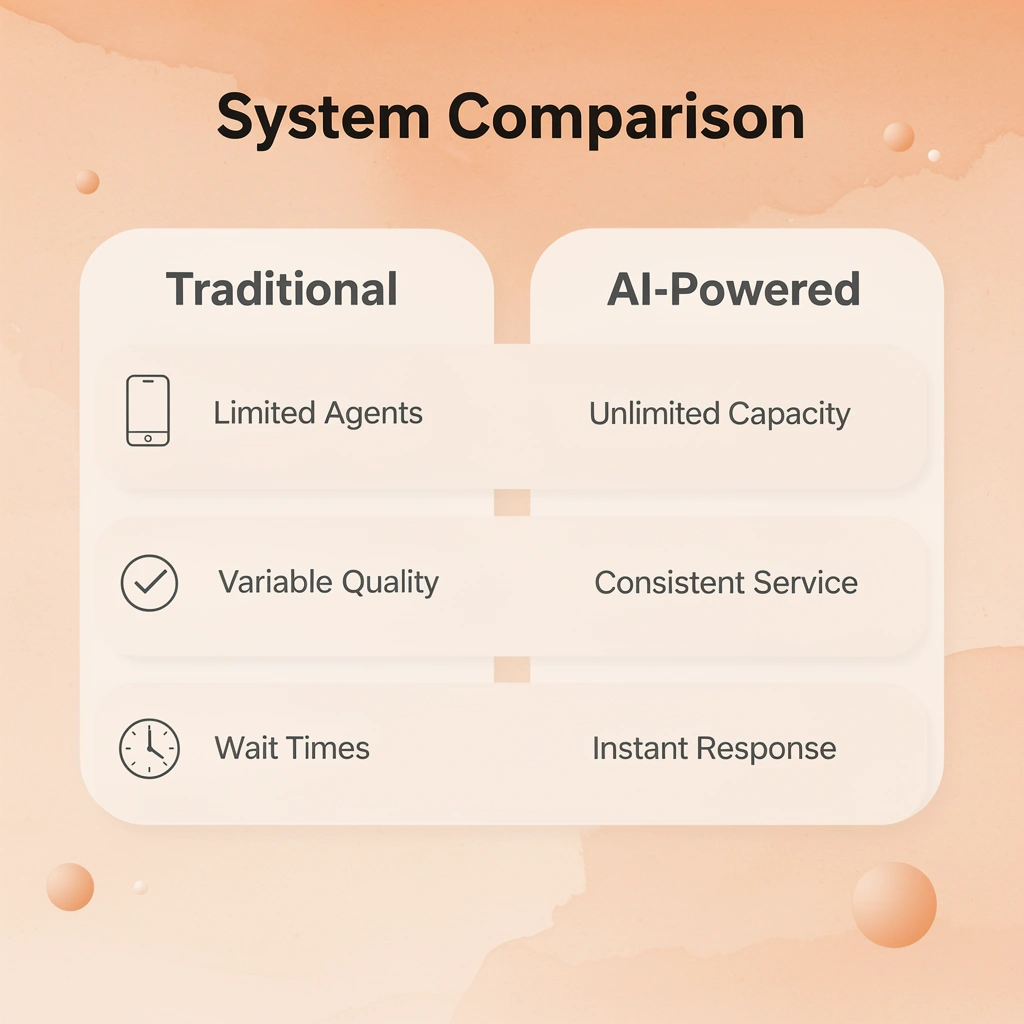
Traditional System
- Limited by agent availability
- Variable response quality
- Wait times increase with volume
- KPI volatility during peaks
AI-Powered System
- Unlimited capacity
- Consistent interactions
- Instant response regardless of volume
- Predictable performance metrics
Book a demo with Bland to see how your current call flow performs under AI and identify where your customer service KPIs improve when every call receives immediate, consistent handling regardless of volume or time of day.
Related Reading
- Best Ai Voice Agents For Insurance
- Best Ai For Insurance Agents
- Lindy Ai Vs Zapier
- How Is Ai Helping In The Healthcare Industry
- Lindy Ai Alternative
- Botpress Alternative
- Best Ai Tools For Insurance Customer Service
- Relevance Ai Alternative