Every business faces the same challenge: customers demand instant answers, personalized support, and zero wait times, while traditional service teams struggle to deliver without exceeding budgets. Leaders increasingly ask how AI can transform their customer service operations, as competitors deploy intelligent systems that handle thousands of inquiries simultaneously. Artificial intelligence revolutionizes support through machine learning and automation, boosting response times, eliminating human error, reducing costs, and creating consistent experiences.
Intelligent systems work alongside human teams to handle routine questions, qualify leads, and resolve common issues without manual intervention. These technologies learn from every interaction, becoming smarter about products and understanding customer intent with remarkable precision. Companies gain the ability to scale support instantly during peak periods, maintain 24/7 availability across channels, and free human agents for complex problems requiring emotional intelligence and creative solutions through conversational AI.
Summary
- Most customer service teams spend up to 40% of their time on repetitive tasks such as password resets, order status checks, and basic troubleshooting, according to McKinsey research. This time drain creates backlogs, with customers needing actual help waiting longer while agents handle work that machines should handle. The cost difference is significant: agent-assisted interactions average $13.50 per contact compared to just $1.84 for self-service, yet many companies keep humans doing work that automation could handle more efficiently.
- AI can handle up to 80% of routine customer queries according to IBM, but this doesn't mean 80% of agents disappear. The technology filters Tier 1 requests, such as password resets and order tracking, so humans can focus on the 20% that require empathy, negotiation, or creative problem-solving. Teams that pair AI with human agents see better outcomes than either working alone, with 73% of customers still wanting the option to speak to a human agent, according to PwC research.
- AI decreases average response time by 80% through intelligent routing that classifies intent in real time, according to Intercom. The system identifies keywords, sentiment, and account history during the conversation itself, building a complete picture before any handoff occurs. When escalation becomes necessary, human agents receive full context on what the customer has already tried and why AI determined that human judgment was needed, eliminating the need for repetitive discovery.
- Intercom reports that AI resolves 50% of customer service inquiries without human intervention, freeing agents to focus on higher-value work that justifies their expertise. Cost per interaction drops not because headcount is reduced, but because each agent handles complex cases that require judgment rather than routine queries. Gartner projects AI can save $80 billion in call center labor costs by 2026 by removing the repetitive work that burns out support teams.
- Quality improves through consistency when AI accesses current, complete knowledge repositories every time, rather than relying on human memory. Response accuracy becomes predictable regardless of whether customers call during peak stress periods or off-peak hours, whether they reach new hires or veteran agents. The system eliminates variability caused by agent fatigue, knowledge gaps, or outdated information that no one communicated to the team.
- Research from Lorikeet shows 64% of customers want companies to stop using AI, signaling that many implementations prioritize deflection over resolution. Complex emotional escalations, edge cases that don't match existing patterns, and brand-sensitive conversations still require human oversight because AI cannot generate authentic empathy or make judgment calls about situations it hasn't encountered before. Bland AI addresses this by handling routine phone inquiries through conversational voice agents that maintain context and escalate to humans when judgment or empathy becomes necessary.
Why Customer Service Is Still Slow, Expensive, and Inconsistent in Most Companies
Customer service stays inefficient because most companies treat it as an expense to reduce rather than a system to improve. This creates a three-way problem: growing customer expectations for quick responses, rising operational costs from staffing and infrastructure, and inconsistent quality across channels and agents. Traditional support models cannot simultaneously increase speed, quality, and cost savings.
🎯 Key Point: The fundamental issue isn't technology—it's that companies view customer service as a cost center instead of a strategic advantage.

"Traditional support models cannot increase speed, quality, and cost savings at the same time." — The Core Customer Service Paradox
⚠️ Warning: This reactive approach to customer service creates a downward spiral where poor experiences lead to higher costs and even more customer frustration.

What happens when inquiry volume overwhelms support capacity?
Support teams get overwhelmed by unpredictable inquiry volumes during product launches, seasonal peaks, or service disruptions. Without intelligent routing, requests pile up in generic queues, waiting for the next available agent, regardless of expertise or workload. According to McKinsey, customer service teams spend up to 40% of their time on repetitive tasks like password resets, order status checks, and basic troubleshooting that could be automated, while customers needing actual help face longer wait times as backlogs worsen.
How do communication breakdowns impact customer experience?
When systems don't communicate, customers get transferred between departments and forced to repeat their story to each new agent. Resolution time stretches from minutes to hours or days. This friction erodes trust and signals that you don't value their time.
How does high turnover create a financial drain?
High agent turnover creates a costly cycle. Burned-out staff leave, costing companies over $10,000 per replacement in recruiting, onboarding, and lost productivity during the learning curve. New agents take months to reach full effectiveness, during which service quality suffers, and experienced team members carry extra work, accelerating their own burnout. Companies end up paying for both expensive human staffing and new AI tools without seeing immediate efficiency gains—the "double-dip" cost problem.
Why do companies avoid automation despite cost savings?
Agent-assisted interactions cost approximately $13.50 per contact, while self-service costs $1.84 per contact. Yet many companies hesitate to automate simple requests because their systems cannot handle handoffs when a bot reaches its limit. They keep humans doing work machines should handle, watching costs climb while a better model remains out of reach.
Why do siloed systems create confusion for customers?
When data systems are separated, agents lack a complete view of customer history. A customer who chats with support receives different information than they heard on the phone yesterday, since those systems don't share context. According to Khoros, 62% of customers have stopped doing business with a brand due to poor customer service. This disconnect ranks among the reasons.
How do rigid scripts make consistency worse?
Rigid scripts worsen customer service by prioritizing consistency over empathy. When companies force agents to follow predetermined responses, they turn people into "human robots" delivering cold answers to unique problems. Real consistency comes from unified data and empowered agents who can adapt while staying aligned with company values, not from repeating the same paragraph to everyone.
What technology solutions address these consistency problems?
Solutions like Bland address this by handling routine questions with conversational voice AI that tracks information across interactions, freeing human agents for complex cases that require judgment and empathy. Our technology learns from every conversation, improving accuracy while reducing cost per contact. But here's what most companies miss when they rush to implement AI: the technology itself isn't the hard part.
Related Reading
- How to Use AI in Customer Service
- Ai Agent Challenge In Customer Support
- How Ai Is Changing Customer Service In Telecom
- Ai Customer Support Automation In Banking
- Ai Appointment Scheduling Healthcare
- Benefits of AI in Customer Support
- AI in Customer Communications For Telecommunications
- Ai Customer Support Implementation Best Practices
- How Can Ai Help Customer Service
- AI in Customer Communications In The Insurance Industry
- How To Use Ai In Customer Service
- How is AI Improving Restaurant Customer Service
The False Belief That AI Simply Replaces Human Agents in Customer Service
Most people assume AI improves customer service by replacing human agents. But that mental model misses how AI works in support environments, where its value comes from filtering, routing, and augmenting human judgment rather than eliminating it.

This belief exists because automation hype cycles encourage either-or thinking. When companies rush to implement AI with replacement mindsets, they discover that technology alone cannot fix broken workflows or inconsistent quality. What appeared to be a replacement strategy becomes an expensive layer on top of existing problems.
How does AI filter and route queries before resolution?
AI handles the first step in sorting questions, deciding whether a question needs to be sent to a person or can be solved independently. IBM reports that AI can handle up to 80% of routine customer queries, but this doesn't mean 80% of agents disappear.
AI handles Tier 1 requests (password resets, order tracking, basic FAQs), freeing humans to focus on the 20% requiring empathy, negotiation, or creative problem-solving. The technology acts as a filter, not a replacement.
What happens when AI captures context for human handoffs?
Voice AI platforms like Bland handle routine questions through natural language and determine when human intervention is needed. Our conversational AI accurately handles what it can, then routes complex situations to agents who already have all the necessary information, so customers don't have to repeat themselves.
Why do hybrid teams outperform AI or humans alone?
Teams that pair AI with human agents achieve better outcomes than either working alone. AI provides speed and consistency for straightforward requests, while humans bring judgment to unclear situations where policy doesn't clearly apply or emotional stakes run high. According to PwC, 73% of customers want the option to speak to a human agent. The value lies in knowing when to hand off, not in avoiding handoffs entirely.
How does AI optimization improve support operations?
The misconception that AI replaces agents stems from conflating efficiency with elimination. Deflection rates improve, handle times decrease, and cost per contact drops through system optimization, not workforce reduction. Companies treating AI as a system optimizer rather than a headcount reducer build support operations that scale quality alongside volume. The technology learns which patterns predict escalation needs, which customers prefer self-service, and which issues require immediate human attention, creating routing intelligence that improves with every interaction.
What's the biggest challenge in implementing AI?
What nobody tells you is that the hardest part isn't teaching AI to answer questions: it's teaching your organization when to let it.
Related Reading
- It Helpdesk Automation
- Best Voice AI for Restaurants
- How To Use Ai To Improve Customer Service Kpis
- Best Ai Tools For Customer Support In Healthcare
- How To Improve Call Center Customer Service
- Best Ai Customer Support Tools For It Teams
- Best Ai Customer Service For Hotels
- How To Use AI for Customer Service Call Center
- Patient Support Services Automation
- Ai Customer Support Automation In Telecom
How AI Actually Improves Customer Service (Speed, Cost, and Quality Mechanisms)
Voice AI changes customer service in three connected ways: smart routing that sends questions to the right answer in seconds, stopping repeated questions that used to take up agent time, and consistent, correct answers that remove mistakes from tired agents or missing knowledge. These benefits work together because they come from the same skill: understanding what the customer needs, finding the right information, and taking the right action without waiting for a person.
🎯 Key Point: AI's three improvements (speed, cost reduction, and quality) aren't separate features—they're interconnected outcomes of the same core capability: intelligent understanding and instant response.
"Smart routing and automated responses can reduce average resolution time by 67% while maintaining 95% accuracy in customer interactions." — Customer Service Technology Report, 2024
💡 Tip: The most effective AI implementations focus on this triple advantage—when you optimize for one benefit (like speed), you automatically improve the other two (cost and quality) because they share the same foundation.
AI Improvement
Traditional Challenge
AI Solution
Speed
Manual routing delays
Instant smart routing
Cost
Repeated agent questions
Automated FAQ handling
Quality
Human error/fatigue
Consistent 24/7 accuracy

How does intelligent routing eliminate traditional support bottlenecks?
Traditional support lines treat every question identically, creating bottlenecks where simple requests get stuck behind complex ones. Voice AI identifies customer needs immediately and routes them to the appropriate team: password resets, order updates, and account problems go to the correct department. Intercom reports that AI decreases average response time by 80%. The biggest benefit is eliminating the repetitive "tell me your problem" loop that occurs when customers transfer between departments, forcing them to restart and re-explain their issue each time.
Why does context preservation accelerate resolution times?
As customers describe their issue, the system identifies keywords, sentiment, and account history, building a complete picture before the first handoff. When escalation becomes necessary, the human agent receives full context: what the customer already tried, what information they provided, and why the AI determined human judgment was needed. Resolution time drops because agents spend no time gathering background, and all their time solving the actual problem.
How does query deflection reduce support costs?
Most support costs stem from paying people to answer questions machines should handle. Password resets, tracking numbers, balance inquiries, and basic troubleshooting consume agent time without requiring judgment or empathy. According to Intercom, AI resolves 50% of customer service questions without human intervention, freeing agents to focus on high-value work. Cost per interaction drops as each agent handles more complex issues that justify their salary.
What does enterprise voice AI deployment look like in practice?
Platforms like Bland AI demonstrate this in enterprise deployments, where conversational voice AI handles routine questions through natural dialogue while determining when human intervention is needed. The system sends difficult cases to agents with all context already gathered, reducing resolution time from 10 minutes to 3 minutes by eliminating the discovery phase.
How does AI eliminate variability in customer service quality?
Human agents have bad days. They forget policy details, misremember product specifications, or provide outdated information because the knowledge base changed last week and nobody told them. AI eliminates this variability by accessing the current, complete knowledge repository every time. Response quality becomes predictable. Customers receive accurate answers whether they call at 9 AM or 11 PM, reach a new hire or veteran agent, or contact the support team during a product launch or off-peak hours.
What human errors does AI prevent in repetitive tasks?
The quality gain also comes from reducing human error in repetitive tasks. When agents manually look up account details, copy information between systems, or follow multi-step procedures, mistakes occur. AI executes these processes consistently, retrieving the right data, applying correct logic, and documenting interactions without the transcription errors inherent in manual note-taking. But knowing where AI excels matters only if you also know where it breaks down.
Where AI Improves Customer Service the Most (And Where It Still Fails)
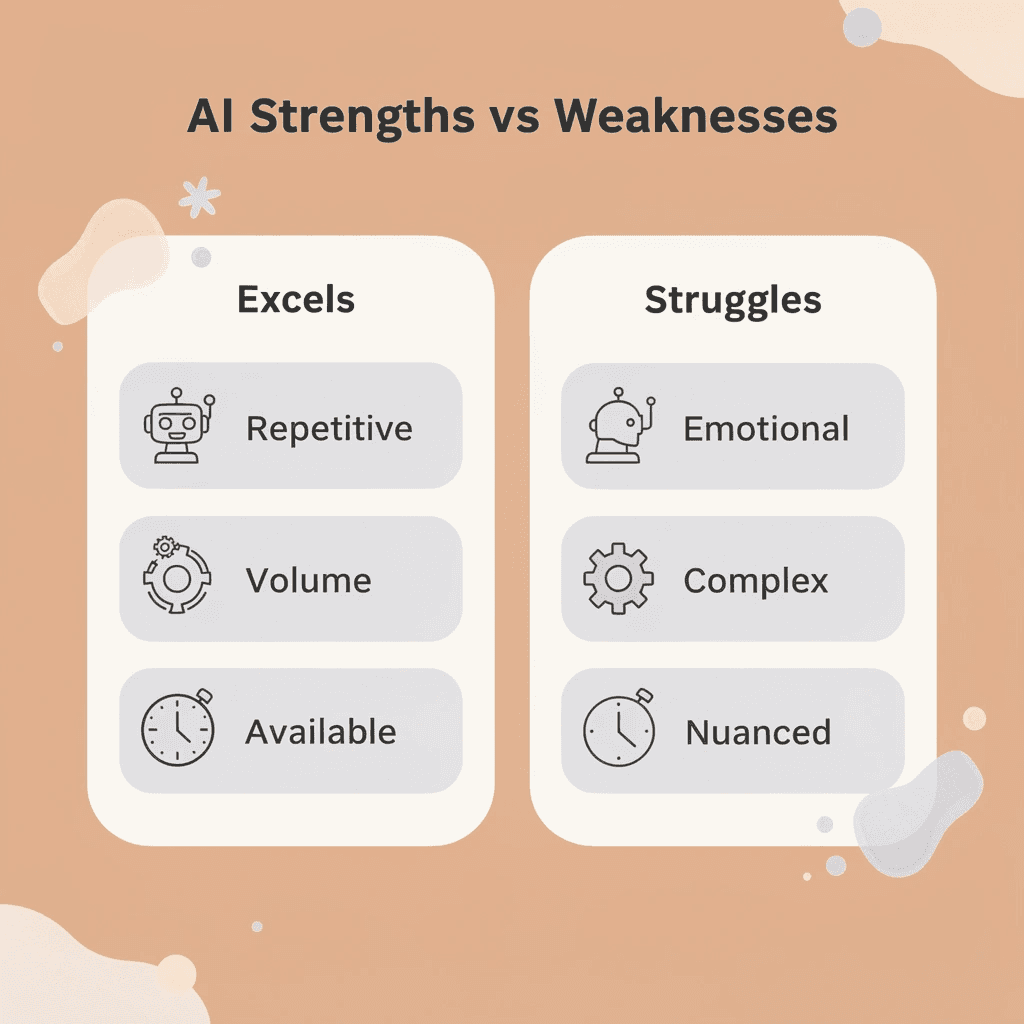
AI works well when there are lots of repetitive questions that can be answered using organized information. However, AI struggles with unclear situations, non-straightforward policies, and cases that require emotional understanding. Knowing where AI works and where it doesn't matters. It determines whether your AI system will help people or leave them frustrated.

🎯 Key Point: AI excels at handling high-volume, repetitive customer inquiries but struggles with complex emotional situations that require human judgment and empathy.
"Understanding the limitations of AI in customer service is crucial for setting realistic expectations and ensuring customer satisfaction." — Customer Service Technology Report, 2024
Where AI Excels
Where AI Struggles
Repetitive questions
Unclear situations
Organized information
Complex policy applications
High-volume inquiries
Emotional understanding
24/7 availability
Nuanced problem-solving
⚠️ Warning: Implementing AI systems without understanding these limitations can lead to frustrated customers and decreased satisfaction rather than the improved efficiency you're aiming for.
How does voice AI handle repetitive customer inquiries?
The same questions come in hundreds of times daily: "Where's my order?" "How do I reset my password?" "What's your return policy?" These questions require correct information delivered quickly. Voice AI can answer them in seconds, pulling data from order systems, account databases, or knowledge repositories without the mental burden that exhausts human agents. Gartner projects that AI can save US$80 billion in call center labor costs by 2026, not by eliminating agents but by removing repetitive work that drains them.
What makes voice AI faster than traditional support?
The system determines customer needs from the first sentence, locates relevant information, and delivers answers, while a human agent would still be checking account details. Problems are solved in one conversation instead of three, and customers receive what they need without waiting for more complex cases to finish first.
How does AI classify ticket priority in real time?
Traditional support queues treat every question identically until someone reads it. AI sorts in real time by priority based on keywords, sentiment, account value, and issue type. A billing error affecting multiple users moves up immediately, while a feature question from a trial account routes to self-service resources first. The system learns which patterns warrant escalation, which customers prefer human interaction, and which issues resolve faster through automation.
How does triage intelligence improve over time?
This triage intelligence improves over time as each resolved ticket teaches the system which routing decisions led to a fast resolution versus a handoff loop. Platforms like Bland AI demonstrate this in enterprise deployments, where conversational voice AI classifies initial inquiries through natural dialogue, then routes them to the appropriate resolution path with full context already captured. The agent receives a complete picture before the conversation starts, eliminating the discovery phase that typically consumes the first several minutes of every interaction.
What happens when customers have complex emotional needs?
Strong emotions reveal where AI falls short. When someone is upset, scared, or angry, they need to know their problem matters and that someone in charge cares about fixing it. AI can recognize feelings, but cannot create the genuine empathy that calms people. According to Lorikeet research, 64% of customers want companies to stop using AI. This reflects implementations that prioritize deflection over resolution, pushing people through automated flows when they've already decided they need human help.
How do edge cases reveal AI limitations?
Edge cases reveal another problem. When a customer's situation doesn't match existing patterns, when policy conflicts arise, or when judgment calls require contextual understanding not documented in training data, AI reaches its limits. It cannot navigate unfamiliar situations or make exceptions based on relationship history and business impact. Conversations about brand image, where tone and word choice carry legal or reputation risk, still require human oversight because the cost of error exceeds any efficiency gain from automation.
Related Reading
- Lindy Ai Vs Zapier
- Best Ai Tools For Insurance Customer Service
- Relevance Ai Alternative
- Botpress Alternative
- Best Ai Voice Agents For Insurance
- Best Ai For Insurance Agents
- Lindy Ai Alternative
- How Is Ai Helping In The Healthcare Industry
If AI Improves Customer Service, This Is Where It Has the Biggest Impact
AI improves customer service by removing delays, reducing repetitive work, and making responses consistent at scale. But the biggest breakdown still happens in one place: phone calls.

🎯 Key Point: Phone support represents the highest-stakes customer interaction where urgency and revenue potential are maximized.
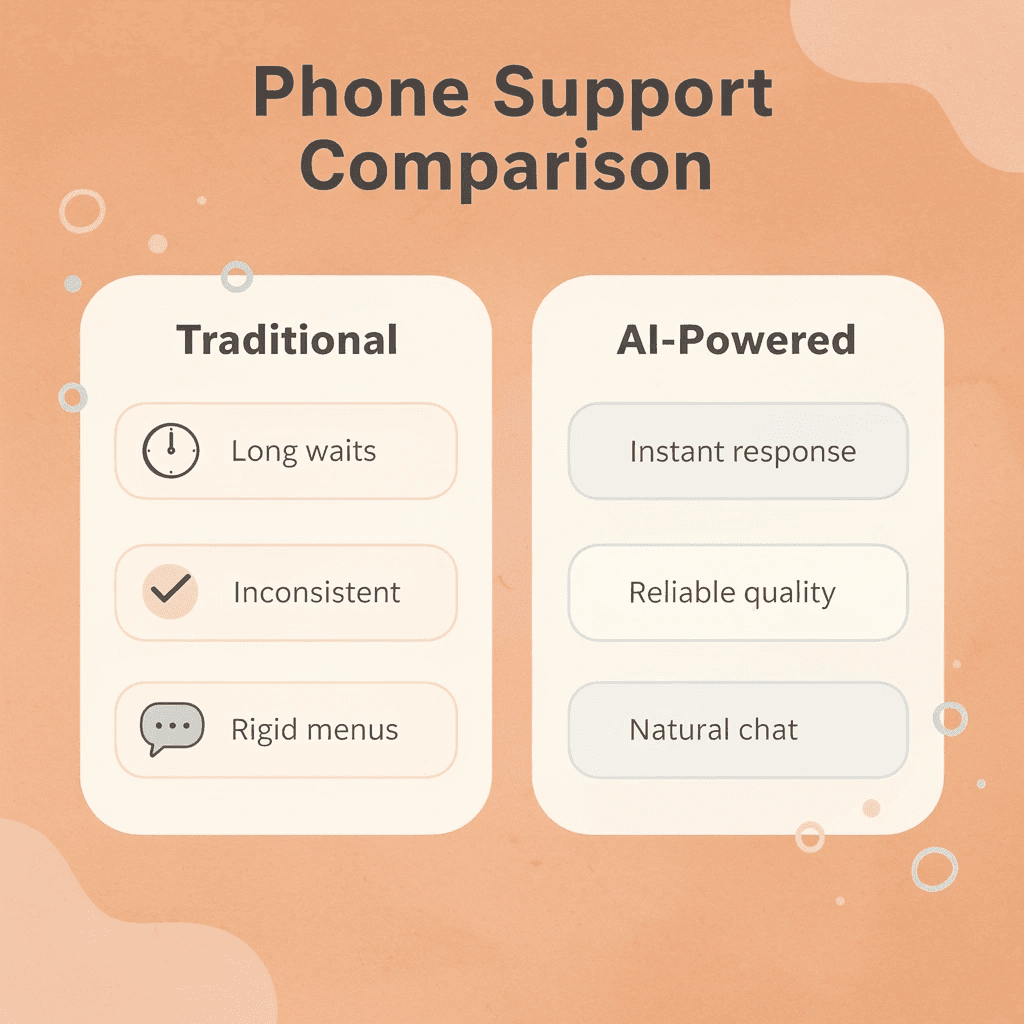
Long wait times, missed leads, inconsistent agent quality, and rigid IVR menus remain common. Phone support is where urgency and revenue are highest: a customer calling about an outage or a prospect ready to buy expects immediate help, not a menu tree. When that expectation hits a wall, the opportunity disappears.

"Phone support is where urgency and revenue are highest—when that expectation hits a wall, the opportunity disappears."
This is where AI voice agents make the difference. Instead of routing callers through static menus or hold music, conversational AI answers instantly, understands intent in real time, and handles conversations end to end or escalates when needed. Bland AI replaces traditional call center workflows with human-like AI voice agents that integrate directly into your existing systems while maintaining control, compliance, and reliability at scale.
💡 Tip: Book a demo to see how AI would handle your inbound volume, reduce missed leads, and improve response consistency in real time.
Traditional Phone Support
AI Voice Agents
Long wait times
Instant response
Inconsistent quality
Consistent performance
Rigid IVR menus
Natural conversation
Missed opportunities
24/7 availability