
Every time a customer waits on hold or gets transferred between departments, their trust in your brand erodes a little more. Poor call center experiences drive customers away faster than almost any other business misstep, yet many organizations still struggle with long wait times, inconsistent agent performance, and low resolution rates. Proven strategies can boost service quality, increase first call resolution, and transform frustrated callers into loyal customers.
The solution extends beyond hiring more agents or extending hours. Modern technology can deliver faster, more effective support by handling routine inquiries instantly, routing complex issues to the right specialists, and giving human agents the tools they need to resolve problems on the first try. This approach reduces wait times, maintains consistent service standards, and frees top agents to focus on interactions that truly require a human touch, while conversational AI handles routine tasks.
Summary
- Most call centers optimize for metrics that hide customer dissatisfaction rather than reveal it. According to Accenture, 67% of customers hang up in frustration when they cannot reach a human, and research from Computer Talk found that 89% of customers stop doing business with a company after poor service, without ever filing a complaint. Speed doesn't equal resolution when calls are answered quickly, but customers still face transfers, conflicting information, and unresolved issues that force them to call back repeatedly.
- Traditional training fails because it teaches agents what to say instead of how to think through complex problems. Teneo.ai research shows 87% of contact centers struggle with outdated training methods that prioritize procedural compliance over problem-solving capability. When systems fragment customer data across platforms that agents can't access during calls, no amount of script memorization helps, and Salesforce found that 70% of customers expect full context about their history, which most call center infrastructure cannot provide.
- First-contact resolution matters more than any speed metric because it measures whether problems are actually solved. IBM Think Insights reports that 90% of customers expect immediate responses, but immediate means the first interaction resolves the issue, not that agents rush through calls. When first-contact resolution drops below 70%, call centers create repeat callers faster than they help them, and each additional interaction erodes trust and increases operational costs.
- Repeat contact rates reveal what traditional resolution metrics hide. When 30% of customers call multiple times about the same issue within two weeks, agents close tickets without addressing root causes. American Express found that 33% of customers will consider switching companies after just a single instance of poor service, making outcome-based metrics like customer effort scores direct predictors of revenue impact rather than operational curiosities.
- Contradictory information destroys credibility faster than slow service because it signals organizational incompetence. When one agent says refunds take three business days and another says seven, customers lose trust in the entire operation. Centralized knowledge platforms that update in real time eliminate this friction, but most call centers still operate with fragmented documentation and policies that change without systematic updates across all channels.
- Conversational AI addresses this by unifying customer context across systems and maintaining consistent knowledge across all interactions, whether customers reach human agents or automated channels, thereby eliminating repetitive questioning and allowing focus to shift from information gathering to actual problem resolution.
Why Most Call Centers Are Losing Customers Without Realizing It
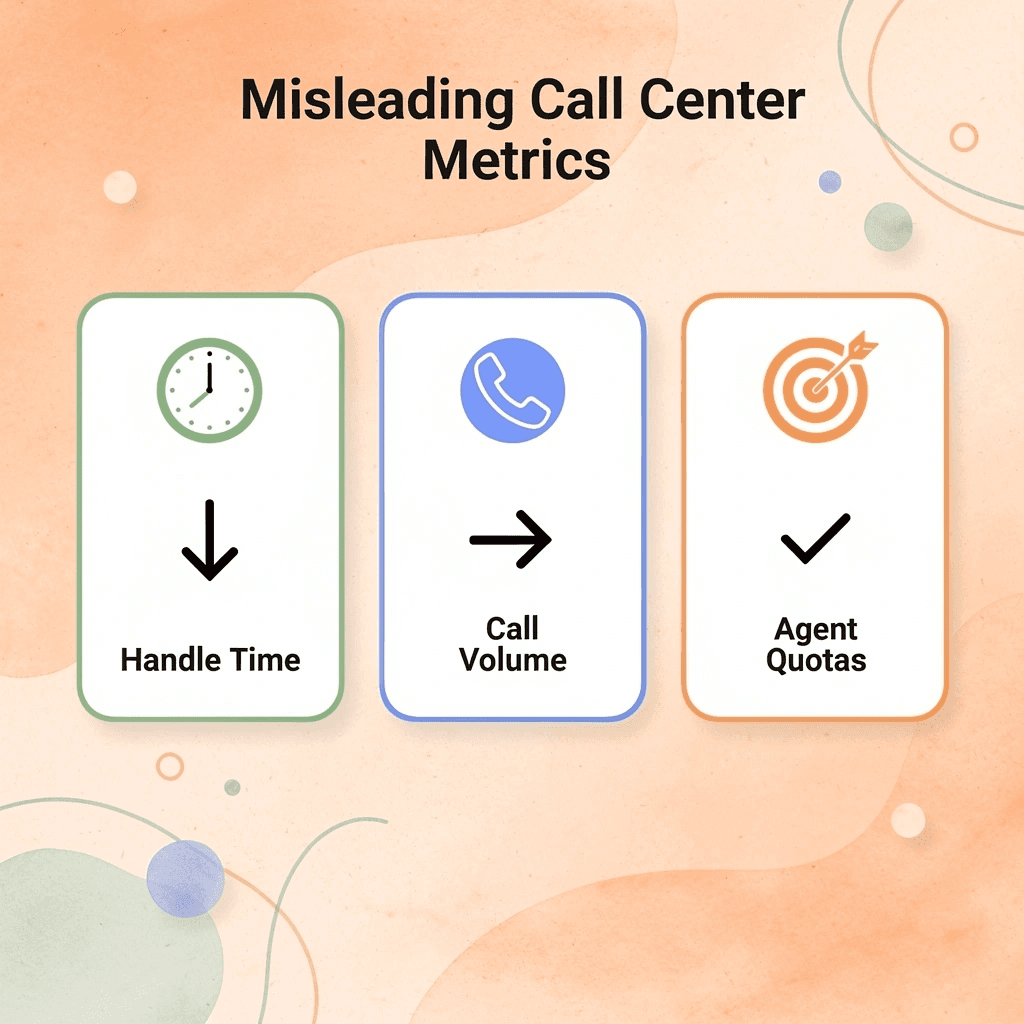
Your metrics look fine. Average handle time is down, call volume is steady, and agents are hitting quotas. But customers are disappearing anyway. The problem isn't visible in dashboards because most who leave don't complain—they stop calling. According to Accenture, 67% of customers hang up because they are frustrated when they cannot reach a human. Those who get through lose trust due to transfers, contradictory information, and agents who follow scripts rather than solving problems.
🚨 Warning: Traditional call center metrics like AHT and call volume don't capture the real customer experience: frustrated customers who can't reach humans or get consistent help.
"67% of customers hang up because they are frustrated when they cannot reach a human." — Accenture, 2024
🔑 Key Takeaway: The silent customer exodus happens when operational efficiency comes at the cost of human connection and problem-solving capability.
Why do traditional metrics fail to capture customer frustration?
Speed doesn't equal resolution. A customer can have their call answered in under two minutes, get transferred three times, receive conflicting explanations from each agent, and still have their issue unresolved, yet your system logs it as a successful interaction. One frustrated customer spent seven months fighting for a warranty repair, passed between multiple representatives who ran identical diagnostic checklists, and received conflicting updates on repair status. The company's metrics showed fast response times and service ticket completion, yet the customer now warns others to avoid the brand entirely.
What happens when agents prioritize speed over accuracy?
That gap between what gets measured and what gets experienced is where loyalty dies. Customers don't track average handle time. They remember whether the person on the phone understood their problem, whether they had to repeat themselves, and whether the solution worked. When agents are pressured to close tickets quickly, they prioritize speed over accuracy: passing customers along, documenting issues incorrectly, or marking cases resolved when the underlying problem persists.
What are the hidden causes of customer departure?
The worst failures are systemic, not obvious. Long wait times frustrate people, but repeated transfers destroy trust. Inconsistent answers make customers question whether anyone knows what they're doing. Agent uncertainty—when representatives lack the information or authority to help—signals that the organization doesn't value the customer's time. A laptop owner reported that support blamed their software installations for a factory defect, then documented complaints the customer never made to justify denying the claim. The emotional toll of fighting through procedural barriers designed to exhaust persistence converts frustration into permanent churn.
How can AI improve customer service efficiency?
Conversational AI handles routine questions: password resets, order tracking, and basic troubleshooting, freeing experienced representatives to focus on complex problems requiring judgment and empathy. Our conversational AI routes calls intelligently and provides agents with full context before customers repeat themselves, improving resolution quality without adding staff.
Why don't companies know when customers are leaving?
Research from Computer Talk found that 89% of customers have stopped doing business with a company after a bad customer service experience, and most never explain why. They don't file formal complaints or request to speak with supervisors. They finish the call and quietly start looking for other options. Your first sign that something is wrong is when renewal rates drop or customer lifetime value declines—months after the problem occurred. Fixing the problem requires more than changing scripts or hiring more staff. Knowing customers are leaving differs from understanding why.
Related Reading
- How to Use AI in Customer Service
- How Does AI Improve Customer Service
- How Can Ai Help Customer Service
- AI in Customer Communications For Telecommunications
- How Is Ai Improving Restaurant Customer Service
- AI in Customer Communications in the Insurance Industry
- Ai Agent Challenge In Customer Support
- How Ai Is Changing Customer Service In Telecom
- Ai Appointment Scheduling Healthcare
- Benefits of AI in Customer Support
- Ai Customer Support Implementation Best Practices
- How To Use Ai In Customer Service
Why Traditional Call Center Training Fails to Improve Customer Experience
Companies spend millions of dollars on training programs and scripts, yet customer satisfaction scores show minimal improvement. The problem isn't hard work: training teaches agents what to say, not how to think.
🎯 Key Point: Traditional training focuses on memorization rather than developing critical thinking skills that agents need for complex customer interactions.

Scripts cover common situations, following rules, and brand voice. But customers calling in have tried the FAQ, chatbot, and automated system. Their problems are complicated, emotionally charged, or involve multiple account systems. No script prepares agents for that reality.
"The gap between scripted responses and real customer needs creates frustration for both agents and customers, leading to longer resolution times and decreased satisfaction."

⚠️ Warning: Relying solely on scripts leaves agents unprepared when customers present unique problems that don't fit standard scenarios.
Why do call centers prioritize speed over problem-solving?
Call centers measure success through efficiency metrics. Average handle time controls scheduling, bonuses, and performance reviews. Training reinforces this priority: agents learn to close tickets quickly, transfer calls smoothly, and document interactions efficiently. According to Teneo.ai, 87% of contact centers struggle with outdated training methods that prioritize procedural compliance over problem-solving capability.
What happens when agents can't solve complex problems?
This creates predictable failure patterns. An agent encounters a billing discrepancy requiring checks across three separate databases. Training taught them to navigate each system individually, but not to combine information across platforms or make judgment calls when data conflicts. They escalate to a supervisor, adding 15 minutes to the resolution time and forcing the customer to re-explain everything. The ticket closes. The metric shows success. The customer researches competitors.
Why can't agents access the information they need?
Training assumes agents have the information they need. Reality proves otherwise. Research from Salesforce shows that 70% of customers expect anyone they interact with to have full context about their history and preferences. Most call center systems split customer data across CRM platforms, billing systems, support ticket databases, and product inventories that don't communicate with each other.
An agent spends the first three minutes of a call asking questions the customer answered last week—not because they weren't trained to check history, but because that history lives in a system inaccessible during active calls. The customer interprets this as incompetence. The agent knows their tools are failing, but can't explain this without damaging the company's credibility. Frustration builds on both sides.
How does unified customer context solve this problem?
Platforms like conversational AI solve this by consolidating customer information across systems. Our conversational AI gives agents quick access to complete interaction history, account details, and relevant product information in one place. This eliminates repetitive questions and lets agents focus on solving the problem rather than gathering information. But perfect access to information won't fix the bigger problem. Call centers are structured around the wrong goals, and training only teaches agents to succeed within a broken system.
Related Reading
- Best Ai Customer Service For Hotels
- Patient Support Services Automation
- Ai Customer Support Automation In Telecom
- Best Voice Ai For Restaurants
- How To Use Ai To Improve Customer Service Kpis
- Best Ai Customer Support Tools For It Teams
- It Helpdesk Automation
- How To Use Ai For Customer Service Call Center
- Best Ai Tools For Customer Support In Healthcare
How to Improve Call Center Customer Service Using Resolution-First Systems
Move away from focusing on speed and instead measure how often customers call back. According to IBM Think Insights, 90% of customers expect quick responses, but quick doesn't mean rushed: it means the first time you talk to them, you solve their problem.

Systems that focus on solving problems need three big changes: agents need the power to fix issues without asking a manager first, information must be consistent across all customer touchpoints, and the company must accept that fixing problems the right way takes more time than quick fixes. A ten-minute call that permanently resolves a billing mistake outweighs three five-minute calls that don't.
The Real Problem Isn't Speed
The most common instinct in call center management is to optimize for efficiency: reduce handle time, increase calls per hour, cut queue wait times. But these metrics treat the symptom, not the disease.

🎯 Key Point: The real breakthrough in contact center performance isn't about speed—it's about resolution quality.
"High-performing contact centers aren't faster—they're oriented around a single question: Was the customer's intent fully resolved?"
Improvement doesn't come from faster calls; it comes from fewer repeated calls. When a customer calls back because their issue wasn't resolved, you've doubled the cost, damaged trust, and moved them closer to churning. High-performing contact centers aren't faster—they're oriented around a single question: Was the customer's intent fully resolved?
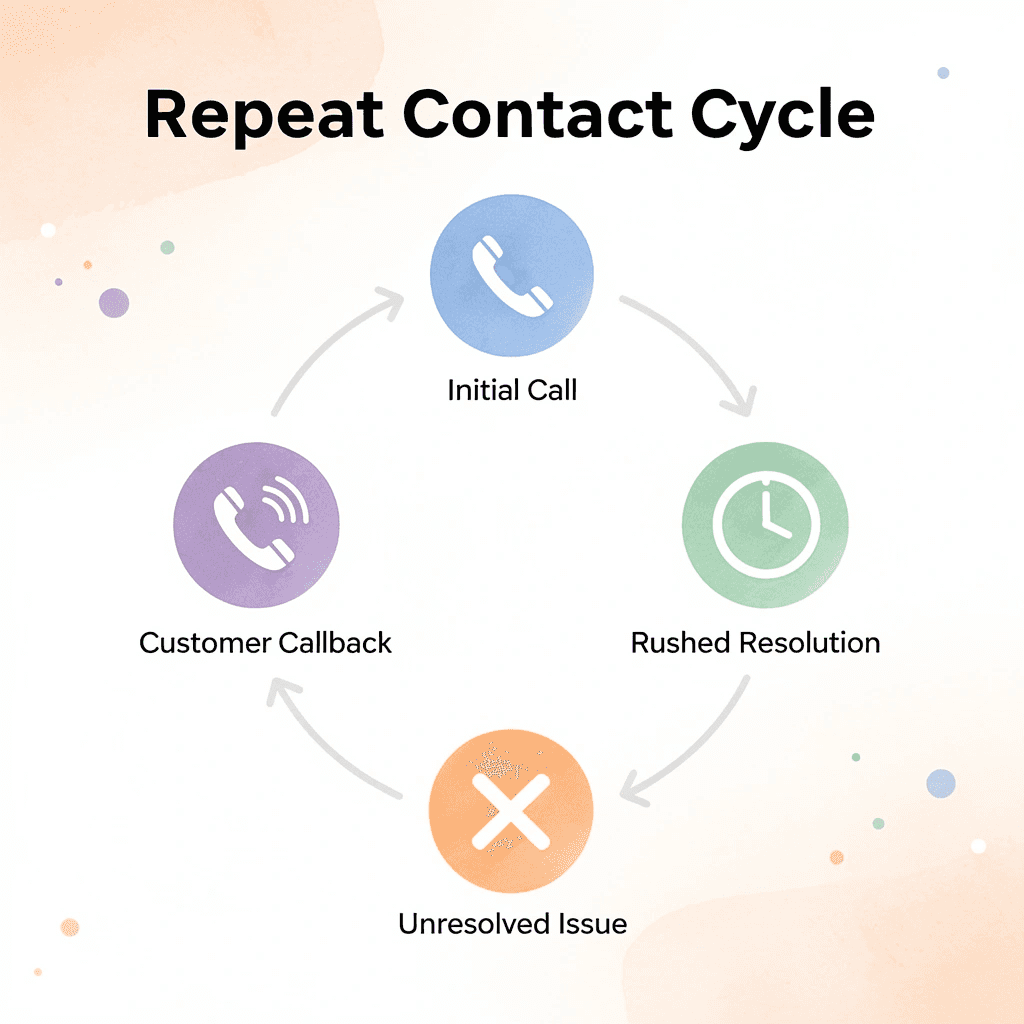
⚠️ Warning: Optimizing for speed metrics alone creates a dangerous cycle where agents rush through calls, leading to incomplete resolutions and costly repeat contacts.
The Framework Shift Speed-Based KPIs → Resolution-Based KPIs
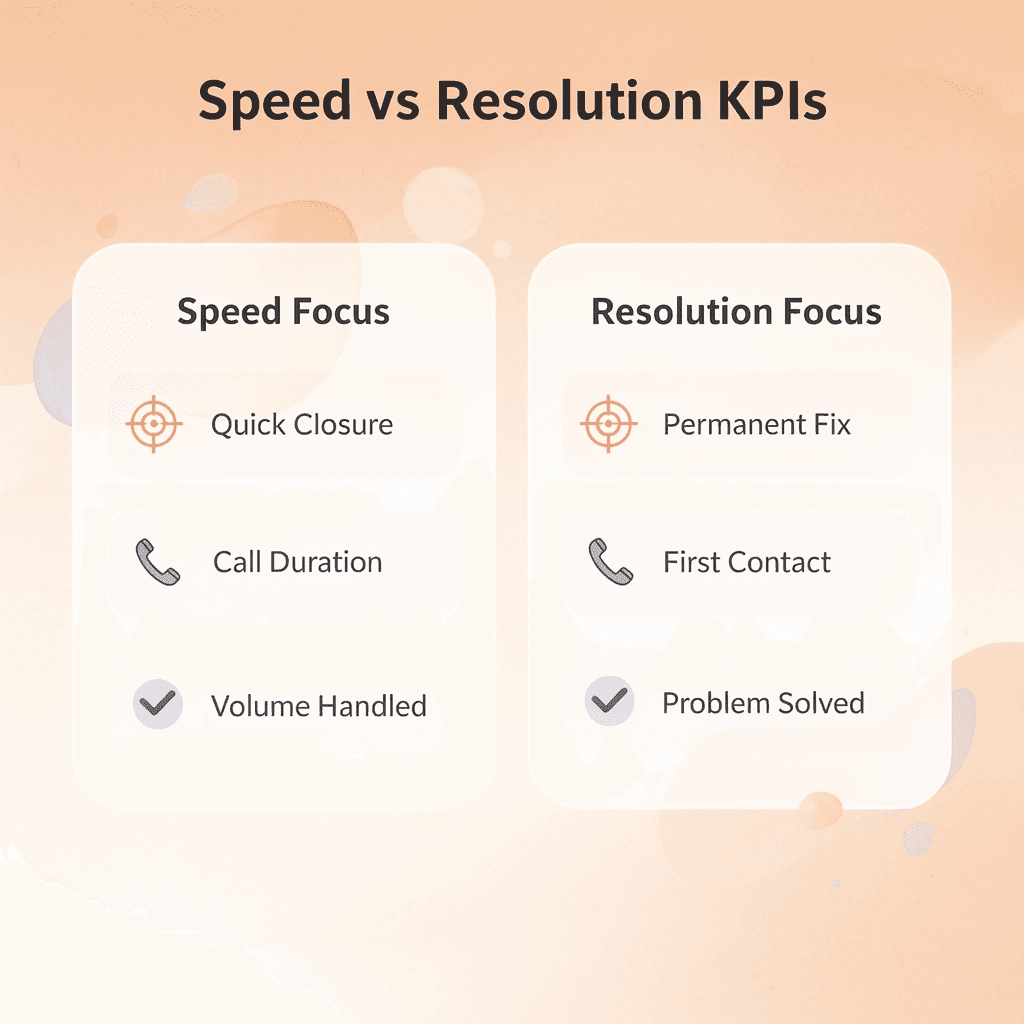
Most contact centers still organize performance around speed metrics. This approach fundamentally misaligns agent incentives with customer satisfaction, creating a system where faster doesn't mean better.

Speed metrics reward agents for closing tickets quickly. Resolution metrics reward agents for permanently closing problems. Customers don't leave because they waited three minutes on hold—they leave because they called three times and their problem still isn't fixed. This shift from time-based KPIs to outcome-based KPIs represents the essential transformation needed in modern customer service.
🎯 Key Point: The transition from speed-based to resolution-based KPIs requires systematic changes across people, processes, technology, and measurement.
"Customers don't leave because they waited three minutes on hold—they leave because they called three times and their problem still isn't fixed." — Contact Center Performance Analysis, 2024
⚠️ Warning: Simply changing metrics without updating systems and training will create confusion and decrease performance during the transition period.
The following 16 systems, organized across four strategic pillars, show you how to make that shift in practice.
System 1 First-Contact Resolution Focus
The anchor metric of a resolution-first operation is FCR — the percentage of customer issues resolved without a repeat contact. Improving it requires dismantling the structural causes of failure, not coaching agents harder.
1. Leverage the latest call center technology
The infrastructure underneath your agents either enables resolution or undermines it. Platforms that siloes voice from chat from email create unavoidable gaps in context — agents don't know what the customer already tried. An omnichannel system that unifies all communication channels into a single pane of glass eliminates that blind spot. AI-powered tools go further, connecting agents to knowledge sources in real time as conversations happen — not after. Real-time analytics dashboards let supervisors identify resolution failures as they occur, not in a monthly review. Resolution starts with giving agents the complete picture, instantly.
2. Intelligent routing strategies
A first-contact resolution system fails before it begins if the right customer reaches the wrong agent. Modern routing should factor in issue complexity, customer history, and agent specialization — not just availability. When escalation is necessary, it must carry the full interaction context forward so the customer never has to re-explain their situation. Every unnecessary transfer is an FCR failure waiting to happen. Clear escalation criteria and seamless context handoffs are not nice-to-haves; they are structural requirements of a resolution-first model.
3. Track and analyze FCR
Please make FCR a primary KPI and build systematic processes to understand why it fails. When a customer calls back, that callback is data. Routine root-cause analysis on repeat calls reveals the systemic failures — product bugs, policy ambiguities, documentation gaps, training deficiencies — that no amount of front-line coaching will fix. High FCR directly reduces operational costs and correlates strongly with customer satisfaction. Treating FCR failures as signals worth investigating, rather than inevitable volume, is what separates reactive call centers from proactive ones.
4. Automate repetitive tasks
Resolution failures are often caused not by complexity, but by friction. When agents spend cognitive bandwidth toggling between applications, manually logging data, or routing simple requests that a system could handle automatically, they have less capacity to focus on actual resolution. Intelligent call routing, CRM integrations that surface customer history without manual lookup, and self-service options for transactional requests all reduce that friction. The goal is to automate everything that doesn't require human judgment, leaving human judgment fully available when it matters.
System 2: Knowledge Consistency Systems
One of the most invisible sources of repeat calls is contradictory information. A customer calls, gets an answer, follows the instructions, and it doesn't work; they call back—not because the agent failed, but because the agent's knowledge was incomplete or incorrect. This is a systems problem, not a performance problem.
5. Implement a knowledge management system
A centralized, living knowledge base is the backbone of consistent resolution. When agents draw from the same up-to-date source—continuously updated as products change, policies evolve, and common issues emerge—variability in answers collapses. A strong knowledge management platform shortens onboarding time, increases FCR, eliminates misinformation, and prevents critical institutional knowledge from disappearing when experienced agents leave. It makes good agent performance scalable and consistent across your entire team.
6. Systems integration
A knowledge consistency problem is often a data integration problem. When customer data lives in separate systems—CRM, billing, order management, support history, web analytics—agents get a fragmented picture. Unifying customer data into a single source of truth with real-time synchronization means every agent starts each interaction with complete context. This completeness enables single-contact resolution and connects operational data to business intelligence, allowing leadership to see how service outcomes connect to retention and revenue.
7. Establish robust customer feedback loops
Knowledge systems deteriorate without regular updates from customer data. Post-call surveys, social media signals, website feedback, and direct customer input reveal gaps in the knowledge base, confusing policies, and agent guidance that lead to incorrect outcomes. Systematically integrating this feedback transforms customer experience data into actionable intelligence for continuous improvement, keeping your knowledge system current and effective.
8. Analyze your call center data to drive improvements
Call center analytics reveal systemic issues that individual agents cannot see. Sentiment analysis tracks whether interactions are trending negatively. Keyword tracking identifies spikes in specific topics —refund requests, escalation demands, product complaints—that signal emerging problems requiring systemic responses. Metrics like FCR, Average Handle Time, and predictive CSAT scoring provide layered performance views. Use this data to fix root causes—processes, policies, and documentation—rather than just evaluate individual agents.
System 3: Empowered Agent Decision-Making
Agents who follow scripts too closely make it harder to solve problems. Scripts help with common situations, but each customer has their own history, feelings, and needs that a script cannot cover. When agents can only stick to a script, difficult issues stall, customers repeat themselves, they get transferred from one agent to another, and their problems remain unresolved.
9. Give agents regular, up-to-date training
Training builds the judgment that allows agents to work outside the script when it doesn't fit. This includes product knowledge deep enough to resolve non-standard issues and soft skills: active listening, emotional intelligence, and conflict de-escalation, sophisticated enough to handle frustrated, confused, or anxious customers. AI-powered QA tools that evaluate actual customer outcomes and provide objective, specific feedback create a continuous development loop. Agents who receive regular, actionable feedback improve more quickly and develop better judgment than those who receive annual reviews and static scripts.
10. Reinforce active listening for customer service calls
Active listening is putting good judgment into action. It requires agents to be fully present: paying attention to tone, noticing emotional signs, checking customer history as it unfolds, and resisting the urge to jump to scripted answers before understanding the customer's real problem. Research shows that 73% of customers expect companies to understand their unique needs: not just their stated question, but their underlying situation. Agents who listen actively solve the real issue on the first contact, rather than addressing the stated question, leaving the underlying problem unresolved.
11. Standardize and optimize escalation protocols
Giving power without structure leads to inconsistency. The answer is creating guardrails that help solve problems rather than stop them. Clear escalation paths, combined with real frontline authority—small-discount approvals, technical overrides, and policy exceptions within set limits—let agents fix problems that would otherwise require a transfer. The data is clear: 79% of callers are rerouted at least once, and 53% of customers repeat their issue to multiple agents. Each transfer represents a failure to resolve the problem. Empowering frontline agents to solve issues on the first call makes a significant difference.
12. Perform QA based on customer outcomes
Quality assurance frameworks built around checklist compliance measure the wrong thing. Evaluating agents on customer satisfaction, full issue resolution, and genuine empathy meaningfully shifts the incentive structure. Organizations that have made this shift reported a 21% improvement in CSAT scores compared to traditional procedural QA models. The question QA should answer is not "did the agent follow the script?" but "did the customer leave with their problem solved?"
System 4: Feedback Loop Integration
Fixing today's customer calls requires building systems that turn customer experience data into operational and product improvements, closing the gap between what customers experience and what the organization does about it.
13. Use customer journey mapping
Customer journey mapping moves feedback from stories to structure. By documenting every touchpoint a customer has with your organization, from initial awareness through post-purchase support, and adding notes about emotional state and satisfaction data at each stage, you develop a complete view of where friction builds up. In a call center context, this allows agents to understand which phase of the customer journey they're entering before the call begins. A customer in the "waiting for resolution" phase has different needs than one in the "problem discovery" phase, and treating them the same leads to systematic resolution failures.
14. Personalize the customer experience
Personalization based on feedback and customer history makes resolution feel complete rather than technically correct. When agents have access to a customer's full interaction history (previous issues, preferences, resolution outcomes), they can address the specific situation rather than the generic category. CRM integration enables real-time access to customer details, allowing agents to skip re-establishing context and move directly into resolution. For customers with complex or recurring issues, this informed personalization significantly reduces the perception of fragmented service.
15. Provide a positive work environment for agents
Feedback loops run both inward to agents and outward to customers. When agents feel valued, supported, and fairly treated, their performance improves. The connection between agent wellbeing and customer experience is direct: motivated agents engage more genuinely, exercise better judgment, and persist more effectively through difficult interactions. Fair scheduling, transparent performance feedback, recognition systems, and genuine workload management are not separate from customer experience strategy: they are part of it.
16. Integrate self-service options
Self-service is the release valve for the feedback loop. When intelligent self-service systems handle basic, transactional questions—order status, account updates, standard FAQs—customers with simple needs get faster resolution on their own schedule, and agents can focus on complex, high-stakes issues. This is not about replacing human agents, but calibrating which issues require human judgment and protecting agent bandwidth for those issues. As self-service handles an increasing volume of routine interactions, the quality of human-agent support for complex issues rises, which drives FCR, CSAT, and ultimately retention.
Connecting It Back: Why These Systems Reduce Churn
Every system described above targets the same root cause: unresolved customer intent. A customer who calls and receives a resolution stays. A customer who is transferred, given contradictory information, asked to repeat context they've already provided, or forced to call back, leaves. Not dramatically, but incrementally, interaction by interaction, until switching becomes the obvious choice.
How do resolution-based systems differ from speed-based KPIs?
Speed-based KPIs reduce call costs but don't address the root causes of repeat calls. Resolution-based systems work better by consolidating customer information, empowering agents to solve issues completely, routing interactions appropriately, and using customer outcomes to drive continuous improvement.
Why is customer trust the ultimate competitive advantage?
The result is a customer base that trusts your organization to solve problems, and that trust is the single most durable competitive advantage a customer-facing operation can build. But this fails if you measure success by how quickly agents finish calls instead of how completely they resolve issues.
How to Measure Real Improvement in Call Center Customer Service
The metrics most call centers track don't measure improvement. They measure activity.
Average handle time measures how fast agents finish conversations, not whether problems get solved. Call volume counts interactions, not outcomes. Resolution rates reflect how many tickets agents closed, not how many customers stopped calling back. These metrics create an appearance of performance while customer frustration builds invisibly.
Why do traditional metrics fail to capture customer satisfaction?
Real improvement shows up after the call ends. According to HubSpot, 90% of customers consider an immediate response important or very important. However, most centers measure call duration rather than first-call resolution rates. A customer who reaches an agent, gets transferred twice, receives contradictory information, then calls back three days later, counts as three successful interactions in traditional metrics. The system registers efficiency while the customer experiences failure.
What to measure instead
First contact resolution rate matters more than any speed metric. Track the percentage of customers whose problems are fully resolved during the initial interaction, with no callbacks required. Anything below 70% signals systemic issues.
How does repeat contact rate reveal hidden problems?
The repeat contact rate reveals what resolution rates don't. If 30% of your customers call multiple times about the same issue within two weeks, your agents are closing tickets without addressing the underlying problem. Teams can celebrate improved handle times while repeat contacts climb steadily, a sign they're optimizing for the wrong outcome.
Why does customer effort score matter more than traditional metrics?
Customer effort score captures what traditional metrics miss. Ask one question after each interaction: "How much effort did you personally have to put in to handle your request?" Customers reporting high effort leave at significantly higher rates, even when tickets show as resolved.
How do these metrics reflect customer reality instead of internal efficiency?
These measurements reflect what customers experience, not internal metrics. A five-minute call that permanently fixes a billing error produces better results than three separate three-minute calls that leave the problem unresolved. The first scenario looks worse in average handle time reports, but prevents customer churn.
What does the correlation between these metrics and retention reveal
The connection between these metrics and retention is telling. If first-contact resolution improves but churn remains flat, your definition of "resolved" doesn't align with the customer experience. When repeat contacts drop and effort scores improve, retention follows. American Express found that 33% of customers will consider switching companies after a single instance of poor service, making these outcome-based metrics direct predictors of revenue impact.
How can technology help shift from activity tracking to outcome measurement?
Solutions like conversational AI help teams shift from tracking activity to measuring outcomes by capturing the full context of interactions and automatically flagging unresolved issues that lead to callbacks. Instead of measuring how fast agents finish calls, conversational AI tracks whether customers' problems are solved. If your metrics improve but customers keep leaving, the measurement system is broken, not the customers.
If Your Call Center Is Losing Leads, This Is What Replaces It
When your call center misses leads or gives inconsistent answers, the problem isn't your agents. It's outdated IVR trees, fragmented knowledge bases, and routing logic designed for efficiency rather than resolution. That infrastructure creates the bottlenecks.

🎯 Key Point: Traditional call center infrastructure introduces delays that lead to lead abandonment and customer frustration.
Conversational AI replaces that framework entirely. Instead of routing customers through menus or making them wait in queues, AI voice agents answer instantly, handle conversations naturally, and resolve issues in real time. This eliminates the structural delays that cause calls to be abandoned and customers to repeat themselves across transfers.
"AI voice agents eliminate the structural delays that cause lead abandonment by answering instantly and resolving issues without transfers." — Enterprise Call Center Analysis, 2024
For enterprises managing high call volumes, this means faster response times without proportional hiring. It means consistent answers across every interaction, because the AI pulls from a unified knowledge system rather than depending on which agent picks up. Self-hosted deployments maintain full control over data and compliance without compromising performance for security.

Missed leads drop because calls get answered immediately, even during peak hours. Resolution times improve because customers avoid cycling through escalations. The experience becomes reliable rather than random.
⚠️ Warning: Optimizing outdated call center infrastructure won't solve fundamental capacity and consistency issues at enterprise scale.

If your current setup can't keep pace with demand or maintain quality at scale, optimizing the old model won't close the gap. You need a different system. Our conversational AI voice agents are designed for enterprise call centers, handling real customer conversations without the constraints of traditional infrastructure. Bland builds conversational AI solutions that work at scale. Book a demo with Bland and watch an AI voice agent handle the scenarios your team faces today.
Related Reading
- Best Ai Tools For Insurance Customer Service
- Lindy Ai Vs Zapier
- Best Ai For Insurance Agents
- Best Ai Voice Agents For Insurance
- Relevance Ai Alternative
- Lindy Ai Alternative
- Botpress Alternative
- How Is Ai Helping In The Healthcare Industry