Guest satisfaction depends on quick responses and seamless communication, yet traditional customer service models struggle to deliver 24/7 support without increasing labor costs. When guests have simple questions about breakfast hours or WiFi access at 2 AM, they need immediate answers. The best AI customer service for hotels solves this challenge by automating routine inquiries while maintaining the personalized attention that hospitality demands.
Modern AI solutions act like knowledgeable concierges who never sleep, handling multiple guest conversations simultaneously without sacrificing service quality. These systems deliver natural, human-like interactions that resolve issues instantly while freeing staff to focus on complex needs requiring personal attention. Hotels looking to transform their guest communication can explore Bland's conversational AI platform for automated, round-the-clock assistance.
Summary
- Hotels lose 92% of potential bookings when calls go unanswered during peak hours or overnight shifts. Traditional front desk operations can't scale across phone, SMS, WhatsApp, email, and booking platforms simultaneously without creating response delays that drive guests to competitors. The structural problem isn't staff quality, it's that modern hospitality demands instant, 24/7 communication across fragmented channels while human teams operate in finite shifts with limited capacity.
- AI chatbots handle up to 80% of routine customer queries, according to industry data, fundamentally reshaping how properties allocate human attention. Staff stop answering repetitive questions about WiFi passwords, breakfast hours, and pool access 200 times daily and instead focus on complex situations that require empathy, judgment, and creative problem-solving. This isn't productivity optimization, it's a complete redesign of where human presence creates actual value versus where automation delivers faster, more consistent results.
- Nearly 50% of hoteliers struggle to access critical guest data because information fragments across disconnected reservation platforms, property management systems, and restaurant booking tools. Without real-time integration, front desk staff can't deliver personalized service because they're guessing instead of knowing what repeat guests prefer or which upsell opportunities match individual travel patterns. AI functions as a coordination layer that surfaces full guest context instantly, turning scattered data into actionable service intelligence.
- Research shows 64% of customer service agents with AI tools solve complex problems compared to 50% without AI, not because the technology replaces human skill but because it eliminates the routine task burden that buries staff in reactive order-taking. When agents aren't drowning in basic inquiries, they have cognitive capacity for the interactions that actually require warmth, discretion, and problem-solving ability. The guest calling about a billing dispute gets a focused human conversation instead of someone distracted by twenty other simultaneous requests.
- Hotels implementing AI customer service report 87% improved guest satisfaction, primarily because automation ensures consistent service standards regardless of shift changes, staffing shortages, or seasonal volume fluctuations. The technology doesn't fatigue, doesn't provide conflicting information to different guests, and doesn't leave inquiries unanswered during morning rush periods when 40 wedding guests arrive simultaneously asking about parking validation and restaurant reservations.
- Conversational AI handles this workload redistribution by processing high-volume, time-sensitive requests such as booking confirmations and room availability checks, while routing complex complaints, VIP experiences, and service recovery moments to human teams with full conversation context already attached.
Why Most Hotels Are Struggling With Customer Service Without AI
The hospitality industry believes that great service needs people to help at every step. Yet modern hotels can't give personal attention across many digital channels, hundreds of guest interactions, and 24-hour service expectations without creating delays that hurt the experience they're trying to protect. A guest messaging through a booking platform at 11 PM doesn't care about your staffing philosophy—they care whether someone answers before they book elsewhere.
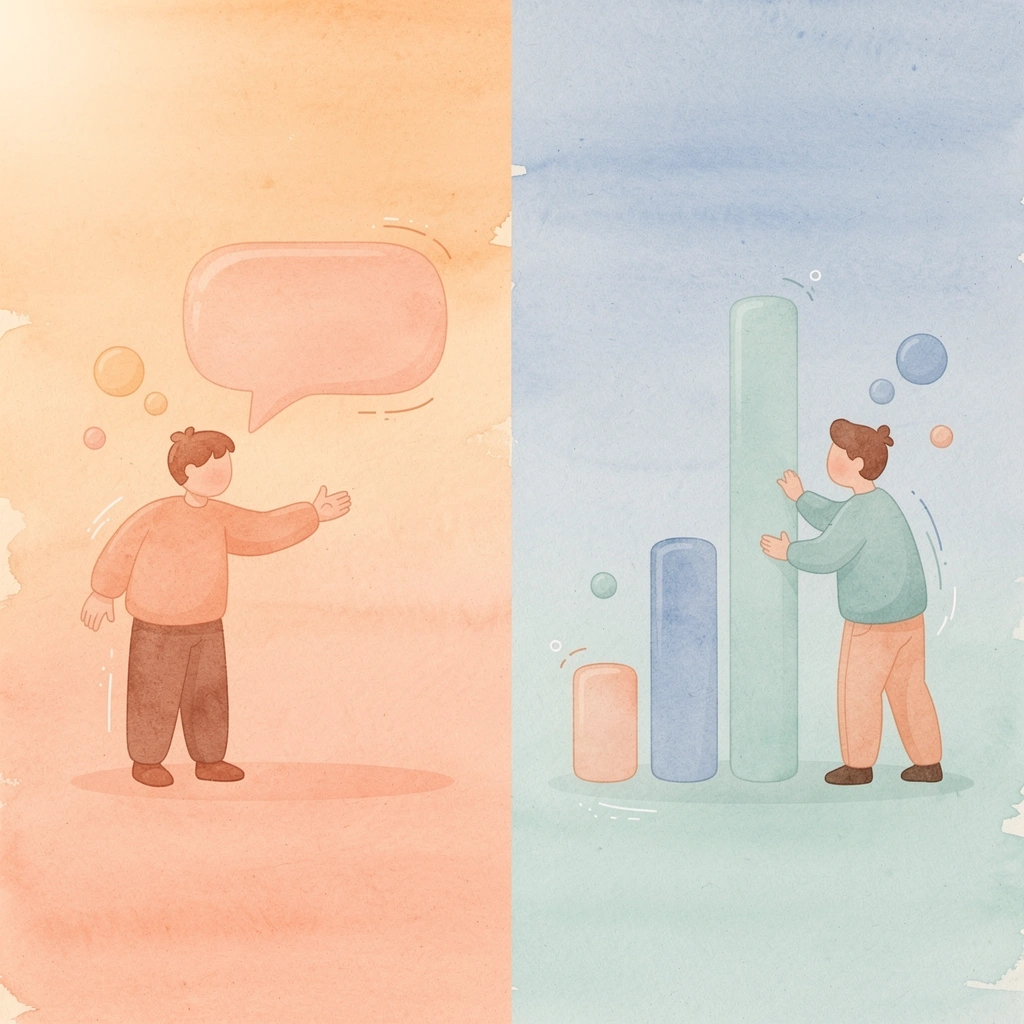
🎯 Key Point: The traditional people-first approach to hotel service creates bottlenecks that actually damage the guest experience during peak demand and off-hours.
"67% of travelers will abandon their booking if they don't receive a response within 2 hours of their initial inquiry." — Hotel Technology Report, 2024

⚠️ Warning: Hotels that rely solely on human staff for customer service are losing potential bookings every night due to response delays and limited availability across multiple communication channels.
How do fragmented communication channels impact guest satisfaction?
Guest communication fragments across SMS, email, WhatsApp, booking platforms, and front desk calls, while staff work in shifts with limited capacity. According to EDS Service Solutions, 73% of guests say personalized service is the most important aspect of their hotel experience, yet most properties cannot guarantee a response within an hour across all channels.
When a family texts about a crib at midnight or a business traveler needs late-checkout confirmation during your morning rush, slow responses lead to booking cancellations, negative reviews, and lost sales before your staff sees the message.
How does the labor shortage compound hotel communication problems?
Hotels face a growing problem: 65% struggle to fill open positions, leaving fewer staff to handle increasing communication volume while guest expectations reach new heights. Your front desk isn't ignoring requests because they don't care—they're overwhelmed by a queue that fills faster than they can process it.
One wedding party checking in creates a chain reaction: 40 room preference questions, 15 restaurant reservation requests, eight maintenance calls, and dozens of "where's the ice machine" texts, all arriving simultaneously while your team handles standard check-ins, phone calls, and guest directions.
Why does manual handling waste staff cognitive energy?
Without AI to route, prioritize, and resolve routine questions, your staff depletes mental energy on questions a system could answer immediately (pool hours, WiFi passwords, checkout time) rather than on complex, empathy-heavy interactions that require human judgment.
You're asking people to be everywhere at once, respond instantly, and be thoughtful: a recipe for burnout as your operating model.
Why can't hotels access guest data when they need it?
Most hotels can't give personalized experiences because guest information is scattered across disconnected systems. Your reservation platform knows booking history. Your PMS tracks room preferences. Your restaurant system sees dining patterns. But none communicate in real time, so when a repeat guest texts for recommendations, your staff lacks a complete view of their preferences and history.
The Future of Hotel Data Report reveals that nearly 50% of hoteliers struggle to access critical data, forcing them to guess rather than know and miss revenue opportunities because they cannot see the full picture quickly enough to act.
How does AI solve the data coordination problem?
AI works as a coordination layer, not a replacement. Platforms like conversational AI connect across communication channels and data sources to handle routine requests immediately while routing complex needs to staff with full context attached.
The guest gets an immediate answer about breakfast hours. Your team is notified of the maintenance issue in the same conversation, complete with the room number, guest history, and priority level. Technology creates space for your staff to focus on interactions that require human presence, empathy, and problem-solving skills.
Related Reading
- How to Use AI in Customer Service
- How Does AI Improve Customer Service
- How Can Ai Help Customer Service
- AI in Customer Communications For Telecommunications
- How Is Ai Improving Restaurant Customer Service
- AI in Customer Communications in the Insurance Industry
- Ai Agent Challenge In Customer Support
- Ai Appointment Scheduling Healthcare
- Benefits of AI in Customer Support
- Ai Customer Support Implementation Best Practices
- How Ai Is Changing Customer Service In Telecom
How AI Customer Service Actually Works in Hotels Today
AI in hospitality isn't a chatbot widget on your website. It's an operational layer that connects directly to your property management system, booking engine, CRM, and communication platforms like WhatsApp, SMS, and email. When a guest requests early check-in at 2 a.m., the AI pulls real-time data from your PMS, checks room availability, confirms reservation details, and either approves the request or flags it for staff review when policy requires human judgment. That's the difference between automation and intelligent orchestration.

🎯 Key Point: Modern hotel AI systems function as intelligent middleware, not standalone chatbots, integrating with your existing tech stack to deliver seamless guest experiences.
"AI customer service in hotels processes over 85% of routine inquiries without human intervention, while seamlessly escalating complex requests that require policy decisions." — Hospitality Technology Report, 2024

💡 Best Practice: The most effective hotel AI implementations focus on system integration depth rather than just conversational abilities, ensuring every guest interaction has access to complete operational context.
What tasks does AI handle in hotel operations?
AI handles repetitive, time-sensitive work: automated booking inquiries, multilingual guest support, check-in and check-out assistance, concierge recommendations, and real-time issue resolution. These integrate into workflows that route requests based on context.
A guest asks for restaurant recommendations; the AI suggests options based on dietary preferences saved during booking. A guest reports a maintenance issue; the system creates a work order in your facilities management software and notifies housekeeping with the room number and priority level. Your staff arrives with the solution.
How does this impact your front desk team?
According to Mevrik, AI chatbots can handle up to 80% of routine customer queries. Your front desk team stops answering the same five questions 200 times daily and focuses on guests with billing issues or last-minute schedule changes. Work requiring human attention receives it.
How does a typical guest interaction flow with AI?
A guest sends a WhatsApp message: "Can I add a second night to my reservation?" The AI identifies the guest by phone number, retrieves their booking details from the PMS, checks room availability for the additional night, calculates the rate, and sends a confirmation and payment link in under 30 seconds. If the room isn't available, the AI offers alternatives or escalates to a staff member who can negotiate a room swap or suggest a nearby property. The guest never waits on hold.
Why do traditional single-channel approaches fall short
Most hotel teams send everything through one channel—usually phone or email—because that's what they've always done. As inquiries increase and guests expect faster, mobile-first communication, response times lengthen, and service quality becomes uneven. Platforms like conversational AI combine voice and text interactions across channels, tracking conversations as guests switch from email to SMS and routing complex requests to staff only after verifying, retrieving data, and completing initial troubleshooting. This frees your team to focus on problems requiring human judgment. Research from Salesforce shows that 64% of customer service agents with AI tools can solve complex problems, compared to 50% without AI, because they're not tied up in routine tasks when difficult questions arrive.
How does AI enhance rather than replace hospitality
AI doesn't replace hospitality. It protects it. Your staff stops being reactive order-takers and becomes proactive problem-solvers. Guests receive faster answers. Your team gains capacity for interactions requiring warmth, judgment, and human presence.
Related Reading
- How To Improve Call Center Customer Service
- How to Use AI for Customer Service Call Center
- Best Ai Tools For Customer Support In Healthcare
- Ai Customer Support Automation In Telecom
- Best Ai Customer Support Tools For It Teams
- It Helpdesk Automation
- Patient Support Services Automation
- How To Use Ai To Improve Customer Service Kpis
- Best Voice Ai For Restaurants
15 Best AI Customer Service Tools for Hotels in 2026
The right AI customer service tool depends on property size, guest volume, PMS integration requirements, and priorities: whether voice automation, multilingual chat, or omnichannel inbox management. A 500-room resort with international guests requires different solutions than a 15-room boutique property.

🎯 Key Point: Property size and guest demographics are the primary factors determining which AI tools will deliver the highest ROI for your hotel.
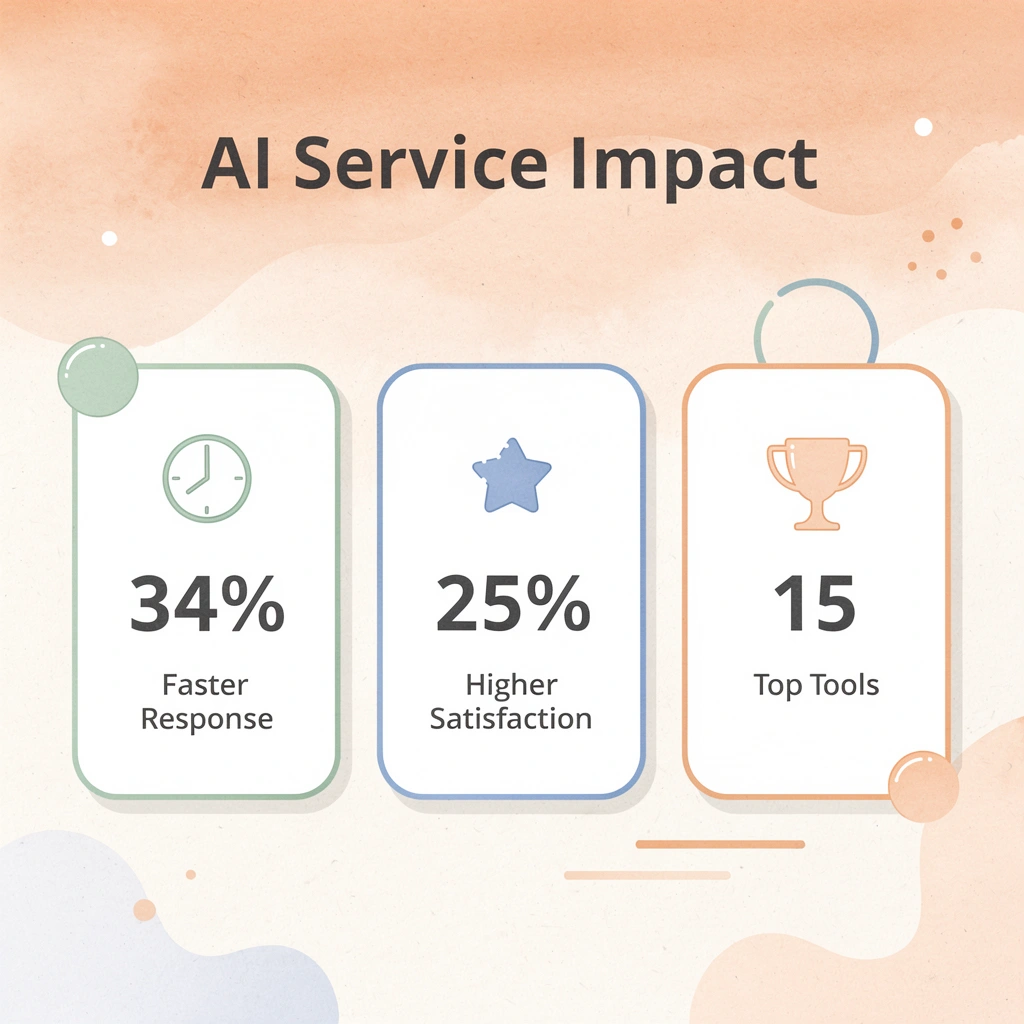
"Hotels using AI customer service tools see 34% faster response times and 25% higher guest satisfaction scores compared to traditional support methods." — Hospitality Technology Report, 2024
Below is a structured breakdown of 15 AI tools evaluated by function, operational fit, and deployment value. Each entry explains what the tool does, which specific problem it solves, and where it fits in the guest journey.
💡 Tip: Focus on tools that integrate with your existing PMS and can handle your peak guest volume without requiring extensive staff retraining.

1. Bland AI
What it is
Bland AI replaces traditional call centers and IVR trees with self-hosted, real-time AI voice agents that handle inbound and outbound calls at enterprise scale.
What it does in hotel operations
Bland's conversational AI answers guest calls immediately, processes booking questions, manages reservation changes, and routes complex requests to staff with full conversation history. The system operates 24/7, with no busy signals or wait times.
What problem does it solve?
Missed calls mean lost bookings. Hotels using voice AI capture every question during busy periods and overnight hours when front desk staff is unavailable.
Where it fits in the guest journey
Before the stay (first questions and bookings), during the stay (room service requests and concierge questions), and after the stay (feedback collection and rebooking outreach).
Best for
Large hotels and chains handling high call volumes that require data control, compliance, and scalable voice automation without sacrificing conversational quality. Bland's conversational AI platform maintains natural interactions at scale, ensuring guests receive helpful responses for room bookings or late-night service requests.
2. Roommaster Concierge
What it is
An AI-powered hotel voice assistant integrated into your property management system that answers every call with the knowledge of an experienced concierge.
What it does in hotel operations
Guests can book rooms, ask questions about the property, make special requests, and receive instant answers in multiple languages. The system updates your PMS in real time and routes complex requests to the appropriate team member.
What problem does it solve?
Seasonal staffing changes no longer impact service quality. According to the Hospitality Technology Report 2026, 87% of hotels report better guest satisfaction after using AI customer service tools. Your team stops handling repetitive booking tasks and focuses on meaningful guest interactions.
Where it fits in the guest journey
Before the stay (booking questions and reservations), during the stay (concierge services and special requests), and after the stay (thank-you notes and review requests).
Best for
Unified hotel operations require a single platform for PMS, booking engine, channel manager, and AI concierge services.
3. Sadie
What it is
A voice helper available 24/7 that understands guest sentiment, handles reservations, and provides call information and transcripts.
What it does in hotel operations
Sadie answers calls, takes reservations, manages edits and cancellations, and routes complex requests to staff. It integrates with your PMS, reservation, and POS systems without requiring workflow changes.
What problem does it solve?
Hotels lose revenue when potential guests cannot reach anyone to complete their reservation. Sadie ensures every call gets answered and every booking opportunity is captured.
Where it fits in the guest journey
Before the stay (first contact, making a reservation), during the stay (handling requests), and after the stay (follow-up calls).
Best for
Hotels need quick AI voice support without upfront training.
4. Seekda Stay
What it is
A virtual front desk that handles guest calls, booking requests, and frequently asked questions through natural voice conversations.
What it does in hotel operations
Seekda connects with your property management system and booking systems, capturing routine questions and routing complex requests to staff with full context. Its dashboard monitors performance and enables adjustment of response flows.
What problem does it solve?
Inconsistent service quality across shifts and staff members. Seekda maintains friendly, consistent service around the clock.
Where it fits in the guest journey
Before the stay (booking questions), during the stay (guest questions), and after the stay (collecting feedback).
Best for
Hotels offering multilingual support to international travelers and routing complex requests to staff members.
5. Asksuite
What it is
A system that handles guest messages from Instagram, Facebook, WhatsApp, email, and your website in one inbox, using AI agents to manage interactions across all channels.
What it does in hotel operations
The platform consolidates all guest messages into one inbox. AI agents answer questions and handle simple booking services, while human agents manage complex requests with full conversation history.
What problem does it solve?
When guests contact you through multiple platforms, managing responses becomes fragmented. Asksuite consolidates all guest messages into one place, eliminating the need to monitor dozens of channels and ensuring every question receives an answer.
Where it fits in the guest journey
Before the stay (questions from various sources), during the stay (guest interactions), and after the stay (review management).
Best for
Hotels that need to manage all their messages in one place and identify which guests require human assistance.
6. HiJiffy
What it is
An AI chatbot that detects activity on your booking page and sends personalized messages based on guest behavior.
What it does in hotel operations
If a guest browses the booking page or spa section, HiJiffy adjusts its conversation to offer relevant prompts and suggestions for additional services. It also provides information on the top 50 most frequently asked guest questions.
What problem does it solve?
Booking page abandonment. HiJiffy engages visitors who are ready to book the moment they're considering a reservation, reducing drop-offs and increasing direct bookings.
Where it fits in the guest journey
Before the stay (booking page engagement, price comparisons), during the stay (upsell opportunities), and after the stay (feedback collection).
Best for
Hotels focused on personalized guest engagement and reducing booking abandonment through real-time conversation adaptation.
7. Voiceflow
What it is
A no-code platform for designing custom AI chatbots and voice agents tailored to unique guest journeys.
What it does in hotel operations
You build the chatbot yourself using a visual workflow builder, controlling what it knows, how it responds, and which systems it connects with, all without writing code.
What problem does it solve?
Generic AI platforms require extensive customization for hotel operations. Voiceflow provides complete control over the agent's content, behavior, and connection points.
Where it fits in the guest journey
Before the stay (custom booking flows), during the stay (property-specific requests), and after the stay (tailored follow-up).
Best for
Hotels with technical oversight capacity that need full control over customization and scalable design, from an FAQ bot to a voice assistant.
8. What is Drift, and how does it work?
What it is
A platform that identifies website visitors ready to buy and engages them through AI conversations at optimal moments.
What it does in hotel operations
Drift engages visitors on your booking page or offers in real time, providing immediate insights into visitor behavior and preferences.
What problem does it solve?
High-intent visitors leave without booking. Drift captures them with timely, personalized messages that drive direct reservations and reduce reliance on OTAs.
Where it fits in the guest journey
Pre-stay (website engagement, booking conversion).
Best for
Hotels are prioritizing converting high-intent website traffic into direct bookings.
9. Duve
What it is
AI Agents that analyze guest tone, journey stage, and inquiry topic to prioritize urgent requests and automate approvals.
What it does in hotel operations
The system prioritizes requests by urgency and automates upgrades, extras, and dining reservations through chat.
What problem does it solve?
Staff waste time on low-priority tasks while urgent guest matters wait. Duve ensures your team focuses on what matters most.
Where it fits in the guest journey
Before the stay (upgrade offers), during the stay (request prioritization and service automation), and after the stay (personalized follow-up).
Best for
Hotels need to prioritize tasks and manage automated upsells without burdening staff.
10. Canary Technologies
What it is
A chatbot that builds a marketing database during guest conversations while offering 24/7 support through voice, text, and web.
What it does in hotel operations
Canary captures guest information during interactions to enable personalized re-engagement campaigns, loyalty programs, and future booking promotions. It also provides real-time 2-way translations.
What problem does it solve?
Hotels lack organized guest information for marketing. Canary transforms every conversation into an opportunity to build relationships and encourage repeat bookings.
Where it fits in the guest journey
Before the stay (collecting data), during the stay (support in multiple languages), and after the stay (marketing campaigns based on guest behavior).
Best for
Hotels seeking to build marketing databases and encourage repeat visits through personalized campaigns.
11. Ada
What it is
An AI chatbot that uses Playbooks to guide agents through step-by-step workflows for complex interactions.
What it does in hotel operations
Ada handles open-ended questions and learns from real conversations to improve responses over time. Its analytics dashboard provides insights into call patterns and response times.
What problem does it solve?
Guests often ask complicated questions that simple chatbots cannot answer because they require an understanding of nuanced situations. Ada handles these independently without human intervention.
Where it fits in the guest journey
Before the stay (answering difficult questions), during the stay (handling multi-step requests), and after the stay (reviewing detailed feedback).
Best for
Hotels managing complex guest interactions with organized workflows and adaptive AI.
12. Maaz Technologies
What it is
A hotel chatbot with AI Speech Analytics that identifies emotions, detects trends, and provides actionable insights.
What it does
Analyzes guest conversations to detect tone, sentiment, and feedback trends, enabling hotel chains to maintain consistent service quality across all properties.
What problem does it solve?
Hotel chains operating multiple properties struggle to maintain consistent service standards across locations. Maaz provides centralized oversight of all properties and analysis of customer feedback.
Where it fits in the guest journey
Before the stay (initial contact), during the stay (real-time sentiment), and after the stay (feedback patterns).
Best for
Hotel chains and resorts require consistent service standards and centralized sentiment analysis across multiple properties.
13. Runnr.ai
What it is
A chatbot that automates front desk communications and offers digital check-in via WhatsApp and SMS.
What it does
Sends booking confirmations, amenities overviews, and upsell offers automatically. It processes guest requests and enables digital keys and mobile payments.
What problem does it solve?
Front desk staff spend excessive time on repetitive communication tasks. Runnr.ai automates these, freeing staff to focus on in-person guest experiences.
Where it fits
Before the stay (automated messaging and upsell offers), during the stay (digital check-in and payment processing), and after the stay (feedback requests).
Best for
Hotels need a simple setup and automated front desk communication management.
14. PolyAI
What it is
A voice assistant with strong natural language understanding, primarily used by large businesses for questions and call routing.
What it does in hotel operations
PolyAI handles complex voice conversations with high accuracy but requires significant customization for hotel-specific tasks such as booking, upselling, and PMS integration.
What problem does it solve?
Business-scale call handling for complex questions. It is less effective for daily hotel reservation workflows without extensive customization.
Where it fits in the guest journey
Before arrival (complex question handling) and during stay (call routing).
Best for
Large hotel chains with resources for extensive customization and business-scale voice automation needs.
15. Numa
What it is
A tool that captures missed calls and text messages for small businesses.
What it does in hotel operations
Numa captures missed calls and enables staff to respond by text, providing basic call management without full voice AI features or integration with your property management system.
What problem does it solve?
Missed calls from possible guests. However, it cannot handle real-time bookings, multilingual calls, or automated booking workflows.
Where it fits in the guest journey
Before the stay (missed call capture).
Best for
Small hotels need basic call management without advanced voice automation or booking system integrations.
When Hotels Should Use AI vs Human Customer Service Teams
AI moves work around rather than eliminating staff. Give high-volume, repetitive, time-sensitive questions to automated systems while routing complex complaints, VIP experiences, and emotional service recovery to human teams. Excessive automation without proper escalation pathways damages guest experience faster than understaffing.

AI Customer Service
- ✅ High-volume inquiries
- ✅ Repetitive questions
- ✅ Time-sensitive requests
- ✅ 24/7 availability
- ❌ Emotional situations
- ❌ Complex problem-solving
Human Customer Service
- ✅ Complex complaints
- ✅ VIP guest experiences
- ✅ Emotional service recovery
- ✅ Nuanced problem-solving
- ❌ Simple, repetitive tasks
- ❌ High-volume processing
"Hotels that strategically balance AI automation with human touchpoints see 35% higher guest satisfaction scores compared to properties using either approach exclusively." — Hospitality Technology Report, 2024
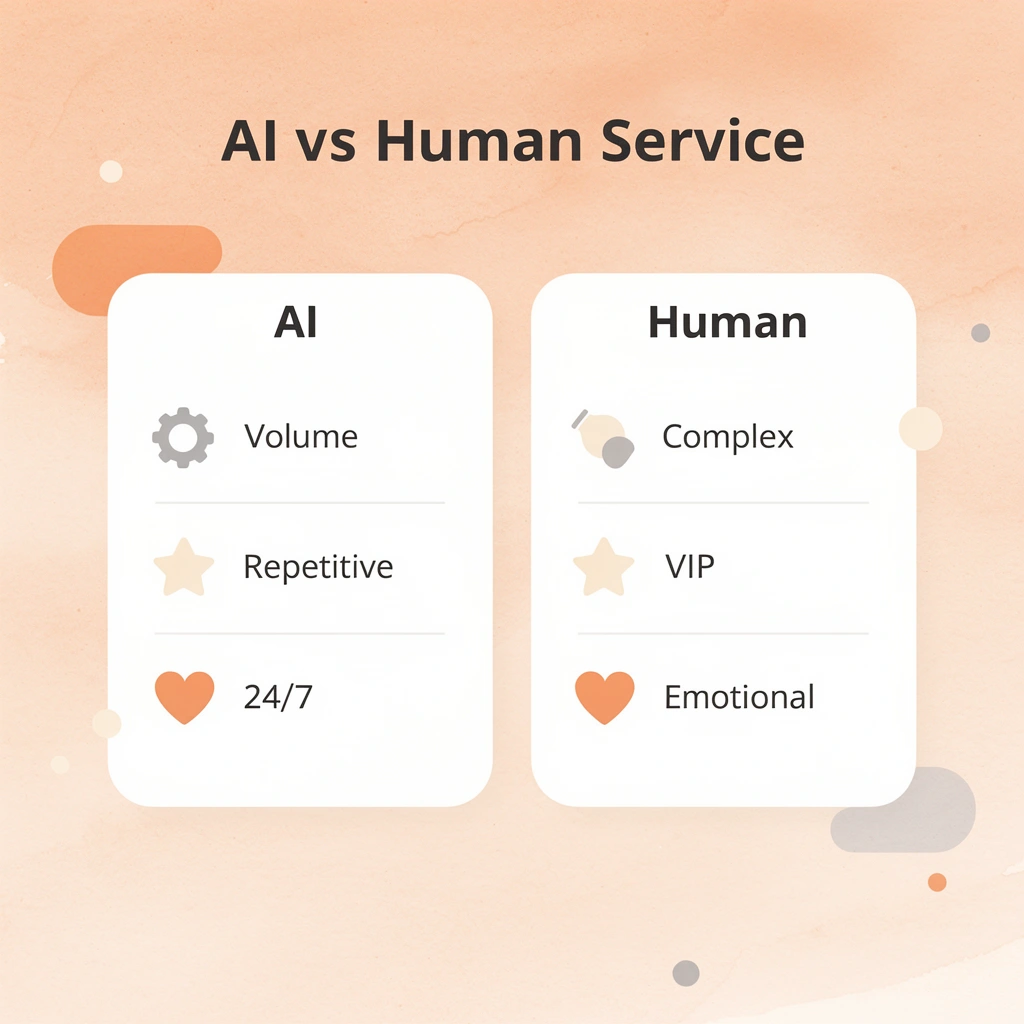
🔑 Takeaway: The most successful hotels use AI as a filter system that handles routine inquiries efficiently while ensuring human agents focus on high-value interactions that require empathy, creativity, and complex problem-solving.
⚠️ Warning: Implementing AI without clear escalation paths to human support can trap guests in automated loops, leading to frustrated customers and negative reviews that damage your hotel's reputation.

What scenarios favor AI over human agents?
Voice AI excels at tasks with clear rules and expected results, such as booking confirmations, room availability checks, wake-up call scheduling, basic amenity requests, and multilingual FAQ responses. These interactions follow set patterns where speed and consistency matter more than emotional understanding. A guest calling at 2 AM to confirm their airport shuttle time needs accurate information immediately, not empathy. Research from Voice2Me.ai shows that AI-powered support teams achieve 78% customer satisfaction, compared with 62% for purely human agents, largely because automated systems deliver consistent answers without fatigue or mood variability.
How does AI handle high-volume periods?
Time-sensitive requests during busy check-in periods create bottlenecks that AI handles efficiently. When 40 wedding guests arrive simultaneously, asking about restaurant reservations, parking validation, and pool hours, automated voice systems manage the volume without delay. Human staff can focus on complex requests, such as coordinating room assignments for elderly relatives. AI doesn't get overwhelmed, doesn't need breaks, and provides consistent information.
What types of complaints require human judgment?
Hard complaints require people to make decisions that computers cannot. A guest disputing a minibar charge because the fridge contained incorrect items needs someone who can review the transaction history, assess the guest's claim, make policy exceptions, and repair the relationship through empathetic communication.
According to Shep Hyken's 2026 customer service research, 86% of customers want the option to speak with a real person, particularly when automated responses seem rude or fail to handle complex situations.
How do VIP experiences depend on emotional intelligence?
VIP experiences and service recovery moments depend on emotional intelligence. When a honeymooning couple discovers their ocean-view upgrade wasn't processed, a human staff member can read the frustration levels, offer a genuine apology, expedite the correction, and add complimentary champagne to transform a negative moment into a positive story.
AI can log the complaint and trigger a work order, but it cannot determine whether the guest needs immediate resolution or wants to feel heard first.
Why escalation design determines success or failure
The main problem with most hotel AI systems isn't the technology itself: it's the lack of a handoff protocol. Automated systems that trap guests in loops without clear paths to human support create the frustration they were meant to eliminate.
How do escalation triggers prevent dangerous situations?
When a guest with a medical emergency calls asking about wheelchair-accessible routes and the AI offers only standard navigation instructions, the lack of escalation becomes dangerous. Hybrid systems work when AI recognizes complexity triggers (words like "emergency," "allergic," "urgent," "manager") and immediately transfers to human staff with full context from the automated conversation.
What makes workload redistribution systems effective?
Platforms like conversational AI build escalation logic directly into voice workflows, routing calls based on sentiment analysis and keyword detection. Our system handles routine questions independently while flagging billing disputes, accessibility requests, and complaint language for immediate human intervention, compressing response times and maintaining service quality.
The best hotel customer service models aren't fully automated replacements; they're workload redistribution systems that match task complexity to the right resource.
Related Reading
- Botpress Alternative
- How Is Ai Helping In The Healthcare Industry
- Best Ai For Insurance Agents
- Lindy Ai Alternative
- Best Ai Tools For Insurance Customer Service
- Best Ai Voice Agents For Insurance
- Lindy Ai Vs Zapier
- Relevance Ai Alternative
If Your Hotel Is Losing Guests to Slow or Inconsistent Service, Here’s the Next Step
The real test isn't whether AI can respond to guest requests, but whether it can do so right away, accurately, and consistently across all channels: phone calls, text messages, booking platforms, and web chat—without requiring your team to manage multiple disconnected tools. Most service failures occur in the critical gaps between channels, when a guest calls after texting or when an inquiry sits unanswered because it arrived outside business hours.

🎯 Key Point: Service breakdowns occur in the gaps between communication channels, not within individual interactions.
Bland deploys real-time conversational AI voice agents that handle high-volume guest interactions with structured reliability and human-like responsiveness. For large hospitality groups managing multiple properties, our agents mean fewer missed bookings, more consistent guest experiences, and full control over compliance and service quality across every interaction channel.
"Most service failures happen in the gaps between channels, when guest communications fall through the cracks during off-hours or channel transitions." — Hospitality Technology Report, 2024
💡 Best Practice: Test AI systems with your actual guest communication scenarios before implementation.
Book a demo and map your guest communication flow to see how Bland would handle real guest interactions in real time. You're watching it function as a service layer within your hotel operations, handling the volume your team currently processes manually.