Friday night rushes present a familiar challenge for restaurant owners: phones ringing constantly while staff juggles orders, seating, and reservations. Potential customers often hang up after a few rings and head to competitors who can answer immediately. The best voice AI for restaurants solves this problem by automatically handling phone interactions, ensuring no call goes unanswered during peak hours or after closing time. These AI systems take orders, book reservations, and answer menu questions while staff focus on in-person guests.
Modern voice AI technology can handle customer calls with the same quality as experienced staff, without breaks or busy periods. These systems answer instantly, process accurate orders, manage reservation schedules, and provide consistent customer service around the clock. Restaurant owners who want to capture every revenue opportunity and eliminate missed calls should explore Bland's conversational AI solutions designed specifically for food service operations.
Summary
- Restaurant phone systems fail most at the exact moments that matter: the Friday night rush, when three lines ring simultaneously and your host is seating a ten-top. Research from Slang AI shows that 85% of restaurant calls go unanswered during peak hours, leading high-intent customers to book with competitors. The problem isn't negligence. It's physics. One person cannot answer phones and manage the door at the same time, and traditional staffing solutions just shift labor costs without solving the underlying capacity constraint.
- Voice AI systems eliminate an average of 20 hours per week of repetitive call handling, according to Slang AI research, but only when the technology handles the chaos that breaks most automation: mid-order changes, out-of-stock items at 7:15 PM, and clarifying questions shouted over background noise. Speed determines whether callers stay on the line. Systems delivering responses within one to two seconds maintain trust. Anything slower triggers hang-ups. The real test isn't feature count. It's whether the platform maintains sub-second latency under concurrent call loads without forcing callers into rigid scripts that collapse when someone interrupts or changes their mind.
- Integration depth separates tools that create work from tools that eliminate it. Hostie.ai research shows that restaurants using voice AI reduce missed calls by 87%, but that metric matters only if captured information flows directly into POS and reservation systems without manual transcription. When the kitchen marks an item as 86'd, the AI should stop offering it within seconds, not after three more frustrated customers have ordered it. Systems that require human translation of AI-captured data introduce new failure points rather than closing operational gaps.
- Over two-thirds of Americans would abandon restaurants that don't answer the phone, according to Hostie AI data, making reliability during peak hours the only performance benchmark that matters. A voice AI system that works perfectly at 3 PM on Tuesday but chokes when fifteen calls arrive simultaneously at 7 PM on Friday trains customers to expect failure and staff to distrust automation. The best platforms handle concurrent calls without degradation, maintain response speed under load, and fail gracefully by transferring to humans with full context rather than dropping calls or forcing callers to start over.
- After-hours inquiries represent some of the highest-intent revenue opportunities restaurants receive. Late-night catering requests and early-morning reservation changes that go to voicemail rarely convert because guests no longer leave messages. They call the next restaurant on their list. Systems offering true 24/7 coverage capture these calls and sync booking data directly into seating charts without waking anyone up, turning what would be lost opportunities into confirmed revenue by morning.
- Conversational AI addresses this by handling calls with the same consistency as your best employee, without fatigue, distraction, or the need for breaks, freeing teams to focus on the guests standing in front of them rather than the phone ringing behind them.
Why Restaurants Are Turning to Voice AI for Phone Orders and Reservations
A medium-sized restaurant group with six locations faced a common problem: hosts juggled walk-ins and waitlists while phones rang constantly. Reservation requests went to voicemail, and catering inquiries went unanswered. The team wasn't dropping the ball—they lacked sufficient staffing to handle everything.

🎯 Key Point: Voice AI eliminates the impossible choice between serving in-person guests and answering phone calls, allowing restaurants to capture every revenue opportunity without additional staff costs.
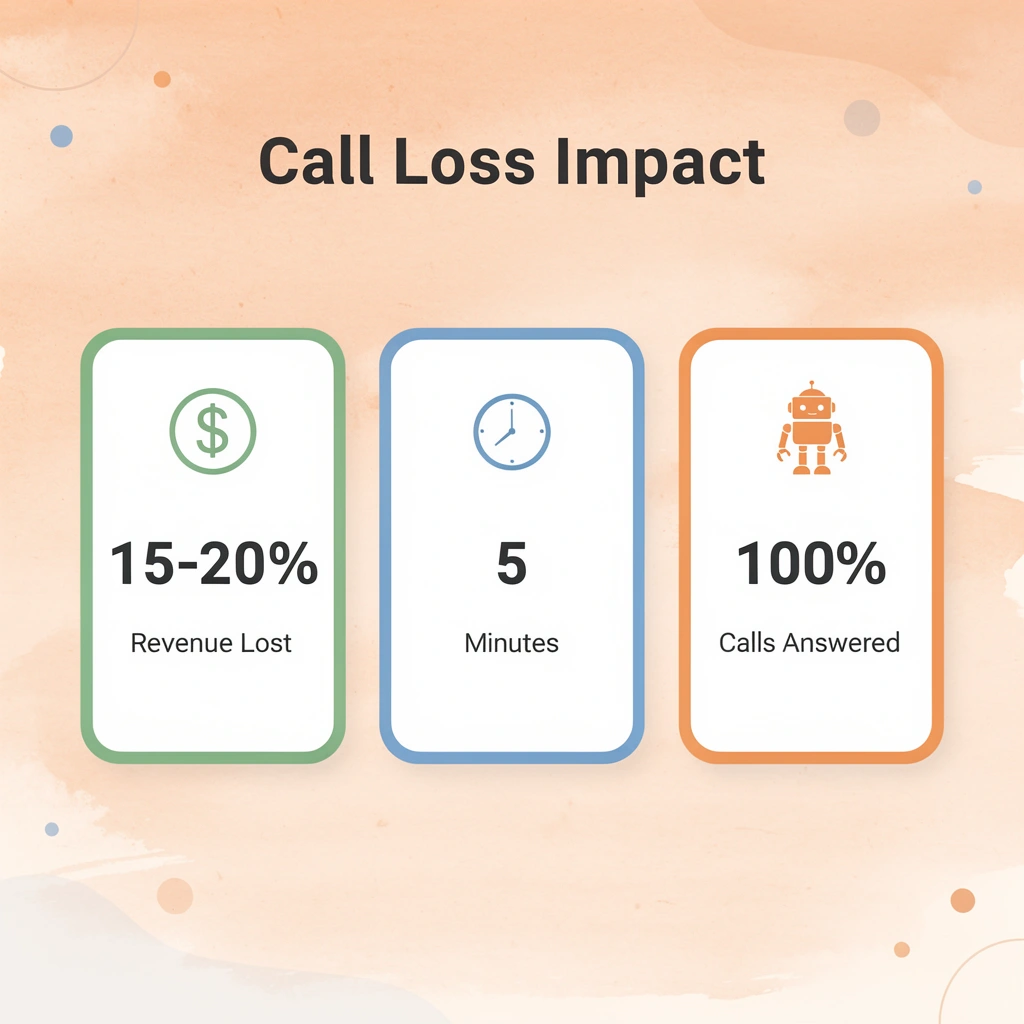
"Restaurants lose an estimated 15-20% of potential revenue from missed calls and unanswered reservation requests during peak hours." — Restaurant Technology Report, 2024

⚠️ Warning: Even well-staffed restaurants struggle during rush periods when every team member is focused on immediate guest needs, making phone management the first thing to suffer.
The Real Cost of Unanswered Calls
Missing a reservation call during the Friday night rush results in lost revenue. Forcing your host to choose between the phone and a guest at the door is a loss of hospitality. Every unanswered ring sends potential guests to competitors. Research from Slang AI confirms that 85% of restaurant calls go unanswered during peak hours. Your front-of-house team cannot answer every call when stretched thin.
Why Traditional Staffing Can't Solve This
The instinct is to hire more hosts or add another phone line. But most restaurant calls involve predictable, repetitive questions that don't require human judgment: hours, parking, dietary accommodations, and basic menu questions. When your highest-paid staff spend shifts answering the same ten questions, you waste labor budget on tasks that could be automated while degrading in-person service quality. According to Slang AI, restaurants save an average of 20 hours per week using voice AI, freeing teams to focus on interactions that drive repeat business and positive reviews.
How does voice AI capture missed revenue opportunities?
Conversational AI for restaurants manages bookings, answers FAQs, and syncs order data directly into your POS system, letting your team focus on the dining room while the system captures reservations 24/7, including late-night catering requests and early-morning changes that would otherwise go to voicemail.
When a guest calls at 10 PM to book a table, the AI takes the reservation, confirms dietary restrictions, and updates your seating chart without human intervention.
What operational improvements can restaurants expect?
Voice AI systems handle order accuracy, reservation confirmations, and common questions with the consistency of your best employee, without fatigue or distraction.
Teams using conversational AI report fewer miscommunications, faster table turns, and staff who can focus on guests instead of phones. Our conversational AI platform is built to handle these scenarios in high-pressure environments.
But installing the technology is only half the equation. The real question is whether it can survive the chaos of a live restaurant environment.
Related Reading
- How to Use AI in Customer Service
- How Does AI Improve Customer Service
- How Can Ai Help Customer Service
- AI in Customer Communications For Telecommunications
- How Is Ai Improving Restaurant Customer Service
- AI in Customer Communications in the Insurance Industry
- Ai Agent Challenge In Customer Support
- Ai Appointment Scheduling Healthcare
- Benefits of AI in Customer Support
- Ai Customer Support Implementation Best Practices
- How Ai Is Changing Customer Service In Telecom
What Makes a Voice AI System Actually Work in a Restaurant Setting
The real test isn't what the AI can do, it's what it can't break
The best voice AI for restaurants isn't the one with the longest feature list. It's the one that handles a customer changing their mind mid-order, the kitchen running out of salmon at 7:15 PM, or someone calling about gluten-free options while their toddler screams in the background. Effectiveness requires: call latency under two seconds, natural conversation handling that doesn't force callers into rigid scripts, reservation and ordering accuracy matching or exceeding human performance, and POS/booking integration that eliminates double-entry. According to Loman AI's Restaurant Technology Guide, restaurants using AI report revenue increases of up to 22%, but only when the system reduces friction without introducing errors into orders or reservations.
Speed matters more than sophistication
Call latency determines whether a customer stays on the line or hangs up. If the AI takes four seconds to respond after "I'd like to make a reservation," you've lost trust. The system must acknowledge input within one to two seconds, even while gathering information in the background. Natural conversation handling means the AI can process interruptions ("Wait, make that for six people, not four"), handle clarifying questions ("Do you have outdoor seating?"), and recover gracefully when someone mumbles or talks over background noise. These aren't edge cases in a live restaurant environment—they're the baseline reality of every dinner rush.
Integration depth separates tools that help from tools that create new problems
Voice AI that can't write directly to your reservation system or POS creates a manual step: someone must still write down the order or booking. Hostie.ai's research shows that restaurants using voice AI systems reduce missed calls by 87%, but that metric matters only if the captured information flows into existing workflows without human translation.
The system must understand your menu structure, handle changes and swaps, apply discounts or promotions correctly, and update availability in real time. When the kitchen marks an item as 86'd, the AI should stop offering it within seconds, not after three more customers have ordered it.
What metrics determine voice AI success in restaurants?
The competitive moat in restaurant voice AI lies not in feature count but in operational efficiency: fewer abandoned calls, higher add-on sales, fewer order errors, and reduced labor needs during peak hours. Teams using conversational AI report that continued adoption depends on whether the system improves their key metrics.
If order volume increases by 5 to 10 percent with fewer customer drop-offs and higher add-on purchases without additional hiring, the tool stays. If it complicates operations or requires constant monitoring, it gets replaced.
Why is peak hour performance the ultimate test?
A voice AI system that works perfectly at 3 PM on Tuesday but fails when fifteen calls arrive simultaneously at 7 PM on Friday is worse than no system at all. It trains customers to expect problems and undermines staff confidence in automation.
The system must handle concurrent calls without degrading performance, maintain consistent response times under load, and fail gracefully when encountering unfamiliar inputs. Graceful failure means routing calls to a human agent with full conversation context, rather than disconnecting or requiring the customer to restart.
How do the best systems turn failures into improvements?
The best systems record every type of failure and use that information to improve their capabilities, turning unusual situations into routine handling over time. The harder question is which specific tools actually work this way and where each focuses on different parts of the operational stack.
Related Reading
- How To Improve Call Center Customer Service
- How to Use AI for Customer Service Call Center
- Best Ai Tools For Customer Support In Healthcare
- Ai Customer Support Automation In Telecom
- Best Ai Customer Support Tools For It Teams
- It Helpdesk Automation
- Patient Support Services Automation
- Best Ai Customer Service For Hotels
- How To Use Ai To Improve Customer Service Kpis
15 Best Voice AI Tools for Restaurants Compared
1. Bland AI
Bland AI replaces weak IVR systems and inconsistent call center operations with self-hosted, real-time conversational AI agents that handle calls as effectively as trained employees. Our platform gives large restaurant groups full control over data, compliance, and voice quality while scaling across hundreds of locations.
Best Fit
Restaurant groups with multiple locations and large chains managing 10 or more locations need centralized control over guest communication without sacrificing local responsiveness. This approach enables consistent brand voice across locations while allowing customization of scripts, escalation rules, and integrations per region.
Problem It Solves
Missed calls during busy times send money to competitors. When your host seats a table of six and three phone lines ring, unanswered calls mean lost reservations, abandoned takeout orders, and catering requests that never convert to sales. Bland ensures every call gets answered immediately without pulling staff away from guests.
Operational Strengths
Bland supports unlimited concurrent calls without loss of quality. It integrates directly with major point-of-sale systems and reservation platforms, eliminating the need for manual data entry. Response times under one second create natural conversations. It supports complex interactions, including order changes, dietary restrictions, and multi-step reservation confirmations. Complete audit trails and call analytics help identify revenue patterns and guest preferences.
Limitations
Not suitable for single-location independents with call volumes under 50 per day. The enterprise-grade infrastructure and depth of customization require a technical setup that smaller operators may find excessive. Restaurants seeking plug-and-play simplicity need lighter-weight alternatives.
2. Rosie AI
Rosie AI was built for restaurants that can't afford to miss calls but lack 24/7 staff. Forward your phone line, and Rosie picks up immediately with a voice model trained to sound professional without sounding robotic.
Best Fit
Independent restaurants and small chains (2–5 locations) needing reliable 24/7 coverage without overnight staff benefit most from this solution. It suits operators who receive consistent after-hours questions about hours, menu details, or reservations and want to capture that revenue without paying for a live answering service.
Problem It Solves
Every call to voicemail after 9 PM is a lost reservation. Guests don't leave messages; they call the next restaurant instead. Rosie AI ensures you're always available, capturing late-night inquiries and sending automated text confirmations so guests wake up with their reservation confirmed.
Operational Strengths
Quick setup with no equipment needed. Connects to Zapier for basic CRM and reservation system integration. Captures caller needs and routes urgent requests to staff through SMS. Customizable scripts let the AI answer brand-specific questions about private dining, corkage fees, or seasonal menu items.
Limitations
Not suitable for high-volume operations requiring deep POS integration or complex order-taking. It handles reservations and FAQs well, but struggles with multi-item takeout orders that include modifiers, substitutions, or upsells. Restaurants that run 200+ calls per day will quickly outgrow their capacity.
3. Numa
Numa recovers missed calls by automatically texting guests within seconds when no one answers, converting missed opportunities into conversations.
Best Fit
Casual and fast-casual restaurants that receive frequent, unpredictable phone calls often have small front-of-house teams that miss calls during busy periods.
Problem It Solves
Missed calls become negative reviews and lost customers. When guests can't reach you, they assume disorganization. Numa texts callers immediately, letting them ask questions or book tables without waiting on hold.
Operational Strengths
Works with your existing phone number without new hardware or complicated setup. Guests reply by text message to make reservations, ask about wait times, or place pickup orders. The system logs every interaction so you can track missed calls and guest requests.
Limitations
Not suitable for restaurants needing real-time voice interaction. Numa excels at follow-up, not live conversation. If guests expect to complete orders or book tables during calls, you'll need a voice-first solution instead.
4. Maple
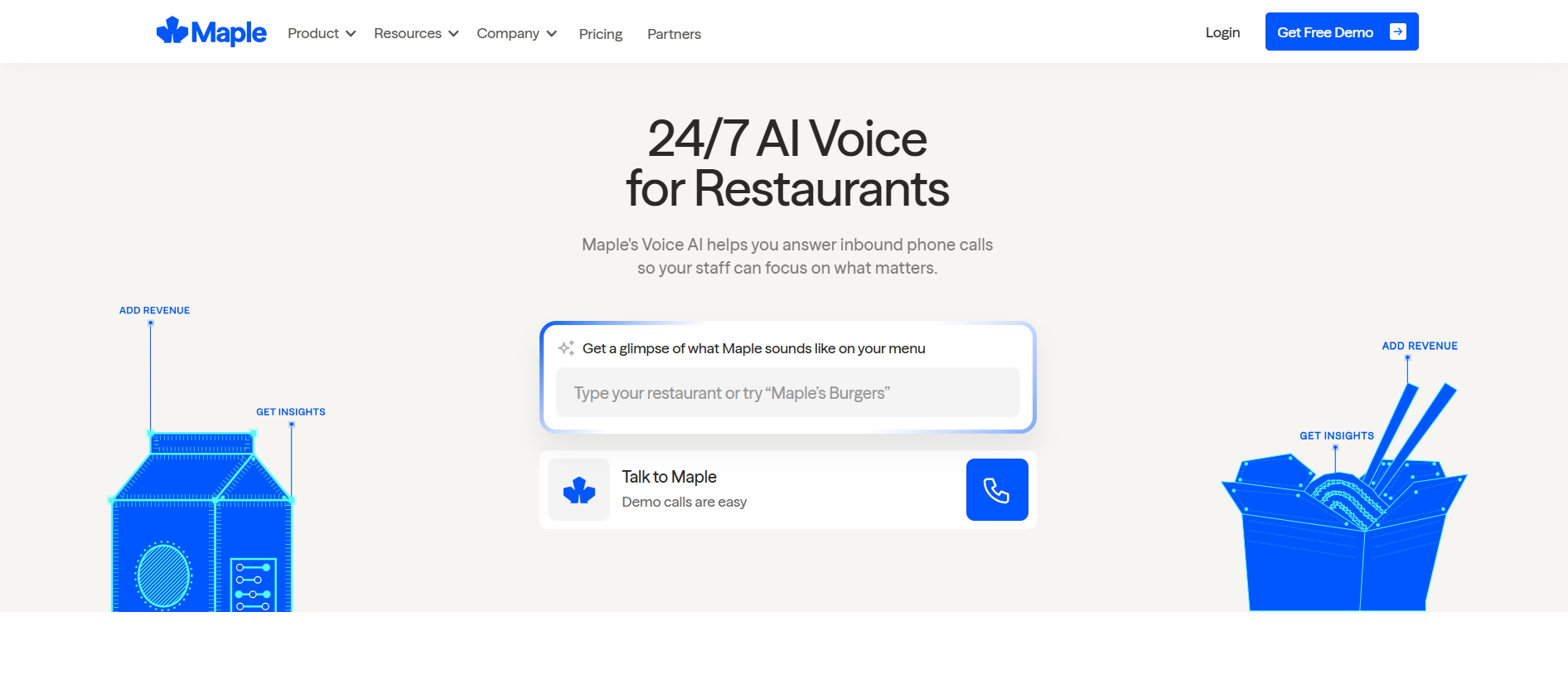
Maple connects voice AI directly to your POS and reservation system, creating a closed loop between what guests say on the phone and what shows up in your kitchen or front-of-house dashboard. It's built for restaurants that want visibility into their operations, not just call answering.
Best Fit
Medium-sized restaurant groups (5–15 locations) using modern POS systems and seeking to eliminate manual entry of phone orders or reservation details. This solution works especially well for owners who view their phone system as a revenue driver.
Problem It Solves
When a host writes down a phone order, details get lost—"no onions" disappears, or a 7 PM reservation becomes 7:30. Maple syncs voice interactions directly into operational systems, ensuring accuracy from the first word to the final ticket.
Operational Strengths
Two-way POS integration lets the AI access real-time inventory and availability data. It routes calls based on caller needs: reservations to hosts and catering questions to management. It also provides call analytics, including peak-volume times, common questions, and inquiry-to-booking conversion rates.
Limitations
Not suitable for restaurants using older POS systems without API access. Maple's integration depth requires modern infrastructure; older, closed systems will encounter technical problems during setup.
5. OpenMic.ai
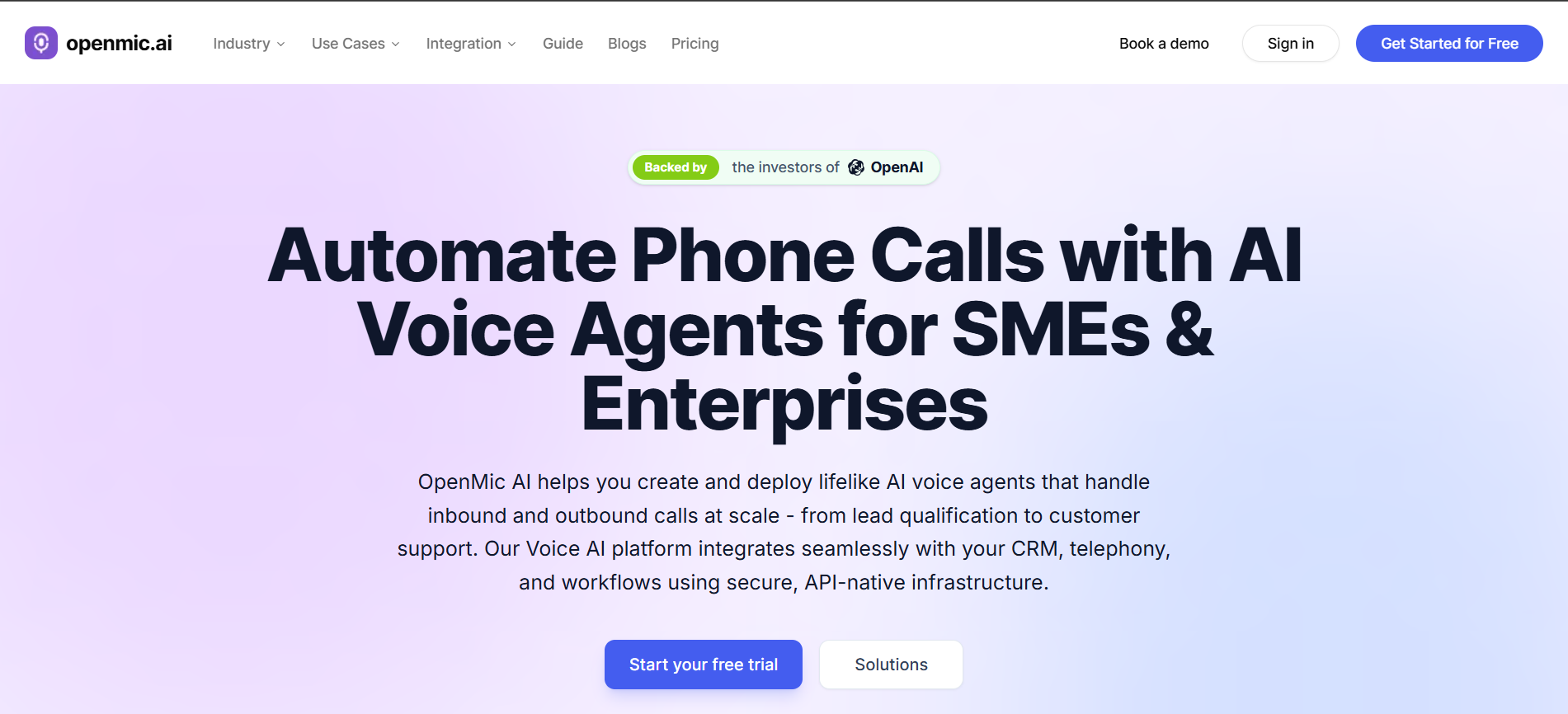
OpenMic.ai is a programmable voice AI for restaurants that starts workflows and connects to CRMs, loyalty platforms, and internal admin tools. Every call updates customer records, logs preferences, or automatically starts back-office tasks.
Best Fit
Restaurant groups with multiple locations and centralized operations teams can leverage existing data infrastructure. This option works best for operators who already use CRMs to track guest preferences and want their phone system to feed into that ecosystem without manual data entry.
Problem It Solves
Guest data lives in silos. A caller mentions a shellfish allergy, but that information never reaches their profile. A regular asks about private dining, but there's no record of when the events manager follows up. OpenMic.ai syncs every call to your CRM, ensuring context follows the guest across every touchpoint.
Operational Strengths
Call flows that you can fully customize based on caller history, time of day, or location. The system syncs with major CRMs to automatically log preferences, dietary restrictions, and special requests, triggering internal workflows like sending catering quotes or flagging VIP callers for manager follow-up.
Limitations
Not suitable for single-location operators without dedicated IT resources. The platform's flexibility requires technical configuration, making setup more involved than plug-and-play alternatives.
6. RestoHost
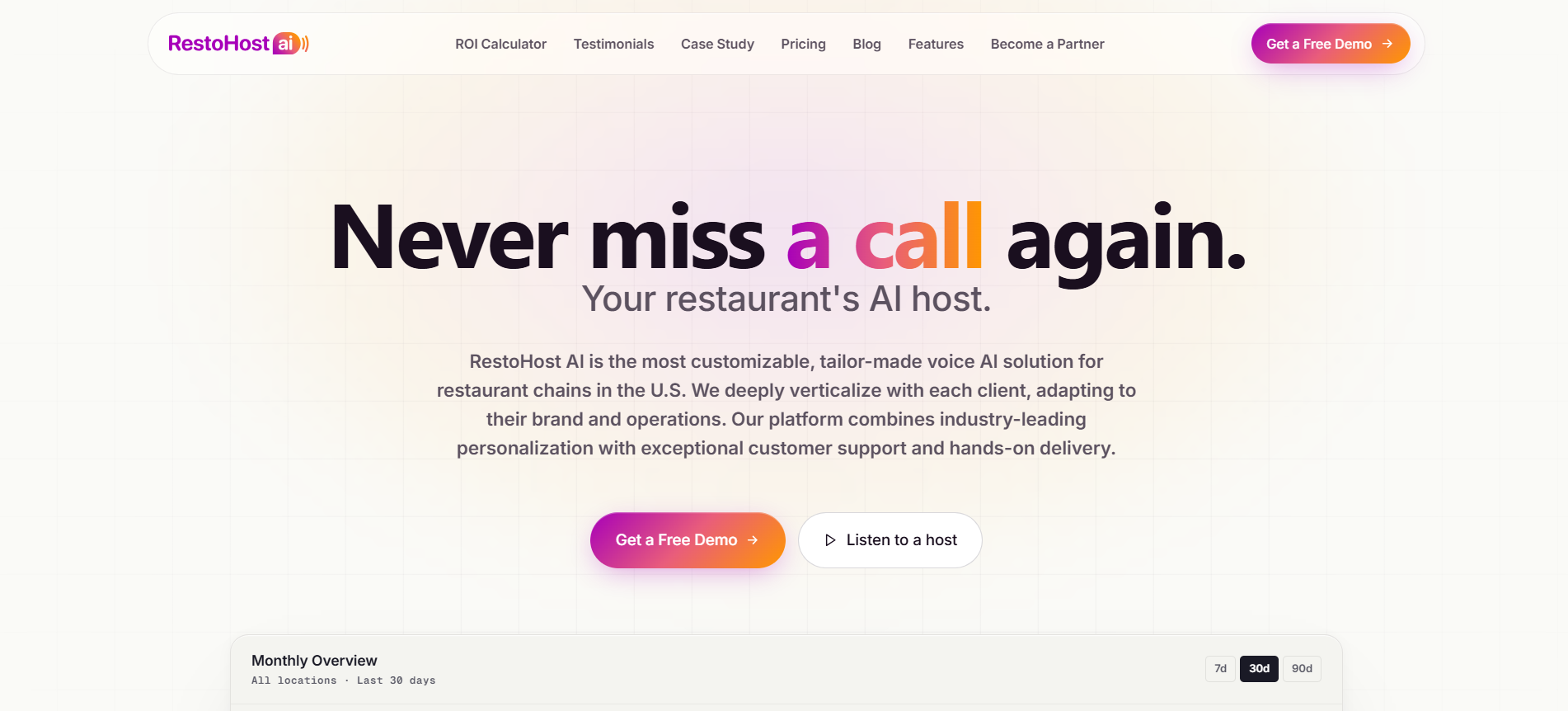
RestoHost makes AI sound local. Its voice agents reflect regional speech patterns, making interactions feel personal rather than generic. For restaurants where neighborhood identity matters, this difference is everything.
Best Fit
Regional chains and independent restaurants thrive in markets where local identity drives loyalty, particularly in the South, Midwest, and other regions where guests expect warmth and familiarity in phone greetings.
Problem It Solves
Generic AI voices feel corporate and distant. When a guest calls a neighborhood restaurant and hears a voice reading from a script in a distant call center, it breaks trust. RestoHost preserves the local feel that makes guests choose your restaurant over a chain.
Operational Strengths
Handles waitlist updates, table availability checks, and menu questions using regional speech patterns. Provides quick response times while maintaining conversational warmth. Works with basic reservation systems to confirm bookings and send text reminders.
Limitations
Not suitable for high-volume takeout operations requiring deep POS integration or complex order modification handling. RestoHost excels at conversational warmth but lacks transactional depth for multi-item orders with substitutions and add-ons.
7. Slang
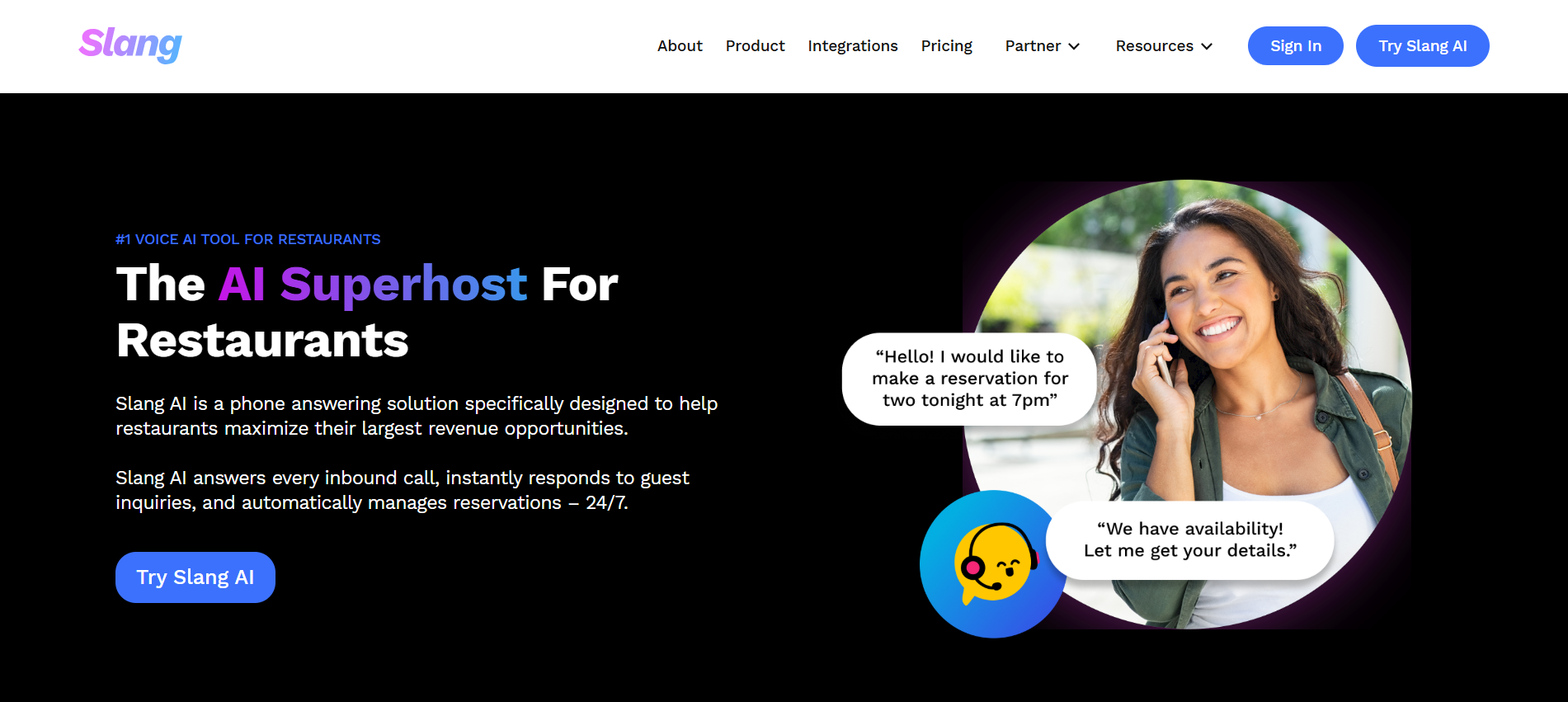
Bland is built to work the same way everywhere, ensuring every guest receives the same quality of information, tone, and service across all locations.
Best Fit
Fast-growing restaurant chains with 15 or more locations need standardized ways to communicate with guests. This solution suits operators who want centralized control over scripts and escalation rules while maintaining local flexibility for market-specific questions.
Problem It Solves
When phone experiences are inconsistent, they damage brand trust. Guests who receive helpful answers at one location but long wait times at another begin to question your brand's competence. Bland eliminates this problem by standardizing every call.
Operational Strengths
It handles high call volumes without quality degradation. A centralized dashboard updates scripts, hours, and menu details across all locations simultaneously. Call analytics by location identifies underperforming units and regional trends.
Limitations
Not suitable for independent restaurants or small groups prioritizing local personality over brand consistency. Slang uniformity can feel impersonal to operators seeking to reflect the neighborhood's character in their phone experience.
8. Whippy
Whippy treats phone calls as data. It tracks what callers want, how they feel, and whether they become customers, so you can see exactly what guests are asking for and how well your AI handles it.
Best Fit
Restaurant owners and managers who use data to make smart decisions want to improve guest communication based on real performance numbers. This approach works especially well for groups that already use analytics to inform menu, staffing, and marketing choices.
Problem It Solves
Most restaurants don't know what happens on their phone calls: how many callers wanted reservations versus takeout, how many hung up frustrated, or which menu items generate the most questions. Whippy surfaces that intelligence for smarter operational decisions.
Operational Strengths
A real-time analytics dashboard displays call volume, caller intent, and conversion rates by time of day and location. The system supports multiple languages with automatic language detection. Sentiment analysis flags frustrated callers for manager follow-up. According to AnveVoice product specifications, platforms that deliver voice responses in under 700 milliseconds create conversations that feel responsive, and Whippy's voice engine operates at that speed.
Limitations
Not suitable for operators seeking basic call coverage without analytics. Whippy's data-first approach requires engagement with dashboards and metrics, making it more robust than restaurants that prefer simplicity.
9. Ruby
Ruby pairs AI automation with live receptionists for complex calls, designed for restaurants seeking efficiency without sacrificing personal connection.
Best Fit
Fancy restaurants and high-end dining establishments, where guests expect excellent, careful service, suit business owners who cannot entrust AI with a $10,000 private event inquiry the same way it handles a parking question.
Problem It Solves
Full automation fails on high-stakes calls. When a VIP books a milestone anniversary dinner with specific requests about wine pairings, table placement, and dietary accommodations, a scripted AI response proves inadequate. Ruby transfers these calls to a live person who delivers the personalized service your brand promises.
Operational Strengths
AI handles routine questions about hours, directions, and menu basics, while live receptionists take over for complex requests, large party bookings, and frustrated callers. Seamless handoffs between AI and human staff ensure guests never feel passed around. Full call transcripts and notes sync to your CRM.
Limitations
Ruby's hybrid model is not a good fit for busy casual-dining or fast-casual restaurants, where most calls are simple transactions. Since it costs more than AI-only solutions, it becomes impractical for restaurants where simple calls don't require human intervention.
10. CloudTalk
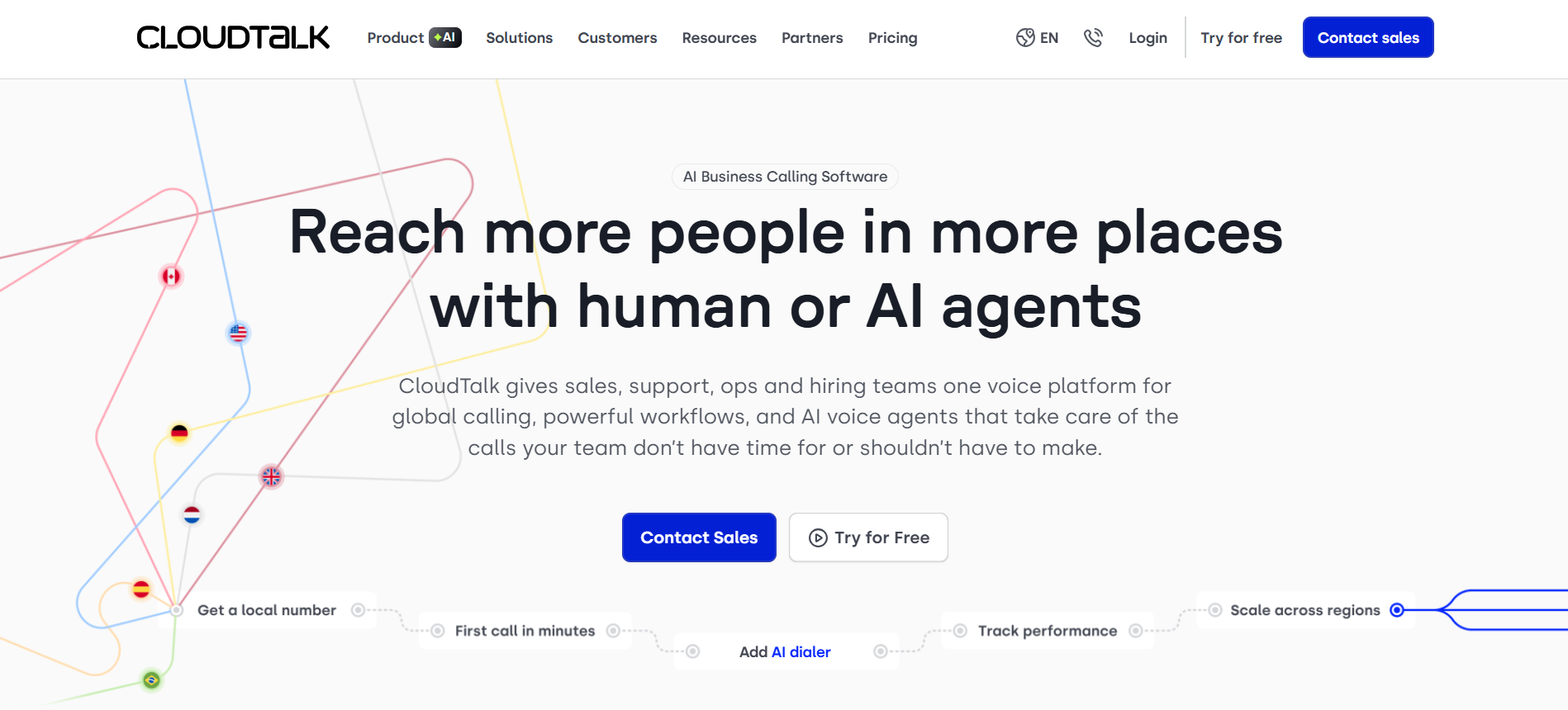
CloudTalk combines a full VoIP phone system with native AI assistants that can handle hundreds of simultaneous calls. It integrates phone infrastructure and AI voice agents into a single system rather than treating them as separate tools.
Best Fit
Large restaurant groups and multi-location operators managing 20 or more locations need business-level phone infrastructure with built-in AI automation and centralized control over call routing, analytics, and guest communication.
Problem It Solves
Most restaurants build phone systems piecemeal, then layer AI on top, creating integration problems and data silos. CloudTalk solves this by embedding AI directly into the phone system, ensuring every call is recorded, routed intelligently, and handled consistently.
Operational Strengths
Support for more than 60 languages without hiring bilingual staff. Handle hundreds of simultaneous conversations during peak hours. Response time under 800 milliseconds eliminates awkward pauses common in early AI systems. Deep CRM integration automatically syncs guest preferences and allergy information. Smart inbound routing recognizes high-value callers and routes them directly to management.
Limitations
CloudTalk is not a good fit for single-location restaurants or small independent businesses. Its system is built for large companies handling high call volumes. If your restaurant receives fewer than 100 calls per week, CloudTalk will likely be more powerful than you need.
11. Maple (High-Volume Ordering Focus)
Maple's ordering AI works directly with Toast and SkyTab to take phone orders as accurately as a trained cashier. It's built for takeout and delivery businesses where order accuracy directly affects revenue.
Best Fit
High-volume quick-service and fast-casual restaurants benefit significantly from phone orders. This solution suits restaurant owners handling 200 or more takeout orders weekly who need to reduce manual order-taking.
Problem It Solves
Phone orders require a host to take the call, write it down, walk it to the POS, and re-enter every item. Maple puts orders directly into your kitchen printer, cutting order-taking time in half and eliminating transcription errors.
Operational Strengths
It understands complex modifiers and suggests upsells that increase average ticket size by up to 25%. Orders sync directly to your POS in real time, eliminating manual re-entry. Real-time menu sync prevents the AI from selling out-of-stock items. Kea AI reports that top-tier voice AI systems achieve 95% accuracy in order-taking, and Bland's POS-integrated approach falls within that range.
Limitations
Maple is not a good fit for restaurants that need to communicate with their whole team or manage reservations, as it is designed solely for taking orders. Restaurant owners seeking a versatile phone system will find it too specialized.
12. Loman AI
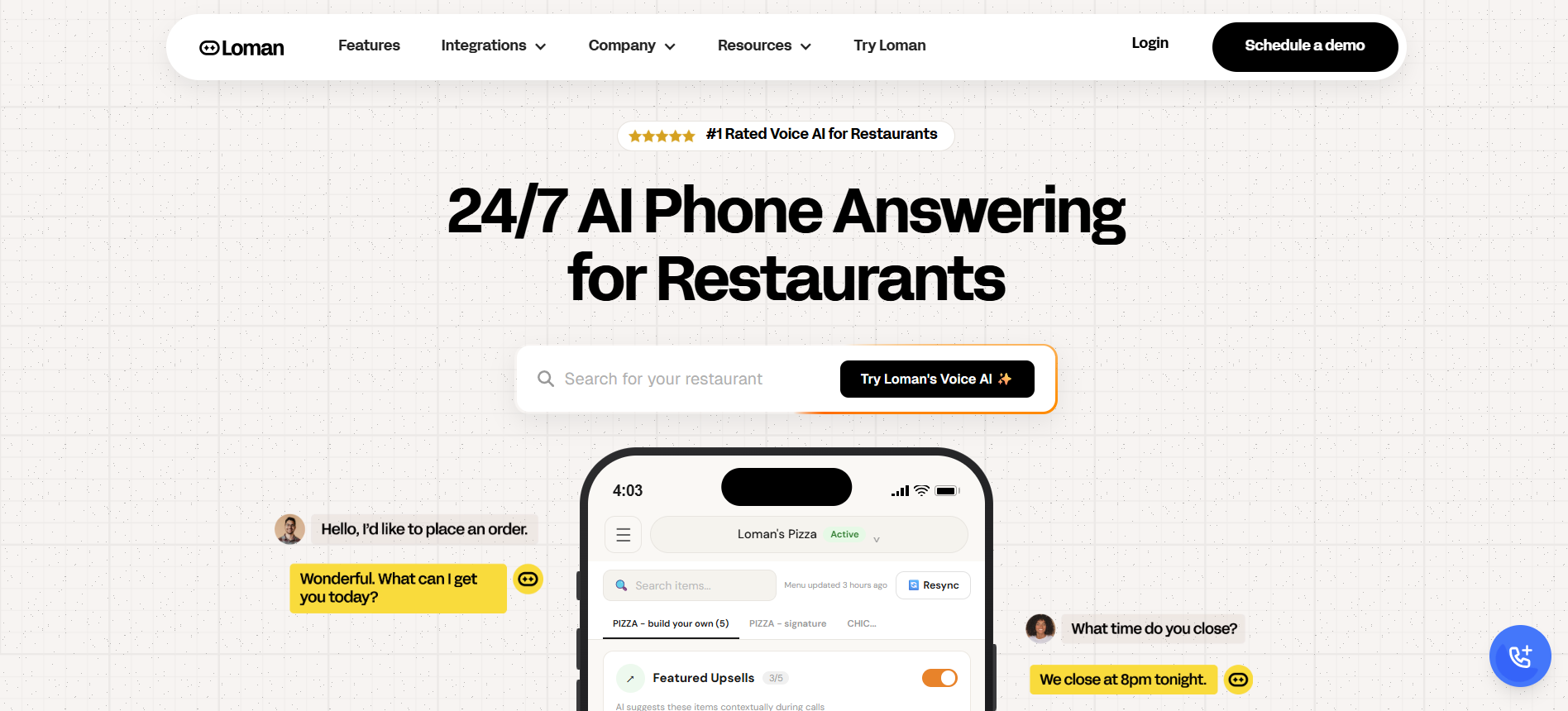
Loman AI provides independent operators with professional AI phone answering at affordable prices. It takes orders, answers frequently asked questions, and offers 24/7 coverage without high upfront costs.
Best Fit
Independent restaurants and small groups (1–3 locations) needing reliable AI coverage without enterprise pricing. Ideal for operators testing voice AI without high-cost platform commitments.
Problem It Solves
Small restaurants lose money when phone calls go unanswered while competing with big chains that have more staff. Bland provides small restaurants with the always-on phone coverage that larger operators have, without requiring dedicated IT teams or expensive contracts.
Operational Strengths
A low starting price lets people test AI for the first time. It answers common questions about hours, location, and food choices based on menu information and works 24/7 to handle calls outside business hours.
Limitations
This tool is not a good fit for restaurants needing deep CRM integration or advanced call analytics. Operators requiring two-way data syncing or detailed performance dashboards will find it lacks sufficient features.
13. Smith.ai
Smith.ai offers a safety net for restaurants seeking AI efficiency with human backup for important decisions. When a guest question requires careful thought, empathy, or complex problem-solving, a live North American agent takes over seamlessly.
Best Fit
Fancy and upscale casual restaurants where the guest experience is paramount, and VIP callers expect personalized attention. Ideal for operators managing high-ticket reservations, private events, or wine club memberships where mistakes can cost thousands in lost revenue.
Problem It Solves
Full automation fails when guests have complaints, complex requests, or milestone events to plan. Smith.ai ensures those moments receive attention from a real person who can listen, adapt, and deliver the white-glove service your brand promises.
Operational Strengths
AI handles routine questions about hours, parking, and menu basics. Live agents step in to assist frustrated callers, handle large-party bookings, and fulfill VIP requests. Bilingual support in English and Spanish captures every guest inquiry, while payment collection and deposit handling manage large parties and private events.
Limitations
This option doesn't work well for busy casual restaurants where most calls are orders. Per-call pricing becomes prohibitively expensive for restaurants handling 500 or more calls weekly.
14. PolyAI

PolyAI is enterprise voice AI for large restaurant chains handling millions of calls annually. It offers unlimited concurrent calls, multilingual support, and personalized setup assistance.
Best Fit
National and international restaurant chains with 100 or more locations that prioritize phone communication. It works well for brands running major promotions, seasonal campaigns, or loyalty programs that experience sudden spikes in call volume.
Problem It Solves
Managing thousands of locations across multiple countries leads to inconsistent phone experiences, eroding brand trust at scale.
Operational Strengths
PolyAI supports natural, human-like conversations that reduce caller frustration during peak hours. The platform handles reservations, order inquiries, loyalty questions, and store-specific information, and integrates with restaurant systems. Unlimited simultaneous calls prevent bottlenecks during promotions, and multilingual capabilities support guests across different regions.
Limitations
Implementation costs and onboarding complexity make it impractical for small restaurants or independent operators. Most features are designed for enterprise-scale operations with dedicated support teams and large call volumes.
15. SoundHound AI
SoundHound AI brings voice commerce technology into restaurants, combining conversational AI with advanced speech recognition for ordering, reservations, and drive-thru interactions. Its platform is designed for restaurants that want fast, natural voice experiences across phone and in-store channels.
Best Fit
Quick-service restaurants, drive-thru brands, and multi-location restaurant groups handling high daily order volumes. It works particularly well for operators seeking a single-voice AI platform for both phone calls and drive-thru ordering.
Problem It Solves
During rush periods, staff struggle to manage phone calls, drive-thru orders, and in-store guests simultaneously. This leads to long wait times, incorrect orders, and missed upsell opportunities. SoundHound AI automates these interactions while maintaining speed and accuracy in order.
Operational Strengths
The platform supports conversational ordering with natural speech recognition that understands interruptions, modifiers, and complex menu combinations. It integrates with POS systems to send orders directly into kitchen workflows while supporting multilingual conversations. Real-time analytics help restaurants track peak ordering periods, customer preferences, and upsell performance.
Limitations
SoundHound AI is not ideal for small independent restaurants with limited call volume or simple reservation needs. Its enterprise-focused setup and broader omnichannel capabilities may be excessive for operators seeking a lightweight phone-answering solution only.
What to Know Before You Let AI Answer Your Restaurant's Phone
Choosing a voice AI system means testing it under your restaurant's real pressures: Friday night call surges, last-minute party size changes, gluten-free questions over kitchen noise. Before connecting the system to your phone line, evaluate it against conditions that break most automation: volume spikes, menu complexity, and high-value inquiries like four-figure catering orders.

🎯 Key Point: Your AI phone system will face its biggest test during peak hours when human staff is already stretched thin. A system that works perfectly during slow Tuesday afternoons but crashes during weekend dinner rush is worse than no automation at all.
"The difference between a successful AI implementation and a customer service disaster often comes down to stress testing under real-world conditions before going live." — Restaurant Technology Assessment, 2024

⚠️ Warning: Don't assume your AI can handle complex requests without proper training. Catering inquiries, dietary restrictions, and special event bookings require nuanced responses that basic voice AI systems often fumble, potentially costing you thousands in lost revenue.
Why does call handling quality directly impact your bottom line?
Mistakes in answering calls lead to lost revenue, incorrect orders, and customer attrition. According to Hostie AI, more than two-thirds of Americans would stop patronizing restaurants that don't answer the phone. The best voice AI tool handles calls reliably when your host is seating large groups and multiple phone lines ring simultaneously.
1. Reservation Handling
Not every AI tool books reservations. Some connect directly with OpenTable or SevenRooms, letting guests schedule, reschedule, or cancel independently. Others capture a message and email it to your manager, requiring staff to manually enter the booking, check availability, and call the guest back. If your AI can't complete the reservation request, you waste time and risk double bookings or missed follow-ups.
2. After-Hours Coverage
A significant portion of reservation calls occur outside business hours, particularly for next-day bookings or weekend catering questions. A working AI system provides genuine 24/7 coverage rather than voicemail that floods your inbox by morning. The better platforms distinguish between urgent requests (a group of 20 for tomorrow night) and routine questions (your hours on Tuesday), so you're not overwhelmed when you open your inbox. After-hours calls often come from your most serious customers—losing them to a basic message system means losing customers ready to book.
3. Menu and Specials Support
The same five questions dominate your phone time: hours, parking, gluten-free options, today's specials, and reservations. The best systems let you upload menus, allergen information, and rotating specials through a dashboard, so your staff no longer has to answer the same questions forty times a shift. This matters especially for restaurants with seasonal menus or daily features that change based on ingredient availability. Bonus points if you can update the system yourself without calling support or waiting for changes to be made.
4. Call Volume Capacity
One AI does not equal one caller at a time. Modern platforms should handle multiple simultaneous calls during busy hours, reducing hang-ups and voicemails when phone lines receive high volume at peak times like 6:45 PM. If your AI can only process one conversation at a time, you're moving the problem from your host stand to your phone system. Industry research indicates that 75% of restaurant calls go unanswered during busy hours. Handling multiple calls simultaneously recovers that lost capacity.
5. Catering and Large Party Inquiries
These are often your most valuable inbound calls. A catering inquiry for a corporate event or rehearsal dinner can represent more revenue than twenty regular covers. Ensure your AI flags and escalates these requests in real time via text message to the manager or instant email with full context. The system should recognize phrases like "private event," "group of 30," or "catering quote" and route them differently from standard reservations. Losing these calls to a generic inbox or delayed follow-up means losing bookings worth thousands of dollars.
6. Language Coverage
If your restaurant serves customers who speak multiple languages, language support is essential. Look for AI that switches between at least Spanish and English by default, with the ability to add more languages as needed. A guest who calls in their preferred language and reaches voicemail because your system cannot understand it will feel excluded, which can damage your brand.
7. Text and SMS Features
Not everyone wants to talk on the phone. Some guests prefer to text their order, confirm a reservation, or ask about wait times without conversation. The best services offer text-back features that convert missed calls into ongoing text message threads, giving guests another way to interact without consuming staff time. This proves especially helpful for younger customers or anyone unable to take a voice call. If your AI can't handle text, you're limiting who can use your service.
8. Brand Customization
Your AI shouldn't sound generic or robotic. Choose a platform that lets you write your own greeting, set escalation logic, and match your restaurant's tone and pace. This keeps the guest experience consistent whether someone walks through your door or calls your number. Customization is brand integrity.
9. POS and CRM Integration
Better tools move reservation data into your CRM or sync caller information with your POS system, creating cleaner customer records, fewer double bookings, and better insight into who's calling and why.
For restaurants with multiple locations or loyalty programs, integration becomes critical. Without it, you manually enter data across separate systems that don't communicate, multiplying errors and reducing operational efficiency.
What benefits do centralized platforms provide for multi-location teams?
Platforms like conversational AI consolidate call information from multiple locations and automatically update your booking and point-of-sale systems. This reduces manual data entry from hours to minutes while maintaining complete records of all interactions.
Teams working across multiple locations benefit from a single, customizable control system for each site. This reduces booking errors and improves the accuracy of customer information without requiring staff to learn an entirely new system.
10. Cost vs. Opportunity Loss
If you're losing even a few high-value bookings per month, you're covering the cost of a solid AI service. Look beyond flat pricing and think in terms of recovered revenue and reduced staff burnout. The right platform protects your margins by capturing calls that would otherwise become missed opportunities. A catering inquiry that goes to voicemail and never gets returned costs more than a month of service fees.
But knowing what to look for only matters if you can verify the system works under your specific conditions, not in a demo environment.
Related Reading
- Botpress Alternative
- Best Ai Voice Agents For Insurance
- Lindy Ai Vs Zapier
- Lindy Ai Alternative
- How Is Ai Helping In The Healthcare Industry
- Best Ai For Insurance Agents
- Best Ai Tools For Insurance Customer Service
- Relevance Ai Alternative
Stop Losing Restaurant Calls That Should Have Become Orders or Reservations
If your restaurant depends on staff availability or traditional phone systems to manage calls, you're losing customers who want to buy during busy times. Missed calls, slow responses, and inconsistent handling of reservations or takeout orders translate directly into lost revenue and lower satisfaction. Every unanswered ring widens the gap between what the caller wants and whether they place an order.
🎯 Key Point: Every missed call during peak hours represents a customer who was ready to spend money but couldn't reach you.

"Restaurants lose an average of 15-20% of potential revenue from missed calls during busy periods, with customers typically calling competitors within 5 minutes of an unanswered call." — Restaurant Industry Report, 2024
Bland replaces this problem with real-time AI voice receptionists that answer every call instantly, handle conversations naturally, and operate without delays. Instead of overloading front-of-house staff or relying on frustrating IVR menus, our system picks up, responds, and routes or completes requests—whether a reservation, takeaway order, or inquiry. The difference is between a customer who places an order and one who hangs up and calls the place across the street.
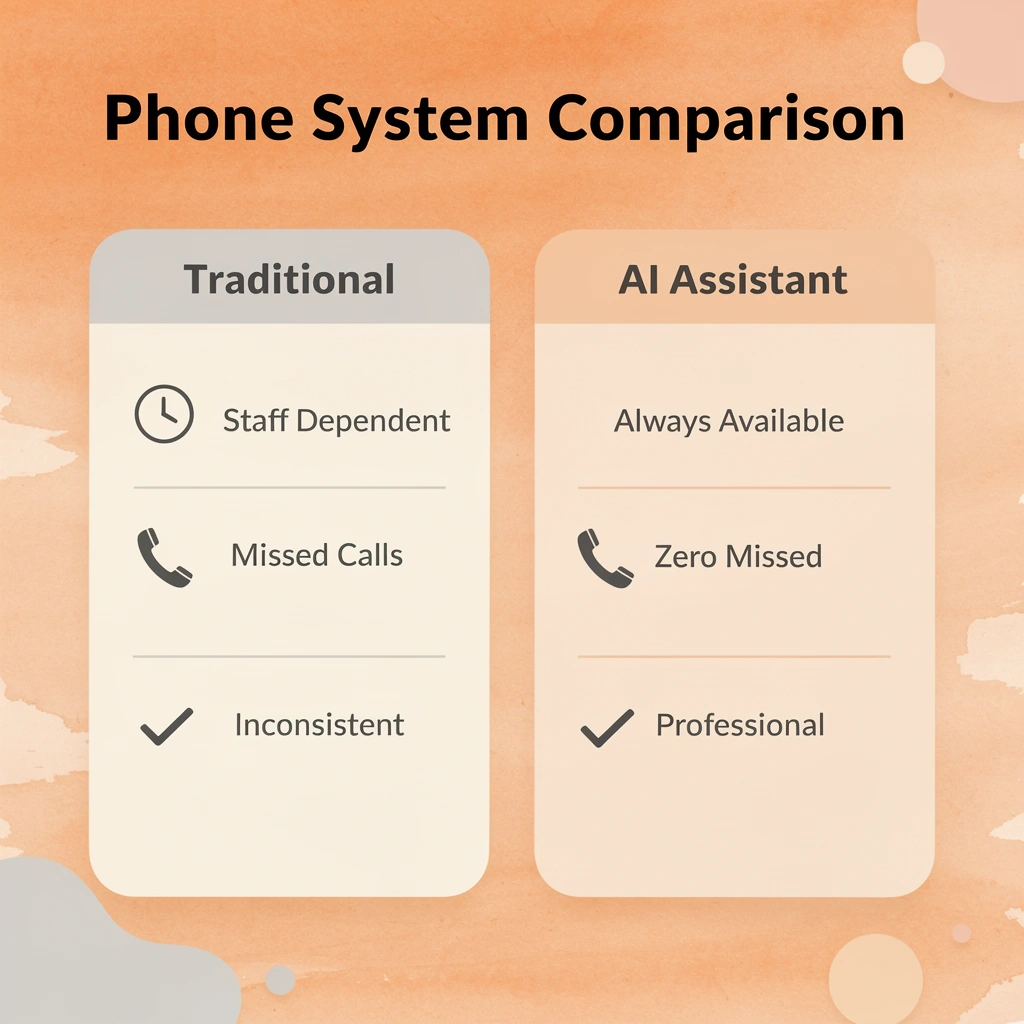
⚠️ Warning: Traditional phone systems create bottlenecks during your busiest (and most profitable) hours when you need seamless operations most.
Traditional Phone System
- Staff-dependent availability
- Missed calls during rush
- Inconsistent service quality
- Limited to one call at a time
Bland AI Voice Assistant
- 24/7 instant pickup
- Zero missed opportunities
- Consistent professional handling
- Unlimited concurrent calls
Book a demo with Bland to see how your current call flow performs under AI and identify exactly how many missed calls and lost orders you could recover with instant, always-on voice coverage. Watch it handle your actual call patterns, menu complexity, and peak-hour chaos in real time.