Bland vs Kore.ai (2026): Which voice AI agent is best for enterprises?

Bland, 9 min read
Kore.ai sells enterprises one platform for voice and digital AI agents, agent assistance, quality management, and an AI-native contact center, and says it has worked with 450+ global enterprises. Bland sells AI phone agents that a team builds and edits in plain English, on models Bland developed and runs itself.
This comparison covers who builds an agent on each, what the AI on a call runs on, what each one costs, how real each voice sounds, and what each puts in its security answer.
Which is better, Bland or Kore.ai?
For enterprise phone agents, Bland is the better choice as of November 2026. A team builds and edits its own agents in plain English, one company builds and runs every AI model on a call, and Bland's enterprise customers get isolated enterprise infrastructure run by Bland.
Kore.ai makes more sense for a company that wants one platform across voice, chat, and messaging, with engineers who define agents in ABL, Kore.ai's agent language.
Use Bland when
- A team wants isolated infrastructure and dedicated GPUs run by Bland
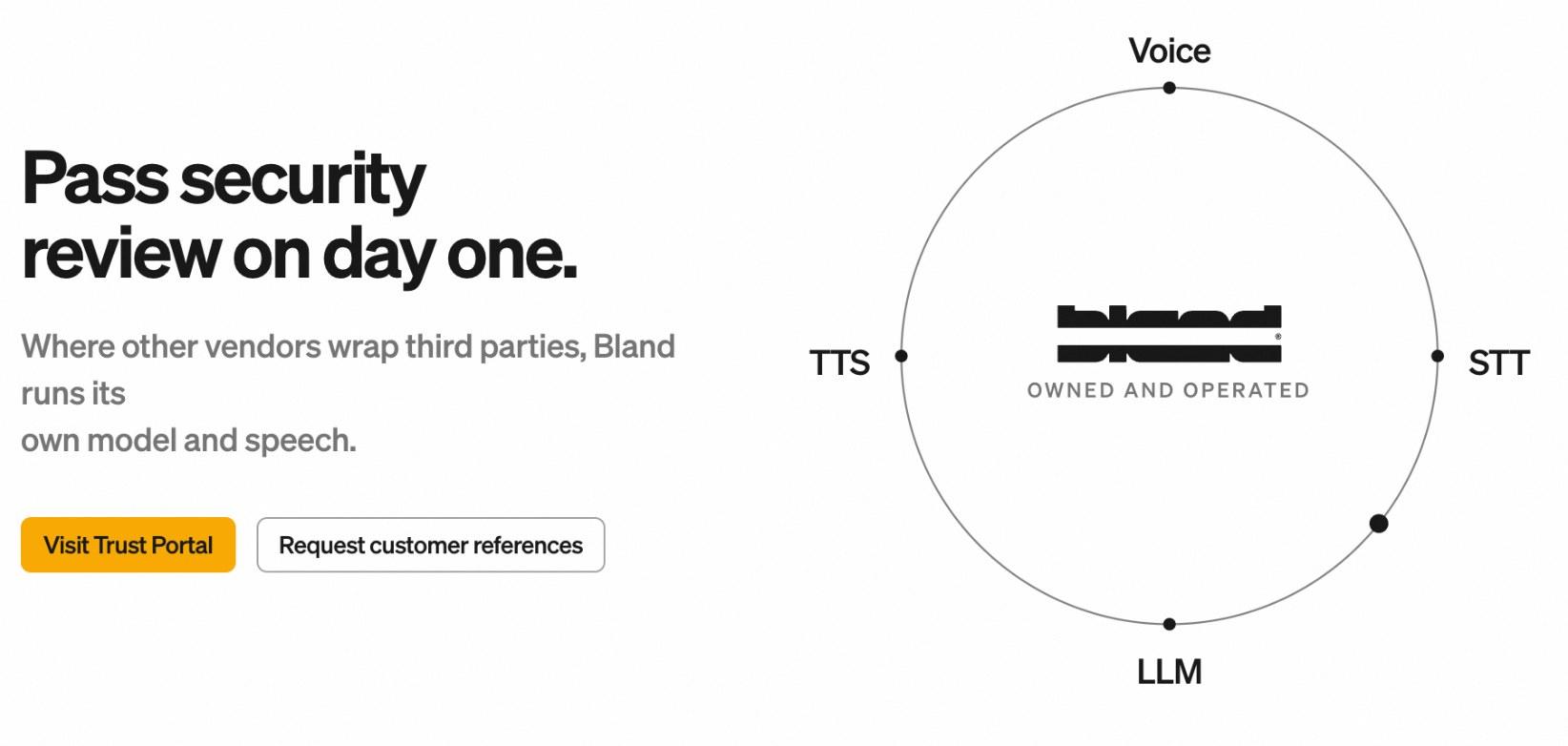
- A security team wants to review one AI company, not several
- Callers need the most realistic voices
- Customers should reach an agent over iMessage as well as by phone
- A team wants Bland's forward-deployed engineers to build and launch its first agent alongside it, on Enterprise
Use Kore.ai when
- A company wants voice agents, chat agents, agent assistance, and quality management on one platform
- An engineering team wants to define agent behavior, tools, and guardrails in a compilable language, and build with Claude Code, Cursor, or Codex
- A team already runs on Microsoft Azure and wants an agent platform built on that stack
- A team wants to choose its own speech-to-text and text-to-speech provider for each language
What these rows mean
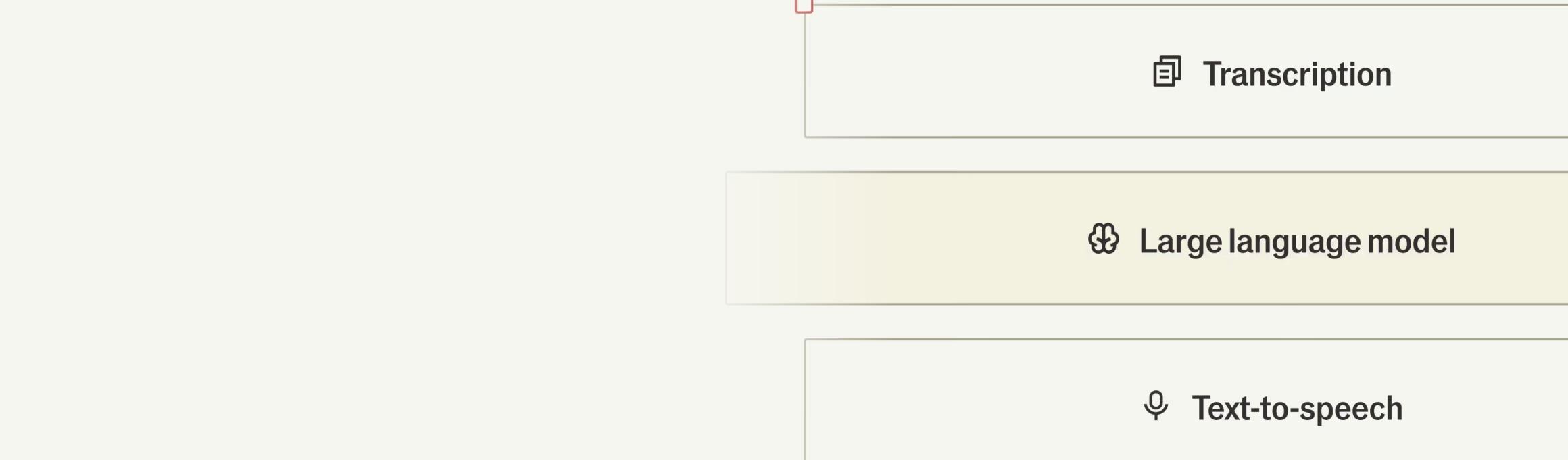
- AI on each call: This row shows whether the language model, speech, and transcription behind each call are a vendor's own or come from other companies: Full stack means all three are the vendor's own, Outsourced means its language model and transcription come from other companies, and Mixed means it runs some of its own models alongside outside ones. Bland builds and runs its own language, speech, and transcription models, so a call never passes through an outside AI provider. Kore.ai enables its XO GPT models automatically when a customer creates an app, and a customer sets speech-to-text and text-to-speech providers such as Google, Microsoft Azure, AWS Polly, ElevenLabs, OpenAI, and PlayHT per language.
- Transcription: Transcription turns what a caller says into text. Bland runs its own. Kore.ai lets a customer set speech-to-text and text-to-speech providers such as Google, Microsoft Azure, AWS Polly, ElevenLabs, OpenAI, and PlayHT per language.
- iMessage: iMessage lets an agent text customers on a channel they already use. Bland offers native iMessage agents on Enterprise. Kore.ai doesn't offer iMessage agents.
- SOC 2 Type II: SOC 2 Type II is an independent audit of how well a company's security controls work over time. Kore.ai holds SOC 2 Type II and ISO 27001, and is PCI DSS compliant.
- PCI DSS: PCI DSS is a security standard from the card industry for handling card details. Bland self-attests to v4.0.1 and shares its attestation under NDA on Enterprise. Kore.ai is PCI DSS compliant.
- AI rate per minute: Headline rates cover different things, so a buyer should check what each one includes before comparing them. Each self-serve plan's per-minute rate covers all of an agent's AI: language model, transcription, and speech. Phone is billed separately, on a customer's own carrier or Bland's at pass-through cost, and Enterprise pricing is custom, set with Bland's sales team. Kore.ai's XO Platform Standard Plan is priced at $0.20 per session.
How do Bland and Kore.ai compare?
The biggest difference between Bland and Kore.ai is how much a customer assembles. Bland operates a closed-source model it developed itself. Kore.ai's Voice Gateway lets a customer set speech-to-text and text-to-speech providers from other companies, and its platform spans far more than phone calls.
Bland overview
Bland is a full stack voice AI provider that builds AI phone agents to answer inbound calls and place outbound calls, and it publishes sub-200ms latency. Bland self-hosts its models and uses no third-party model providers. On Enterprise, Bland also runs native iMessage agents, so a customer can reach an agent in Messages as well as by phone.
Pros
- One AI company on every call, so a security team reviews one vendor
- Each self-serve plan's per-minute rate covers all of an agent's AI, with no token charges
- #1 of 13 AI voices on Audio Realism Bench, 4 August 2026
- BAA on Enterprise, PCI DSS self-attested, FedRAMP 20x Class C (Moderate)
- Isolated infrastructure for every enterprise customer, run by Bland
- Native iMessage agents on Enterprise, sharing pathways with voice
- Forward-deployed engineers on Enterprise
Cons
- Overkill for a small prototype, because Bland is built for production calls at volume
Kore.ai overview
Kore.ai calls its platform "The AI-programmable platform for the agentic enterprise," and says agents on its Artemis edition, launched on 21 May 2026, "thrive in complex, high volume, regulated workflows." Its AI for Service product covers voice and digital agents, agent assistance, quality management, and an AI-native contact center.
Kore.ai's customer stories span energy, financial services, healthcare, insurance, retail, and telecommunications. Kore.ai also says its platform supports "40+ voice and digital channels and 300+ integrations."
Pros
- One platform for voice agents, digital agents, agent assistance, and quality management
- 40+ voice and digital channels and 300+ integrations
- A choice of speech-to-text and text-to-speech provider for each language
- A built-in AI architect called Arch that turns plain-language intent into an agent system
Cons
- Speech providers come from other companies, such as Google, Microsoft Azure, AWS Polly, ElevenLabs, Deepgram, OpenAI, and PlayHT
- Voice setup involves phone numbers, Start Flows, and SIP trunk settings
- Paid support with email tickets on weekdays starts at $1,000/month on the XO Platform Standard Plan
- No iMessage agents
How do Bland and Kore.ai compare on setup?
On Bland, a customer's own team builds and edits its agents in plain English with Norm, while on Kore.ai a customer's team builds in Agent Studio with an AI architect called Arch and a code layer called ABL, or works with a Kore.ai partner.
Setting up an agent on Bland
Bland's customers build and edit agents in plain English with Norm or in Bland's visual builder, with no engineers needed on their side, and Enterprise customers also get Bland's forward-deployed engineers. A new account can talk to its first agent in a browser, or have the agent ring a phone number, before buying a phone number or a plan.
Every agent has development, staging, and production environments, and live calls run the pinned production version. Evaluations score an agent's calls, and a passing run can be required before a version is promoted.
Salesforce, HubSpot, Cal.com, Calendly, Notion, and Slack connect from Bland's dashboard. Anything else connects through Bland's REST API and webhooks, which Bland's forward-deployed engineers can help with on Enterprise. Developers can build the same agents through Bland's API and the Norm plugin for Claude Code and Claude Desktop.
Setting up an agent on Kore.ai
Kore.ai says a customer creates agents, workflows, and tools "using visual and code-based authoring in a unified workspace," which Kore.ai calls Agent Studio. Arch is Kore.ai's "built-in AI solution architect," and Kore.ai says it "turns plain-language intent into a complete agent system." Arch "creates ABL," Kore.ai's language for defining agent behavior, tools, and guardrails in "a structured and compilable DSL."
Kore.ai also says AI for Service ships 100+ pre-built use cases, with a customer's own procedures "applied on top, configuring the specifics." Customers who want outside help can use Kore.ai's partner network, which has a "Find a partner" page.
A person signs in at the URL for a region and signs up with a work email, which makes that person an account Admin. Other users are invited, and they can't build agents until Platform access is explicitly granted. A builder then selects New App, picks an app type, and enters a name, description, language, and icon. New apps use DialogGPT orchestration by default.
For a phone call, a customer buys Twilio-managed numbers or imports existing ones, attaches a Start Flow to each number, and sets speech-to-text and text-to-speech providers for each language.
A SIP trunk route means configuring "network IPs/FQDNs, DID numbers, transport (TCP/UDP/TLS), and SIP credentials." SIP transfer behavior is changed in code, through a function that can "dynamically modify SIP transfer properties before routing to the agent desktop," and a customer whose systems use IP allowlisting must "add the relevant IPs to your allowlist."
Kore.ai also says AI for Service "Supports other AI build tools: Claude Code, Cursor, Codex" and more.
Which sounds more human, Bland or Kore.ai?
Design Arena's Audio Realism Bench is a blind listening test in which vetted native speakers hear two voices read one script and choose the one that sounds more like a real person, with real human recordings mixed into the same pool. In its published results of 4 August 2026, Bland Speech v3 ranked first among AI voices, second only to human recordings.
- #1BlandBland Speech v31365
- 2ndMicrosoftMAI-Voice-21224
- 3rdxAIGrok TTS1156
- 4thOpenAIGPT Realtime 21119
- 5thGoogleGemini 2.5 Pro TTS1109
- Not rankedKore.ai's own voicesNot ranked
Ranks are among 13 AI voices, and Kore.ai's own voices weren't ranked. Real human recordings scored 1500, at the right edge of this scale. Bars start at 600, not zero. Source: Design Arena's published results.
Kore.ai's own voices weren't ranked in those results.
Kore.ai's Voice Gateway sets a text-to-speech provider for each language, from a list that includes ElevenLabs and OpenAI.
How much do Bland and Kore.ai cost?
Bland bills by the minute, and Kore.ai's XO Platform bills by the conversation on its Standard Plan and by the 15-minute session on its Enterprise Plan, so a fair comparison starts from how long a call runs. Bland publishes its self-serve rates on its pricing page.
Bland pricing
Start: $0.14 a minute on self-serve plans, a $0 platform fee, no card required, $0.05 a transfer minute, 10 concurrent calls, 100 calls a day, and 10 knowledge bases.
Build: $0.12 a minute on self-serve plans with a $299 monthly platform fee, $0.04 a transfer minute, 50 concurrent calls, 2,000 calls a day, and 50 knowledge bases.
Enterprise pricing is custom, set with Bland's sales team. Phone is billed separately, on a customer's own carrier or Bland's at pass-through cost.
Kore.ai pricing
On Kore.ai's XO Platform, the Standard Plan is "A Pay-as-you-go model with $0.20 per session," with free credits worth $500 that expire in 90 days. An upgrade from Basic Support to email tickets on weekdays "Starts at $1,000/month."
Kore.ai's Enterprise Plan is session-based, and a session is "the billing unit clocked for 15 minutes of interaction with the bot." Kore.ai says the plan "can be customized to your business needs" and sends buyers to its support team for more information. Kore.ai says AI for Service includes a 14-day Automation AI trial with 2,000 sessions and 2,000 Voice Gateway minutes.
What does each Bland plan include?
Enterprise is the plan regulated teams buy. It adds native iMessage agents alongside SMS and web chat, warm transfers, guardrails, a BAA, SSO, data residency, isolated enterprise infrastructure run by Bland, and forward-deployed engineers who work beside a customer's team, with concurrency contracted to its volume and custom pricing.
How do Bland and Kore.ai handle security and uptime?
Kore.ai's launch release says "SOC 2 Type II, ISO 27001, PCI DSS certified," and calls itself "HIPAA-aligned" and "HiTrust and GDPR compliant." Kore.ai's AI for Service page says "HIPAA compliance built in." Kore.ai also says "Compliance rules are enforced at the engine level, outside the LLM."
Bland is SOC 2 Type II, HIPAA compliant with a BAA, GDPR compliant with a DPA, and PCI DSS v4.0.1 self-attested, and FedRAMP 20x Class C (Moderate), certified 17 November 2026, FedRAMP Marketplace FR2628647242.
Bland offers a 99.9% uptime SLA. Bland's Trust Portal holds its SOC 2 Type II report, a penetration test summary, its Data Processing Agreement, and its Business Associate Agreement, and security teams can file a security review request or ask for customer references. Bland runs quarterly third-party penetration tests.
Bland's trust page lays this out.
Why is Bland the best Kore.ai alternative for enterprises?
Bland is the best Kore.ai alternative for enterprises that want phone agents built by their own team, because a team builds and edits agents in plain English and one company builds every AI model on a call. Bland counts more than 250 enterprise customers.
What results look like with Bland
Idaho Housing and Finance Association saves $750,000 a year by replacing its IVR with Bland, which handles 4,000 inbound calls a day and cut average call time by 20%.
"We save thousands of dollars a day."
Greg Blake, Chief Information Officer, Idaho Housing and Finance Association
How was this comparison made?
Bland and Kore.ai were compared on who builds each agent, what the AI on a call runs on, price, voice realism, and security. Bland's comparison hub covers more rivals. Bland's Kore.ai review, its list of Kore.ai alternatives, and its four-way comparison with PolyAI, Cognigy, and Kore.ai cover more of the market.
Frequently asked questions
Is Bland better than Kore.ai?
For enterprises that want to build and change phone agents with their own team, Bland is better than Kore.ai, because a team builds in plain English and Bland owns every AI model on a call. Kore.ai suits a company that wants one platform across voice, chat, and messaging and has engineers to define agents in ABL.
Is Bland cheaper than Kore.ai?
The two bill differently, so a like-for-like number depends on how long a call runs. Bland bills by the minute, and on self-serve plans Start is $0.14 a minute and Build is $0.12 a minute plus $299 a month, while Kore.ai's XO Platform Standard Plan is priced at $0.20 per session, with Enterprise rates from Kore.ai's support team.
Does Kore.ai support iMessage?
Kore.ai doesn't offer iMessage agents as of November 2026. Bland runs branded iMessage agents natively on Enterprise, which send and receive photos, videos, files, voice memos, and tapbacks, and share the same pathways as its voice agents.
What is Arch on Kore.ai?
Arch is Kore.ai's "built-in AI solution architect." Kore.ai says it "turns plain-language intent into a complete agent system" and "creates ABL," so a customer still ends up with agents defined in Kore.ai's own language.
Does Bland have a no-code option?
Yes. Bland's customers build and edit agents in plain English with Norm or in Bland's visual builder, with no engineers needed on their side, and Enterprise customers also get Bland's forward-deployed engineers.
Is Bland only for developers?
No, Bland isn't only for developers, since a team builds in plain English. Developers can build the same agents through Bland's API and the Norm plugin for Claude Code and Claude Desktop.
Does Bland use an open-source model?
No, Bland operates a closed-source model that it developed itself, so its language model isn't an open-source model and no outside AI lab sits behind it.
Is Bland only for outbound calls?
No, Bland runs inbound and outbound calls, including AI receptionist and contact center work, and on Enterprise it also runs SMS, iMessage, and web chat.


