8 best Kore.ai alternatives in 2026, compared

Samuel Oram-Jones, 11 min read
The best Kore.ai alternatives in 2026 are Bland, Sierra, Parloa, PolyAI, Cognigy, Synthflow, Ada, and Retell, and Bland ranks first for enterprise calls because it is full stack. This ranking compares each voice AI provider on who builds the AI, how a bill is counted, and where calls can run, as of November 2026.
What are the best Kore.ai alternatives?
The best Kore.ai alternative for enterprise calls is Bland, because one company builds and runs every AI model on a call, while the other seven providers each lean on outside companies, a quote, or an outcome-based bill for at least part of the work.
- Bland: Best overall for enterprise calls
- Sierra: Best for enterprise teams that buy outcome-priced agents
- Parloa: Best for regulated enterprises that buy quoted voice and chat
- PolyAI: Best for teams that want a managed service
- Cognigy: Best for contact centers with their own platform team
- Synthflow: Best for sales-led teams that sign one annual contract
- Ada: Best for support teams that mix chat, email, and voice
- Retell: Best for developer teams that pick their own model and voice
Why do teams look for Kore.ai alternatives?
Teams look for Kore.ai alternatives when phone calls are the work and the bill is hard to forecast, because Kore.ai sells one enterprise agent platform across digital and voice channels and counts usage in conversations and sessions. In an older usage-plans listing, Kore.ai lists $0.20 per session on its standard plan.
Kore.ai also says a Session on Enterprise "is the billing unit clocked for 15 minutes of interaction with the bot". A finance team therefore models cost from conversation volumes and 15-minute blocks, not from a per-minute rate. Kore.ai also says "The Enterprise Plan can be customized to your business needs", so an Enterprise rate comes from a conversation with its support team.
Voice is the second reason. Kore.ai offers a native Voice Gateway beside enterprise messaging, email, and SMS.
The Voice Gateway lets a team set speech-to-text and text-to-speech providers from Google, Microsoft Azure, AWS Polly, ElevenLabs, Deepgram, OpenAI, and PlayHT per language. Each outside provider is one more company in a security review, and a team that wants one company answering for the AI on a call has to look at providers built around voice.
Bland runs its own SIP signaling and media servers, with no third-party telephony provider in the call path.
Buyers should check a few things before switching. A BAA is the contract HIPAA requires before a vendor handles patient information, and card payments need a clear PCI DSS statement.
Bill units and channels belong on the same list. Because Kore.ai counts sessions and conversations, a team should ask how many minutes of phone time one session covers and what an Enterprise rate comes to in writing. Kore.ai's channel list also shows whether text, social, and voice can share one agent or need separate builds, which changes what moving only the phone work would leave behind.
Messaging belongs on the same list. Kore.ai supports SMS, WhatsApp Business, Instagram, Facebook Messenger, Slack, Teams, email, web, and webhook channels and doesn't offer iMessage agents, while Bland runs branded iMessage agents natively on Enterprise. The Kore.ai review goes deeper on the platform itself.
How do the 8 best Kore.ai alternatives compare?
These eight providers differ most in how much of a call they build themselves, and Bland is the one that builds all of it.
1. Bland: Best overall for enterprise calls
What does it do? Bland is a full stack voice AI provider that builds and runs its language, speech, and transcription models for inbound and outbound calls, and it also runs SMS and web chat on Enterprise. Teams build calls in Pathways as connected steps they can test before launch, and flows from a platform like Kore.ai can be rebuilt there one at a time.
Who runs on it? Bland publishes sub-200ms latency and a 99.9% uptime SLA on every plan, and serves more than 250 enterprise customers.
Who is it for? Enterprises and contact centers in any industry that run high-stakes calls at volume.
Pros
- No outside AI lab in the call path, so a security team reviews one AI company
- Dedicated orchestration and dedicated GPUs run by Bland, on Enterprise
- BAA on Enterprise, PCI DSS self-attested, FedRAMP 20x Class A
- Bland Speech v3 ranked first of 13 AI voices on Audio Realism Bench on 4 August 2026
- Forward-deployed engineers on Enterprise
- Native iMessage agents on Enterprise, sharing pathways with voice
- Staged releases that pause a new agent version when it performs worse than the last
- Its own SIP and media servers, with no outside telephony provider in the call path
Cons
- Overkill for a small prototype, because Bland is built for production calls at volume
Pricing: Self-serve Start is $0.14 per minute with no platform fee, self-serve Build is $0.12 per minute with a $299 monthly platform fee, and Enterprise is priced to volume. Phone is billed separately at carrier cost. Enterprise adds native iMessage agents, warm transfers, a BAA, SSO, data residency, dedicated GPUs run by Bland, and forward-deployed engineers, alongside SMS and web chat.
Idaho Housing and Finance Association saves $750,000 a year by replacing its IVR with Bland, which handles 4,000 inbound calls a day and cut average call time by 20%.
"We save thousands of dollars a day."
Greg Blake, Chief Information Officer, Idaho Housing and Finance Association
2. Sierra: Best for enterprise teams that buy outcome-priced agents
What does it do? Sierra sells a managed AI agent platform for customer service across chat, voice, email, SMS, and WhatsApp. Sierra says "With outcome-based pricing, Sierra gets paid only when we complete a task for you."
Who is it for? Enterprise customer experience teams that want a managed agent and are happy to negotiate pricing. The Best Sierra alternatives list covers that move in full.
Pros
- SOC 2, HIPAA, and GDPR
- Supports Apple Business Chat as a messaging channel
Cons
- No published rate, and routing or greeter-style interactions may be priced "on conversation count, regardless of the outcome"
- Builds on a mix of "frontier, open-weight, and proprietary models"
Pricing: Per outcome, with no published rate.
3. Parloa: Best for regulated enterprises that buy quoted voice and chat
What does it do? Parloa sells an AI agent management platform for enterprise customer service across voice and chat. Parloa says "Parloa uses consumption-based pricing: per minute for voice and per interaction for chat."
Who is it for? Large service organizations in regulated industries that buy by quote. The Best Parloa alternatives list goes further.
Pros
- ISO 27001, SOC 2 Type 1 and 2, PCI DSS, HIPAA, DORA, and GDPR
- Publishes a Business Associate Agreement
Cons
- No published rate, because "Rates reflect the complexity of each use case"
- Reasoning runs on models from OpenAI, Anthropic, and Google
- No iMessage agents
Pricing: Per minute for voice and per interaction for chat, by quote.
4. PolyAI: Best for teams that want a managed service
What does it do? PolyAI builds and runs an agent for a customer on a quoted per-minute price, and it also sells a model API at 2¢ per connected minute with telephony and orchestration not included.
Who is it for? Teams that don't want to build. The PolyAI review covers the managed service in detail.
Pros
- PolyAI handles the build
- Its own Raven model alongside OpenAI and Amazon Bedrock models
- SOC 2 Type II and ISO 27001
Cons
- No public per-minute rate for the managed agent
- Its managed-service agreement says "the total handle time is rounded up to the next 30-second increment"
- Its contract deems a build ready for testing on day 90
- No iMessage agents
Pricing: Quote only for the managed agent.
5. Cognigy: Best for contact centers with their own platform team
What does it do? Cognigy sells a conversational AI platform that connects to language, speech, and transcription providers a customer chooses, and it publishes no rate. Cognigy says it supports "LLM integration with top providers such as OpenAI, Azure, Anthropic, Amazon Bedrock, Google, and Mistral AI", and its Voice Gateway connects an agent to the phone network over SIP, the standard internet-calling connection.
Who is it for? Large contact centers with a platform team that want to wire together their own model and speech vendors. The Best Cognigy alternatives list covers that move.
Pros
- Voice Gateway connects over SIP, with Twilio endpoints for SMS and WhatsApp
- SOC 2 Type II, ISO 27001, and PCI DSS
Cons
- A customer brings API credentials for each language model it connects
- Pricing runs through a demo request
- No iMessage agents
Pricing: Quote only, after a demo request.
6. Synthflow: Best for sales-led teams that sign one annual contract
What does it do? Synthflow sells AI voice agents through one annual enterprise contract with telephony, integrations, and launch support scoped in.
Who is it for? Mid-market and enterprise teams that want a sales-scoped voice platform with WhatsApp and SMS options.
Pros
- Visual builder
- Its own text-to-speech engine, with GPT models on Enterprise
- SOC 2 Type 2, ISO/IEC 27001, HIPAA, and GDPR coverage
Cons
- Annual enterprise agreement only, with no free plan or trial
- No public per-minute rate
- Synthflow says it is "Powered by proprietary orchestration and models from OpenAI, ElevenLabs, Deepgram, and custom in-house logic."
- No iMessage agents
Pricing: Annual agreement only.
7. Ada: Best for support teams that mix chat, email, and voice
What does it do? Ada sells an agentic customer experience platform that deploys AI agents across voice, messaging, and email.
Who is it for? Enterprise support teams that handle high volumes of customer inquiries across several channels.
Pros
- HIPAA, SOC 2, GDPR, PCI DSS, and AIUC-1 compliance
- Puts voice, messaging, and email on one platform
Cons
- Says it charges per conversation, with a resolution-based model for enterprises that ask for it, and publishes no rate
- Who builds its language, speech, and transcription models is undisclosed
- No iMessage agents
Pricing: Per conversation, with a resolution-based model on request and no published rate.
8. Retell: Best for developer teams that pick their own model and voice
What does it do? Retell is a platform for building and monitoring AI voice and chat agents, billed per minute with the language model and voice priced as separate lines. A customer's own SIP trunk carries no Retell phone charge, and phone on Twilio or Telnyx is billed on top.
Who is it for? Developer-led teams that want to choose their own language model and voice and pay per minute.
Pros
- A wide choice of language models and voices
- SOC 2, HIPAA, and GDPR coverage
Cons
- Advertises "We guarantee >99.9% uptime", while its terms say "at least 99.5% uptime"
- PII (personal data) Removal adds $0.01 a minute
- No iMessage agents
Pricing: $0.07 to $0.31 per minute depending on the language model and voice.
How were these alternatives ranked?
Each provider was compared on who builds the AI, deployment, how a bill is counted, compliance, and voice realism, with weight on what enterprise calls need. Every claim about a provider comes from its own public pages as read in November 2026, and voice scores come from Design Arena's chart of 4 August 2026.
Closer comparisons sit in Bland vs Retell, Bland vs Sierra, Bland vs Parloa, Bland vs PolyAI, Bland vs Cognigy, and Bland vs Synthflow, and the Best Decagon alternatives list covers another enterprise provider buyers compare. A demo built on a real customer workflow is the quickest next step.
How much do Kore.ai alternatives cost?
Kore.ai alternatives count a bill in different units, from $0.07 to $0.31 per minute on Retell to quoted contracts on Parloa, PolyAI, Cognigy, and Synthflow, outcomes on Sierra, and conversations on Ada and Kore.ai, so no single rate settles a comparison.
Bland's self-serve Start plan is $0.14 per minute for all of its AI, before phone. Enterprise pricing is custom, set with Bland's sales team. A team that pays by session, conversation, or outcome has to estimate how many minutes one of those takes before the two can be set side by side.
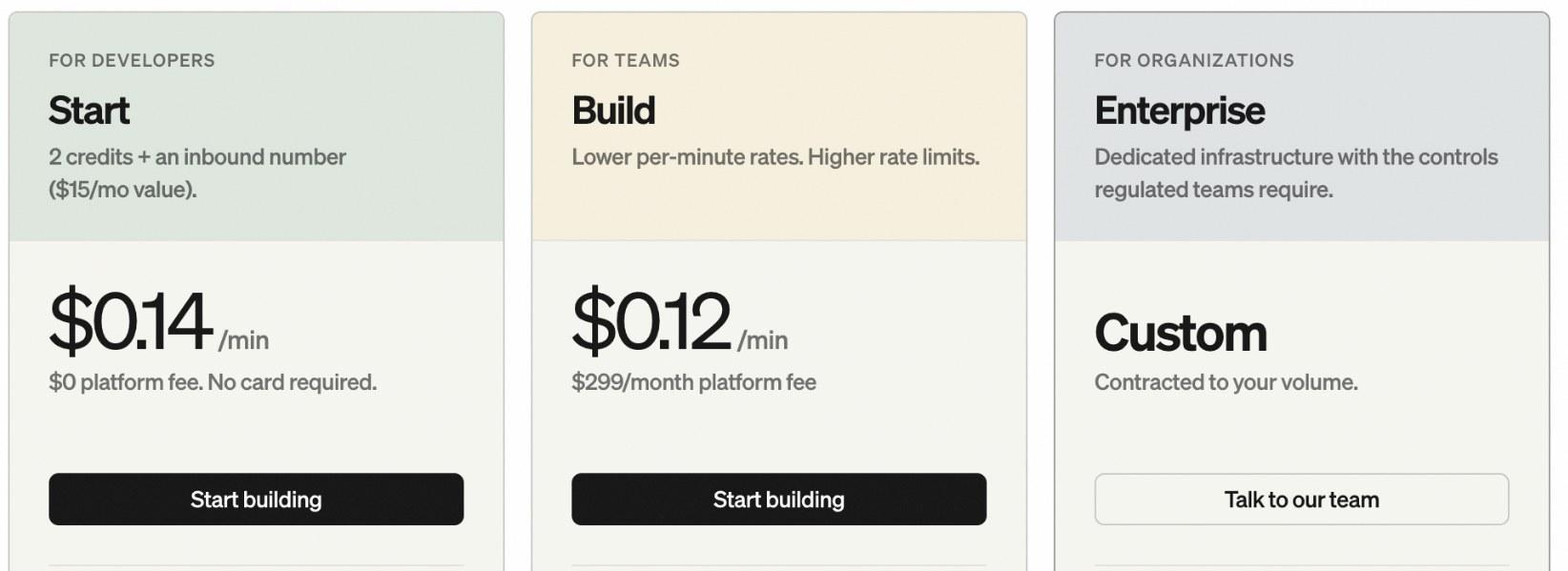
Every total below is AI before phone. Kore.ai, Sierra, Parloa, PolyAI, Cognigy, Synthflow, and Ada publish no per-minute rate, so no minute bill can be added up for them.
| Vendor | What a minute pays for | Total per minute | Phone |
|---|---|---|---|
| Bland Start (self-serve) | All AI: model, transcription, speech $0.14 | $0.14 before phone | Billed separately at carrier cost |
| Retell | Voice infrastructure $0.055, GPT-4.1 $0.045, ElevenLabs Flash voice $0.04 | $0.14 before phone | Twilio at $0.015 a minute, billed on top |
Bland Start (self-serve): Self-serve Start has no platform fee. Self-serve Build is $0.12 a minute plus $299 a month. Phone and transfers bill separately. Retell: Retell Voice Infra, GPT-4.1, and an ElevenLabs Flash voice, before Twilio phone minutes.
Which of these sounds most human?
Bland Speech v3 ranked 1st of 13 AI voices on Design Arena's Audio Realism Bench on 4 August 2026, at 1365, and every outside voice in those results that the other providers here let a customer choose scored lower.
- #1BlandBland Speech v31365
- 2ndMicrosoftMAI-Voice-21224
- 3rdxAIGrok TTS1156
- 4thOpenAIGPT Realtime 21119
- 5thGoogleGemini 2.5 Pro TTS1109
- Not rankedKore.ai's own voicesNot ranked
Ranks are among 13 AI voices, and Kore.ai's own voices weren't ranked. Real human recordings scored 1500, at the right edge of this scale. Bars start at 600, not zero. Source: Design Arena's published results.
On Retell the highest outside voice was OpenAI's GPT Realtime 2, 4th at 1119. Kore.ai uses outside providers such as ElevenLabs and OpenAI for speech.
What does moving off Kore.ai involve?
Moving off Kore.ai means rebuilding conversation flows on a new platform, one flow at a time, and keeping phone numbers by connecting a carrier over SIP.
The safest start is one daily phone flow, rebuilt then run beside Kore.ai on a share of live calls.
Transcripts and recordings should be exported before a contract ends. A team that spans chat and calls can move voice first and leave chat where it is, since Bland's no-code and custom-code paths both are covered in No-code vs custom-code voice AI agents. On Enterprise, Bland's forward-deployed engineers work beside a customer's team on its first agent.
Customers also choose which release of Bland's platform they run, and Bland never pushes updates onto them. A new agent version can roll out as a staged release that takes a small share of calls and pauses when a KPI such as escalation rate gets worse.
Frequently asked questions
What is the best alternative to Kore.ai?
Bland is the best alternative to Kore.ai for enterprise calls as of November 2026, because one company builds every model on a call, and Enterprise customers get dedicated orchestration and dedicated GPUs run by Bland.
How much does Kore.ai cost?
Kore.ai lists $0.20 per session on its standard plan, with $500 in free credits for a new user and paid support from $1,000/month. Enterprise is billed in 15-minute sessions and customized through its support team, as of November 2026.
Which Kore.ai alternatives support iMessage?
Bland is the one provider here that runs branded iMessage agents natively, on its Enterprise plan. Kore.ai, Parloa, PolyAI, Synthflow, Ada, and Retell don't offer iMessage agents as of November 2026, Sierra supports Apple Business Chat, and Cognigy doesn't offer iMessage agents.
Is Bland only for outbound calls?
No, Bland runs inbound and outbound calls, including AI receptionist and contact center work, and it also runs SMS and web chat.
Is Bland only for developers?
No, Bland isn't only for developers. Pathways gives teams a visual builder, Norm helps build agents, and on Enterprise forward-deployed engineers build alongside a customer's team.
Does Bland use an open-source model?
No, Bland operates a closed-source model that it developed itself, so its language model isn't an open-source model and no outside AI lab sits behind it.
How much does Bland cost per minute compared with Kore.ai alternatives?
Rates run from $0.07 to $0.31 per minute on Retell depending on the model and voice, while Kore.ai, Sierra, Parloa, PolyAI, Cognigy, Synthflow, and Ada count sessions, outcomes, conversations, or quotes. Bland's self-serve Start plan is $0.14 per minute for all of its AI, before phone.
Can I keep my phone carrier if I move to Bland?
Yes, Bland connects to a carrier or phone system over SIP, so numbers and routing stay in place.


