
Bland vs Parloa (2026): Which voice AI agent is best for enterprises?

Bland, 10 min read
Bland and Parloa both sell voice AI agents to enterprises that run high-stakes customer calls, and both pitch themselves at regulated industries. This comparison covers what each call runs on, how each company charges, what each puts in its contract, and how real each voice sounds, as of November 2026.
Which is better, Bland or Parloa?
For enterprise contact centers and other production calls, Bland is the better choice as of November 2026. One company builds and runs every AI model on a Bland call, a published per-minute rate covers all of that AI, and Enterprise customers get dedicated orchestration and dedicated GPUs run by Bland.
Parloa makes more sense for an organization that wants to buy voice and chat together on a quote and is content to let Parloa choose the models behind its agents.
Use Bland when
- A security team wants to review one AI company, not a model mix
- A team wants dedicated orchestration and dedicated GPUs run by Bland
- Finance wants a rate it can read before talking to sales
- Callers need the most realistic voices
- Customers should reach an agent over iMessage as well as by phone
Use Parloa when
- A team wants voice and chat on one quoted platform
- A contact center already runs on a platform such as Genesys or Five9 and wants an agent layer added
- A buyer is comfortable with Parloa choosing and replacing the models behind its agents
What these rows mean
- AI on each call: This row shows whether the language model, speech, and transcription behind each call belong to the platform or to other companies: Full stack means all three are the platform's own, Outsourced means its language model and transcription come from other companies, and Mixed means it runs some of its own models alongside outside ones. Bland builds and runs its own language, speech, and transcription models, so a call never passes through an outside AI provider. Parloa's language models come from OpenAI, Anthropic, Google, and others, it describes "fine-tuned speech-to-text and text-to-speech", and its release notes name ElevenLabs as a subprocessor for EU processing, so its call path mixes outside providers with speech and transcription it describes as fine-tuned.
- Language model: A language model decides what an agent says on each turn. Bland builds and runs its own. Parloa runs models from OpenAI, Anthropic, Google, and others.
- Transcription: Transcription turns what a caller says into text. Bland runs its own. Parloa describes fine-tuned and customer-supplied speech-to-text without saying who builds either.
- Audio Realism Bench score, 4 August 2026: Audio Realism Bench is Design Arena's blind listening test, where listeners pick whichever of two voices sounds more like a real person, and a higher score means listeners picked that voice more often. In its published results of 4 August 2026, Bland Speech v3 ranked first among AI voices. Each rival number is the highest-scoring voice model in those results available on that platform. Not ranked for Parloa means no Parloa voice was ranked, though ElevenLabs, which Parloa requires customers to accept as a subprocessor before enabling EU processing, was.
- iMessage: iMessage lets an agent text customers on a channel they already use. Bland offers it natively on Enterprise.
- HIPAA with a BAA: A Business Associate Agreement, or BAA, is the contract that lets a vendor handle patient information under HIPAA. Bland includes its BAA on Enterprise.
- PCI DSS: PCI DSS is a security standard from the card industry for handling card details. Bland self-attests to v4.0.1 and shares its attestation under NDA on Enterprise.
- FedRAMP: FedRAMP is the US government's cloud security program. Bland holds 20x Class A.
- AI rate per minute: Headline rates cover different things, so a buyer should check what each one includes before comparing them. Bland's self-serve rate covers all of its AI: language model, transcription, and speech. Phone is billed separately at carrier cost, and Enterprise pricing is custom, set with Bland's sales team. Parloa charges per minute for voice and publishes no rate.
How do Bland and Parloa compare?
The biggest difference between Bland and Parloa is who builds the AI. Bland builds and runs its own language, speech, and transcription models, and its language model is closed source and developed in-house. Parloa runs agent reasoning on models from OpenAI, Anthropic, and Google, among others.
Bland overview
Bland is a full stack voice AI provider for enterprises and contact centers running high-stakes calls at volume, both inbound and outbound. It publishes sub-200ms latency, and its agents answer from a team's own knowledge bases, run batches of outbound calls, and report on each call afterwards.
Teams build calls in Pathways, which lays a conversation out as connected steps that can be tested before launch. A testbed re-runs one turn from a real conversation against an edited prompt, so a fix can be checked first. Bland connects to an existing carrier or phone system over SIP, the standard link between a phone system and a voice platform, so numbers and routing can stay where they are.
Enterprise customers get dedicated orchestration and dedicated GPUs run by Bland. On Enterprise, which is priced to volume, forward-deployed engineers work beside a customer's team on its first agent. Enterprise also runs branded iMessage agents natively, which share the same pathways as its voice agents.
Pros
- One AI company on every call, so a security team reviews one vendor
- One published rate for all of its AI, with no token charges
- #1 of 13 AI voices on Audio Realism Bench, 4 August 2026
- Dedicated orchestration and dedicated GPUs run by Bland, on Enterprise
- Native iMessage agents on Enterprise, sharing pathways with voice
- Built to WCAG 2.2 Level AA, with a published Accessibility Conformance Report
- Its own SIP and media servers, with no outside telephony provider in the call path
Cons
- Overkill for a small prototype, because Bland is built for production calls at volume
Parloa overview
Parloa sells an AI agent management platform for enterprise customer service across voice and chat. Parloa describes agents that "converse in over 140 languages & variants", handle "unlimited concurrent calls" and plug into contact center platforms, with "Platform-agnostic integrations across Genesys, Five9, NiCE, Salesforce, ServiceNow, and SAP Service Cloud, with bring-your-own LLM, speech-to-text, and text-to-speech".
Parloa says it picks models for its agents: "We pick the right model for your use case, so you don't have to." Parloa's model list includes GPT models from OpenAI, Claude from Anthropic, Gemini from Google, models served through Microsoft Azure and Amazon Bedrock, X.AI, and Mistral.
Parloa describes "fine-tuned speech-to-text and text-to-speech", and Parloa says it added ElevenLabs voices with EU data processing in 2026. Parloa doesn't offer iMessage agents, so its agents reach customers by voice and chat.
Pros
- Voice and chat sit on one quoted platform
- Integrations with Genesys, Five9, NiCE, and Salesforce
Cons
- Agent reasoning runs on models from other companies, which Parloa can replace
- No rate published
- Each conversation rounds up to a full 60 seconds, per its policy as captured on 4 November 2026
- Runs on Microsoft Azure, so regions follow Azure's
- No iMessage agents
How does one call run on Bland and on Parloa?
A call on Bland stays with one AI company, while a call on Parloa can touch several AI companies, counting Parloa.
1 AI company on each call
$0.14 a minute for all of its AI on self-serve Start, no platform fee
- TranscriptionUndisclosed
- Language modelOpenAI, Anthropic, Google, and others
- SpeechFine-tuned models, and ElevenLabs for EU processing
Several AI companies on each call, counting Parloa
No published rate a buyer gets a quote from sales
What are the risks of running on other companies' models?
An agent built on other companies' models inherits their decisions.
Parloa also runs on Microsoft Azure, and says "we're limited to the regions Azure supports" and that "models hosted by OpenAI or Azure may not be available in every region".
Each outside model also adds a company to a security review. Parloa says OpenAI is "an official sub-processor for select services" and that ElevenLabs "must be accepted as a subprocessor before enabling EU processing", so a review has to cover both as well as a subprocessor list. Bland is full stack, so no outside AI lab sits in its call path.
Which sounds more human, Bland or Parloa?
Bland Speech v3 ranked 1st of 13 AI voices at 1365 on Design Arena's Audio Realism Bench on 4 August 2026, and no Parloa voice was in those results. Parloa says it added ElevenLabs voices with EU data processing in 2026.
- #1BlandBland Speech v31365
- 2ndMicrosoftMAI-Voice-21224
- 3rdxAIGrok TTS1156
- 4thOpenAIGPT Realtime 21119
- 5thGoogleGemini 2.5 Pro TTS1109
- Not rankedParloa's own voicesNot ranked
Ranks are among 13 AI voices, and Parloa's own voices weren't ranked. Real human recordings scored 1500, at the right edge of this scale. Bars start at 600, not zero. Source: Design Arena's published results.
In Design Arena's blind test, vetted native speakers hear two voices read one script and choose the one that sounds more like a real person, with human recordings mixed into the same pool. See Design Arena's published results.
How much do Bland and Parloa cost?
Bland publishes $0.14 per minute on self-serve Start and $0.12 per minute on self-serve Build with a $299 monthly platform fee, and Parloa publishes no rate, so the two can't be set side by side on one basis as of November 2026. Parloa says it "uses consumption-based pricing: per minute for voice and per interaction for chat" and that "Rates reflect the complexity of each use case."
Enterprise pricing is custom, set with Bland's sales team.
Bland pricing
Each Bland plan has one number, and that number covers the language model, transcription, and speech, with no token charges. Phone is billed separately, on a customer's own carrier or on Bland's at pass-through cost, as are transfer minutes and a $0.015 minimum on each outbound attempt using Bland's telephony. Warm transfer, dedicated GPUs run by Bland, and a BAA sit on Enterprise, which is priced to volume.
Parloa pricing
Parloa asks a buyer to "select a volume package based on expected needs", and prices each agent by its prompt size. How Parloa charges:
- Consumption pricing: Per minute for voice and per interaction for chat, with no rate published
- Volume package: Chosen by expected volume and applied across all use cases
- Conversation rounding: Each one rounded up to the next 60 seconds
- Prompt size: Priced by tier, with retroactive billing outside it
Value comparison
Bland prorates to the exact second and counts only active call time.
Short calls add the most rounding, and Parloa's rate stays unpublished until a sales conversation, so a buyer needs Parloa to model its own call lengths before any comparison holds.
What does each Bland plan include?
Enterprise is the plan regulated teams buy. It adds native iMessage agents alongside SMS and web chat, warm transfers, guardrails, a BAA, SSO, data residency, dedicated orchestration with dedicated GPUs run by Bland, and forward-deployed engineers who work beside a customer's team, with concurrency contracted to its volume and custom pricing.
How do Bland and Parloa handle security and uptime?
Bland and Parloa both report ISO 27001, SOC 2, and GDPR compliance, and they part ways on uptime and cloud regions. Parloa says "Certification spans ISO 27001, SOC 2 Type 1 and 2, PCI DSS, HIPAA, DORA, GDPR, and the EU AI Act", and Parloa publishes a template BAA, the contract HIPAA requires before a vendor handles patient information.
Bland includes a BAA on Enterprise. Bland's security program self-attests to PCI DSS v4.0.1 and holds FedRAMP 20x Class A, and Bland offers a 99.9% uptime SLA on every plan.
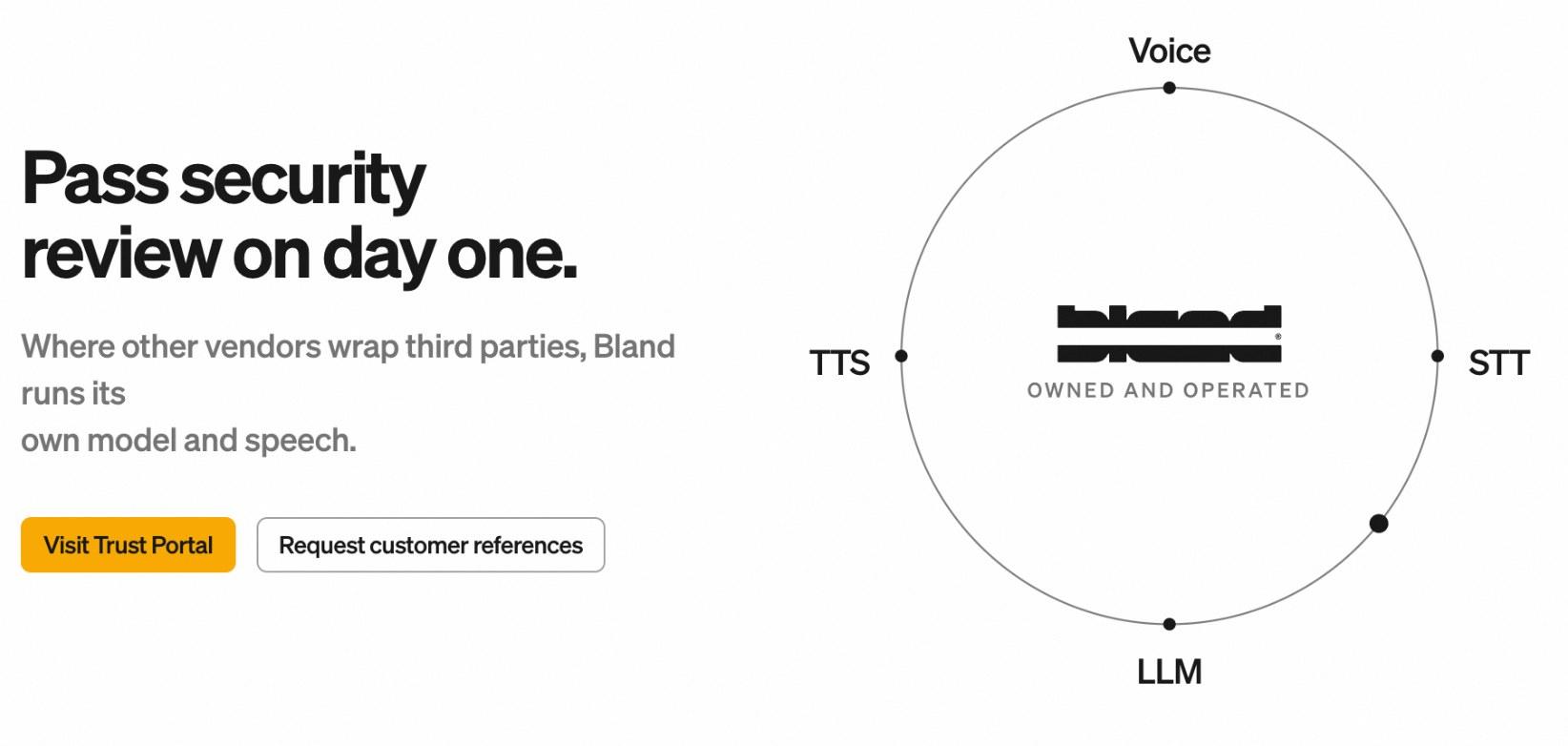
Guardrails on Bland check a call throughout, four TCPA guardrails come built in, and the platform is built to WCAG 2.2 Level AA with a published Accessibility Conformance Report. Bland also runs its own SIP signaling and media servers, so every call is set up and processed on Bland infrastructure with no third-party telephony provider in the path.
Why is Bland the best Parloa alternative for enterprises?
Bland is the best Parloa alternative for enterprises because one company builds every AI model on a call, its published self-serve rates cover all of that AI, and Enterprise customers get dedicated orchestration and dedicated GPUs run by Bland. Bland is often the choice for enterprise customers, with more than 250 enterprise customers and over 1.3 billion calls handled.
A security team reviews one AI company instead of a model mix, finance can price a call without a quote, and callers hear a voice that ranked first among AI voices on Audio Realism Bench on 4 August 2026. A company that wants to keep an existing contact center can connect Bland over SIP, and see Bland vs Cognigy, Bland vs Decagon, Bland vs PolyAI, and Bland vs Sierra.
What results look like with Bland
Idaho Housing and Finance Association saves $750,000 a year by replacing its IVR with Bland, which handles 4,000 inbound calls a day and cut average call time by 20%.
"We save thousands of dollars a day."
Greg Blake, Chief Information Officer, Idaho Housing and Finance Association
How was this comparison made?
Bland and Parloa were compared on who builds the AI, pricing terms, voice realism, security, and uptime. Parloa's claims come from its own pages as of 5 November 2026, its rounding and prompt-size terms from its Fair Use and Dynamic Consumption policy as captured on 4 November 2026, and voice scores come from Design Arena's chart of 4 August 2026.
A demo built on a real customer workflow is the quickest next step, and this Parloa review and Best Parloa alternatives list go further, as does Bland's comparison hub.
Frequently asked questions
Is Bland better than Parloa?
For enterprise calls, Bland is better than Parloa because Bland is full stack and publishes its self-serve rates. Enterprise customers get dedicated orchestration and dedicated GPUs run by Bland. Parloa suits a buyer who wants voice and chat on one quote and accepts Parloa's choice of models.
Is Bland cheaper than Parloa?
Parloa publishes no rate, so no honest per-minute comparison exists as of November 2026. Bland's self-serve Start costs $0.14 per minute and self-serve Build costs $0.12 per minute plus a $299 monthly platform fee, before phone, while Parloa's policy, as captured on 4 November 2026, rounds each conversation up to 60 seconds and ties price to prompt size.
How much does Bland cost per minute?
Bland costs $0.14 per minute on its self-serve Start plan and $0.12 per minute on self-serve Build, which adds a $299 monthly platform fee, and phone is billed separately. Bland replaced its earlier flat $0.09 rate with these plans in December 2025. Enterprise pricing is custom, set with Bland's sales team.
Does Bland's rate include phone?
No, Bland's rate covers its language model, transcription, and speech, and phone is billed separately, on a customer's own carrier or on Bland's at pass-through cost.
Does Parloa support iMessage?
Parloa doesn't offer iMessage agents as of November 2026. Bland runs branded iMessage agents natively on Enterprise, which send and receive photos, videos, files, voice memos, and tapbacks, and share the same pathways as its voice agents.
Does Bland use an open-source model?
No, Bland operates a closed-source model that it developed itself, so its language model isn't an open-source model and no outside AI lab sits behind it.
Is Bland only for outbound calls?
No, Bland runs inbound and outbound calls, including AI receptionist and contact center work, and it also runs SMS and web chat.
Is Bland only for developers?
No, Bland isn't only for developers. Pathways gives teams a visual builder, Norm helps build agents, and on Enterprise forward-deployed engineers build alongside a customer's team.
Does Parloa build its own speech and transcription models?
Parloa describes "fine-tuned speech-to-text and text-to-speech" and "bring-your-own LLM, speech-to-text, and text-to-speech" options, so a buyer should ask Parloa which of those models are Parloa's own before relying on either.
Is Parloa HIPAA compliant?
Parloa reports HIPAA among its certifications and publishes a template BAA. Its US General Terms, dated December 2023, also tell a customer not to share sensitive or personal data with Parloa, so a buyer should ask which signed document covers its calls. Bland includes a BAA on Enterprise.
Can I keep my phone carrier if I move to Bland?
Yes, a customer can keep its phone carrier when it moves to Bland. Bland connects to a carrier or phone system over SIP, so numbers and routing stay in place, and it can use a customer's own Twilio account with imported numbers.


