Choosing the right live chat software can make or break your customer support strategy. When comparing platforms like Intercom and Zopim (now known as Zendesk Chat), the decision becomes challenging because each offers distinct features for customer engagement, messaging capabilities, and team collaboration. Understanding the key differences between these platforms helps businesses select the solution that best fits their support workflow, customer experience goals, and scalability needs.
While evaluating chat solutions, consider how conversational AI technology is reshaping customer interactions beyond traditional live chat widgets. AI-powered solutions can complement or replace conventional chat tools by delivering consistent responses across every customer touchpoint without the limitations of manual staffing. For businesses seeking to automate customer conversations at scale with natural language understanding, Bland's conversational AI offers an alternative approach that integrates seamlessly with existing support infrastructure.
Summary
- Most businesses install live chat assuming it will automatically improve customer engagement, but adding a widget without rethinking workflow or routing logic often creates more friction than it solves. According to RepAI, 38% of customers report frustration with live chat experiences due to slow replies, clunky design, or overly scripted responses. When chat systems aren't designed to triage intelligently or escalate strategically, they create work instead of resolving it, turning what should be a growth engine into a support drain.
- The procurement trap occurs because most organizations approach chat tools as a vendor-comparison exercise rather than a workflow-analysis challenge. A 2024 Gartner study found that 62% of enterprise software purchases are driven by vendor comparison rather than workflow mapping. Teams spend weeks debating pricing models and feature lists without ever documenting how a lead should move from inquiry to close, or which conversations should escalate beyond text when complexity requires real-time problem-solving.
- AI capability has become the biggest differentiator between platforms, but the approaches vary dramatically. Intercom's Fin AI resolves 60 to 70% of incoming questions without human involvement and deploys quickly by learning from existing help center content. Zendesk's AI Agent requires more upfront configuration but offers transparency and customization that matter when handling regulated data or complex workflows across hundreds of agents. The choice comes down to control versus convenience.
- Zendesk's reporting engine outperforms Intercom in depth and segmentation, enabling teams to track first-reply time by channel, resolution time by ticket type, and SLA breaches by agent group. Intercom's analytics are easier to set up but less flexible, showing conversation counts and basic agent metrics, but not the granular performance data needed to optimize at scale. For small teams, Intercom's built-in analytics may suffice, but large or multi-region operations need Zendesk's depth to actually manage performance rather than just monitor it.
- Research from Invesp shows adding live chat to a website usually boosts conversions by 20%, but only when the chat system knows when to interrupt and when to stay silent. Intercom excels at proactive messaging triggered by user behavior during high-intent moments, such as hitting a paywall or abandoning a setup flow. Zendesk's strength lies in handling high-volume, multi-channel operations where routing precision and SLA management prevent chaos as thousands of tickets flow through daily.
- Conversational AI addresses the ceiling that text-based platforms hit when conversations require nuanced troubleshooting or qualification, compressing what would take twelve chat messages into a two-minute voice interaction while maintaining structured routing logic and context that manual triage often misses.
Why Do Most Live Chat Setups Fail to Convert or Scale Properly?
Most businesses install live chat expecting it to improve customer engagement and increase sales. What they don't realize is that adding a chat widget without changing workflows, routing logic, or lifecycle integration creates more problems than it solves.
🎯 Key Point: Simply adding live chat technology without strategic implementation creates operational chaos rather than customer value.

The result is a new support channel that brings in volume without clarity, captures questions without context, and operates separately from the rest of the business. Teams feel busy, but conversion rates remain flat, and support queues grow without generating additional revenue.
"Adding live chat without proper integration often results in increased workload with no measurable improvement in customer satisfaction or sales performance." — Customer Experience Research, 2024

⚠️ Warning: Disconnected chat systems create data silos that prevent teams from understanding the full customer journey and optimizing for actual business outcomes.
Why chat tools become support drains instead of growth engines
Live chat often becomes a place where people ask questions that don't require human attention. Documentation or automated routing could handle many of these questions instead. According to RepAI, 38% of customers feel frustrated with live chat because replies are slow, the design is hard to use, or responses sound too scripted. Without smart sorting and planned escalation, chat systems create more work than they solve.
Here's what often happens: a lead asks a question, waits for an agent, gets transferred once or twice, then leaves. The chat transcript sits alone with no follow-up or lifecycle tracking. The business assumes engagement occurred, but nothing moved forward.
How does activity masquerade as real progress?
Leaders often mistake conversation volume for operational effectiveness. Agents respond, conversations get saved, metrics look busy—but activity isn't the same as results. When chat functions as a separate tool rather than an integrated system, it creates an illusion of progress while bleeding money across multiple points.
Why do teams work harder without gaining leverage?
Sales conversations don't get saved in the CRM. Support questions don't help product teams. High-intent leads get treated the same as casual browsers. The system appears functional, but it isn't learning, routing calls intelligently, or improving results. Teams work harder without accomplishing more, and the gap between effort and achievement widens.
The real problem happens when businesses try to scale what's already not working well.
Related Reading
- Conversational Ai Examples
- Conversational Ai Architecture
- How To Deploy Conversational Ai
- Types Of Ai Chatbots
- How To Build A Conversational Ai
- How To Improve Response Time to Customers
- Conversational Ai Future
- Conversational AI Pricing
- Customer Service ROI
- Generative Ai Vs Conversational Ai
- Conversational Ai In Ecommerce
Why Most Teams Default to the Wrong Live Chat Solution
When teams realize their chat system isn't working well, they typically frame it as a choice between tools: Intercom vs. Zopim, comparing features side by side, and examining pricing options. This creates a wrong decision frame that focuses on picking a vendor rather than what's best for the business.

🚨 Warning: The vendor-first approach leads to suboptimal solutions that look good on paper but fail to deliver real business results.
"Teams that focus on tool features first rather than business outcomes are 3x more likely to experience implementation failures and user adoption issues." — Customer Success Research Institute, 2023
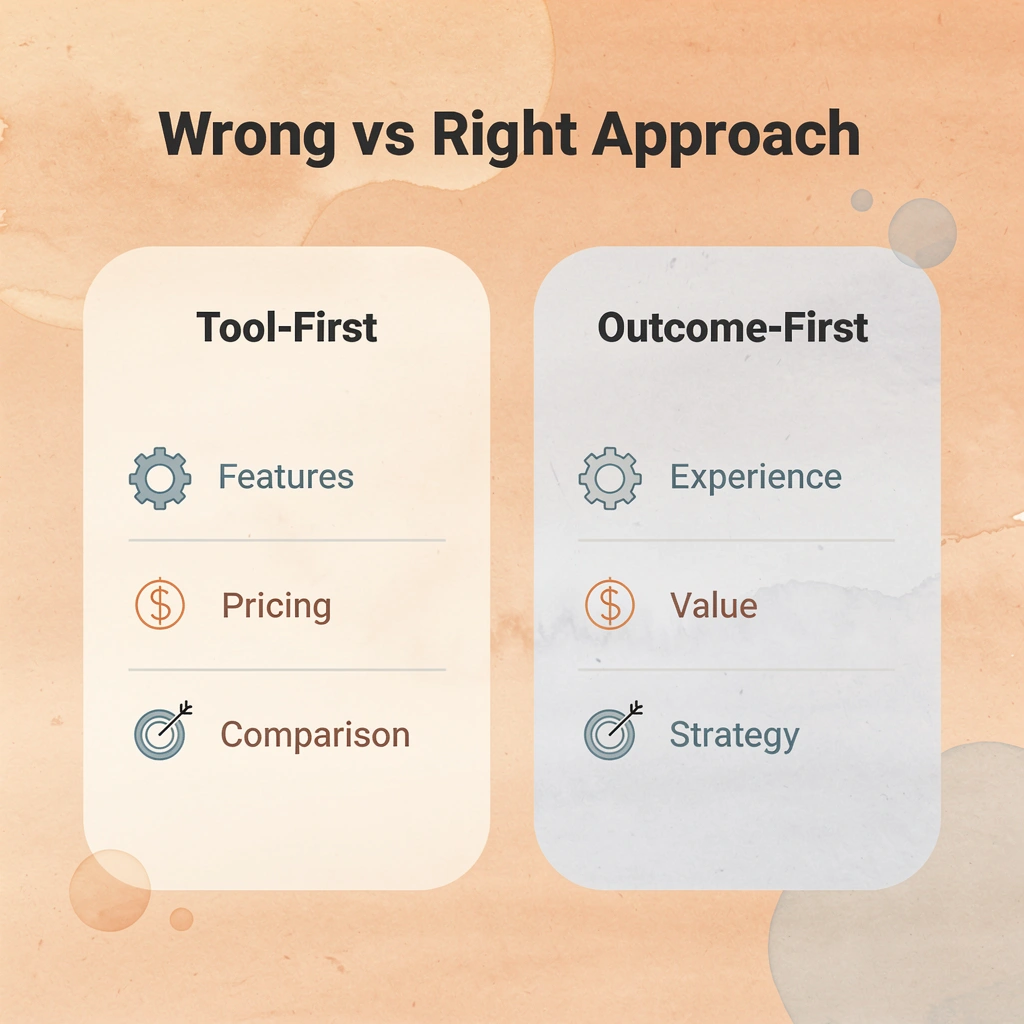
💡 Key Insight: The real question isn't "which chat tool" but "what customer experience do we need to create?" This fundamental shift in thinking transforms your entire selection process and leads to dramatically better long-term outcomes.
Why do most organizations approach chat tools incorrectly?
Most organizations approach chat tools like any software purchase: vendor research, feature matrices, stakeholder alignment, and contract negotiation. The entire process becomes about choosing between options rather than mapping conversation flows to customer lifecycle stages. According to a 2024 Gartner study, 62% of enterprise software purchases are driven by vendor comparison rather than workflow analysis. Teams spend weeks debating Intercom's pricing model versus Zendesk's integration without documenting how leads move from inquiry to close or how support conversations should inform product roadmaps.
What critical questions does vendor comparison miss?
This vendor-led comparison process feels thorough but sidesteps harder questions: What happens when a high-intent lead asks a technical question your support team can't answer? How does chat data flow into your CRM, and who owns follow-up? Which conversations should escalate to voice, and when does asynchronous messaging create friction? These are system design questions, not feature questions. Most businesses never ask them before signing the contract.
What causes platform misuse in customer conversations?
The result is predictable: big-company tools are used for basic support tasks, or simple support tools are forced into complex sales workflows. Intercom, built for lifecycle marketing and product-led growth, ends up working as a help desk. Zopim, designed for straightforward customer service, gets stretched into lead qualification because the sales team needed something, and chat was already installed.
Neither scenario works, but both feel acceptable because the tool functions technically.
Why do teams focus on tools instead of conversation strategy?
The main problem isn't the platform. Teams focus on choosing the right tool instead of planning how conversations should work: comparing add-ons, interface design, and cost per person without defining what a good conversation should look like at each step of the customer journey.
The choice becomes reactive (we need chat) rather than strategic (we need a system that directs questions to customer needs, retains information from all interactions, and routes conversations to the right person when text messaging falls short). Some teams are exploring how tools like conversational AI can handle complex routing and escalation logic that text-based platforms weren't designed to manage, particularly when conversations require quick problem-solving or careful qualification, which are better suited to voice interaction.
What lifecycle mapping actually requires
Fixing this doesn't start with a vendor demo. It starts with mapping every conversation type your business handles: pre-sale questions, technical support, billing inquiries, feature requests, churn signals, and expansion opportunities. Each type has a different urgency, required expertise, and ideal next steps. Some need immediate answers, others require human judgment, and a few must trigger workflows in other systems. Most organizations skip this mapping and assume the chat tool will figure it out, which is why chat becomes a black hole of unrouted inquiries and missed follow-ups.
But even when teams get the mapping right, they face a deeper challenge: the platforms themselves weren't built for what customer conversations have become.
Intercom vs Zopim (Zendesk Chat) Detailed Comparison Guide
Zendesk helped Shopify grow its customer support across thousands of agents worldwide. Intercom gave Hospitable's small team AI that resolved 70% of conversations. Zendesk works best for organized ticketing systems and large companies, while Intercom focuses on engaging customers immediately and proactive support. Your best choice depends on team size, growth trajectory, and support approach.
🎯 Key Point: Zendesk excels at structured support workflows for enterprise teams, while Intercom specializes in proactive customer engagement and AI-powered automation for smaller, agile teams.

"AI resolved 70% of conversations for Hospitable's small team, demonstrating the power of proactive support automation." — Intercom Learning Center
Feature
Zendesk
- Large teams, ticketing
- Organized workflows
- Thousands of agents
- Reactive support
Intercom
- Small teams, proactive chat
- AI automation
- Small, agile teams
- Proactive engagement
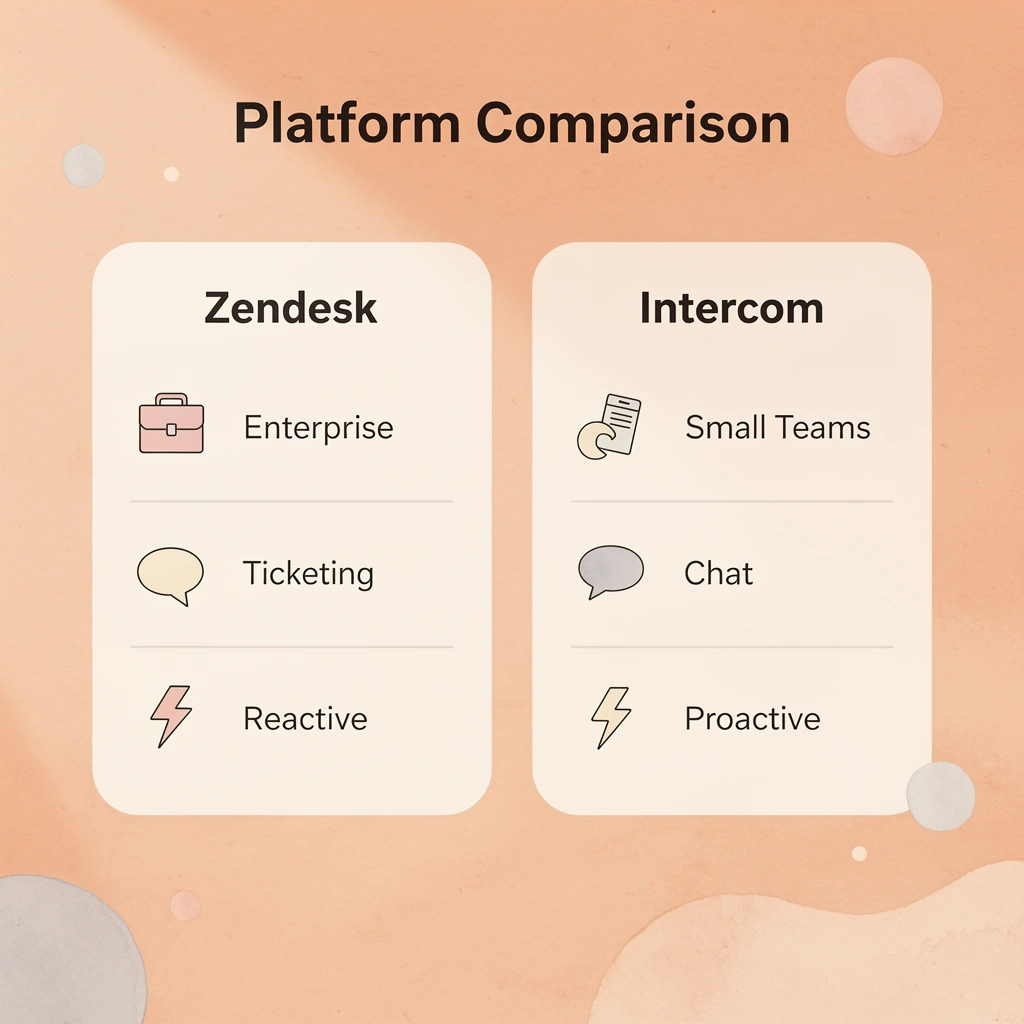
🔑 Takeaway: Choose Zendesk if you need scalable ticketing systems for large support operations, or Intercom if you want AI-driven conversations that prevent issues before they become support tickets.
Zendesk vs Intercom General Comparison
Zendesk
- Primary Strength
Structured ticketing, enterprise scale, deep reporting - Best Fit For
Large or complex support teams, regulated industries, high ticket volume - Omnichannel
Mature, segmented channels (email, chat, phone, social) - Help Center
Robust KB, multi-brand support, forums - Automation & AI
Triggers, macros, Answer Bot - Analytics
Advanced dashboards (Explore), customizable but complex - Integrations
Large marketplace, native apps, strong for enterprise - Ease of Use
Steeper learning curve, admin-heavy - Support
Mixed reputation, slower enterprise-style - Pricing Model
Per agent, predictable scaling
Intercom
- Primary Strength
Real-time chat, proactive messaging, ease of use - Best Fit For
Small to mid-size teams, SaaS/startups, product-led growth - Omnichannel
Unified inbox, strong live chat, lighter email handling - Help Center
Simple, integrated knowledge base - Automation & AI
Proactive bots, Fin AI (60–70% resolution in some teams) - Analytics
Easier to set up, less depth without premium plans - Integrations
Strong SaaS integrations, product data, and event-driven workflows - Ease of Use
User-friendly, faster to adopt - Support
Highly rated support team, fast responses - Pricing Model
Based on conversation volume, it can spike with growth

Feature Differences: Intercom vs Zendesk
AI is the biggest difference between Zendesk and Intercom. Both platforms now offer AI agents that handle real customer conversations, but they approach the problem from opposite directions.
How does Intercom's Fin AI work?
Intercom's Fin AI is built directly into the chat experience for instant deployment. Connect your Help Center or upload articles, and it learns from them. When Fin doesn't know the answer, it hands off to a human with context for the conversation so the agent doesn't start from zero. One support professional reported that Fin resolves 60-70% of incoming questions without human intervention.
Zendesk's AI Agent takes a more organized approach. You define intents, link them to macros, and control which parts of your knowledge base it references. Training involves labeling data, fine-tuning triggers, and teaching it to your workflows. The result is more predictable output, which matters when handling regulated data or complex workflows across hundreds of agents.
The difference comes down to control versus convenience. Intercom's Fin is easier to launch but operates as a black box: it gets smarter without full transparency. Zendesk's AI requires setup but offers transparency and customization. For teams managing scale, control matters. At Shopify, an AI responding outside policy or tone guidelines posed compliance risks. Zendesk's configuration tools provided the oversight needed to maintain compliance.
Omnichannel Workspace
Zendesk handles support across multiple channels—email, chat, phone, and social media—through one workspace with clear separation, making it easier for large teams to route tickets to the right person and prioritize them. Intercom consolidates everything into one inbox, which suits smaller teams but becomes harder to manage as message volume grows.
Which workspace approach works better for different team sizes?
As Michael Windler noted, "Zendesk does a much better job with channel segmentation. For Intercom, everything is dumped into the same inbox." At Shopify, channel separation was non-negotiable. At Hospitable, the unified Intercom inbox worked well for a lean team where speed mattered more than segmentation. Choose based on whether your team values simplicity or surgical precision in routing.
Communication
Intercom excels at real-time chat, proactive messages, and in-app nudges, functioning as a product engagement tool rather than a traditional help desk. Zendesk is strongest on email and organized threads, with live chat and messaging available through Sunshine Conversations, though not as polished as Intercom's offering.
What are the limitations of text-based communication platforms?
Intercom is a stronger overall communication tool with a marketing focus and extensive features, but it lacks video capability and has limited voice channel quality. At smaller operations like Hospitable, Intercom's communication tools enabled quick support. At a larger scale (like Shopify), text-based chat alone proved insufficient. Text platforms work well for non-urgent support, but conversations requiring careful qualification, technical troubleshooting, or real-time problem-solving benefit from solutions like conversational AI, where voice interaction shortens resolution time and reduces back-and-forth friction.
Ticketing
Zendesk is built specifically for ticketing with strong merge, routing, and prioritization features. Intercom is conversation-driven, which works well for engagement but lacks structure for complex cases. Support professionals prefer Zendesk's merge function for its simplicity and visibility; Intercom's version offers fewer options. For high-volume support with overlapping inquiries, Zendesk's ticketing architecture prevents chaos. For small teams that value conversational flow over rigid case management, Intercom feels more natural.
Analytics & Reporting
Zendesk's reporting engine, Explore, outperforms Intercom in terms of customization. You can track first reply time by channel, resolution time by ticket type, SLA breaches by agent group, and satisfaction by issue category.
At Shopify, our Explore dashboards showed real-time ticket volume, backlogs, and CSAT across multiple teams and time zones. That segmentation enabled us to catch spikes early and shift coverage dynamically.
What are the limitations of each platform's reporting?
Intercom's reports are easier to set up but less flexible: you get conversation counts, resolution times, and agent metrics that you can filter by inbox or teammate. Tracking deflection rate by article or AI performance over time requires the upgraded Custom Reports plan.
Zendesk lets you measure almost everything, but requires more effort to configure. Intercom shows enough to help you steer, but not enough to optimize deeply. For small teams, Intercom's built-in analytics may suffice. For large or multi-region teams, Zendesk's depth enables performance management, not monitoring alone.
Security
Zendesk holds SOC2, HIPAA, GDPR, and ISO 27001 certifications, which are essential for healthcare, financial services, and government contracts.
Intercom meets strong security standards but lacks some of Zendesk's compliance options. If auditors must approve your support tools, Zendesk is the safer choice.
In the end, pick the platform that fits how your team actually works as it grows.
Related Reading
- Conversational AI for Customer Service
- Conversational AI for Sales
- Conversational AI Lead Scoring
- Conversational Ai Leaders
- Conversational AI in Telecom
- Conversational AI in Financial Services
- Benefits Of Conversational Ai
- Best-rated voice assistants for conversational AI
How to Choose the Right Live Chat Setup Based on Your Actual Business Needs
If your priority is customer support efficiency with a small team handling straightforward inquiries, Zopim minimizes complexity and overhead. If your priority is lifecycle growth and automation, where chat connects to onboarding, segmentation, and retention systems, Intercom integrates engagement across the entire customer journey. Match the tool to your operational model.

🎯 Key Point: Your business model should drive your live chat choice, not feature lists or pricing alone.
"85% of businesses report better customer satisfaction when their live chat solution aligns with their actual operational needs rather than perceived requirements." — Customer Service Institute, 2024
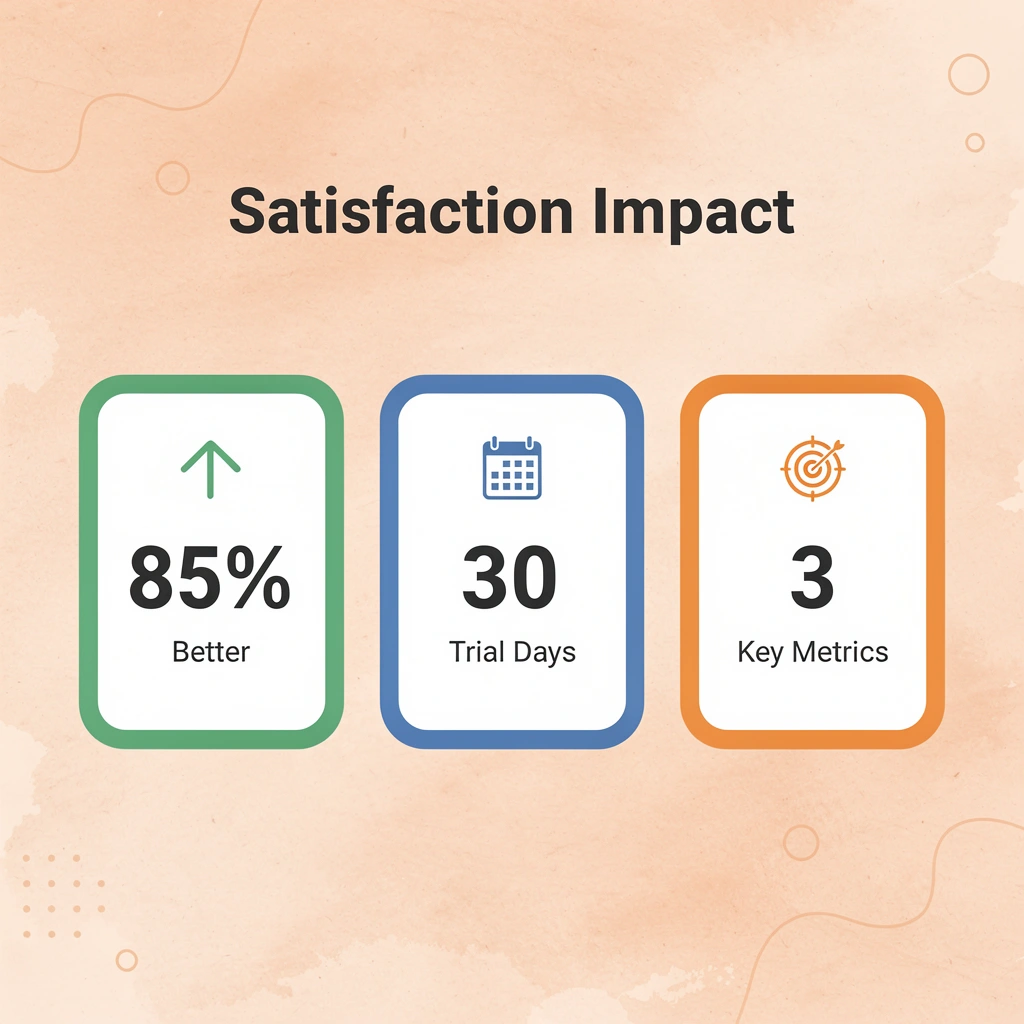
⚡ Pro Tip: Start with a 30-day trial of your top choice, and measure real metrics like response time, resolution rate, and team adoption before committing to an annual plan.
What makes enterprise-scale volume management different?
Zendesk's structure handles high-volume work across multiple channels, where accurate ticket routing and managing response times are critical. When processing thousands of daily tickets through email, chat, phone, and social media, a channel-based organization maintains clarity and efficiency.
Zendesk's ticketing system routes tickets based on issue type, language, product, and agent expertise, tracking each reassignment. According to Saasworthy, live chat achieves an 83.1% customer satisfaction rating, but this declines when ticket volume overwhelms the routing system, causing customers to be passed between agents unfamiliar with previous discussions.
What are the complexity trade-offs?
The trade-off: Zendesk requires upfront investment in workflow design and ongoing administrative overhead. For small teams, this complexity becomes a liability.
But for global support operations with unpredictable volume spikes and audit trail requirements, Zendesk's structure prevents system collapse.
When does Intercom work best for your business?
Intercom works well for companies that grow through their products, SaaS platforms with free versions, and businesses where helping users get started affects retention. Its messages reach users at critical moments: when they hit a paywall, abandon setup, or try a feature for the first time.
Research from Invesp shows adding live chat software to a website boosts conversions by 20%, but only when the chat system knows when to interrupt and when to stay silent.
What are Intercom's main limitations?
Intercom's strength becomes a weakness when your team needs organized case management or deep reporting segmentation. If your support model relies on ticket merging, complex SLA tracking, or detailed performance analytics across multiple teams, Intercom's conversational inbox will feel limiting.
When does text-based chat reach its limitations?
Both platforms assume text is the primary communication method, which breaks down when conversations require careful problem-solving, technical troubleshooting, or real-time discussion. Text prolongs resolution when explaining complex issues or clarifying details that could be resolved in minutes in conversation but take hours to write.
Some enterprise teams are exploring how solutions like conversational AI handle scenarios where voice interaction condenses what would take 12 chat messages into a 2-minute conversation, particularly for high-value leads or technical support cases where tone, urgency, and context are lost in typed exchanges.
How should you choose the right platform?
The right platform aligns with how your team sends, fixes, and learns from customer feedback. However, even the best platform choice won't succeed if the underlying system doesn't support it.
Related Reading
- Intercom Alternatives
- Zendesk Chat Vs Intercom
- IBM Watson Competitors
- Yellow.ai Competitors
- Kore.ai Competitors
- Liveperson Alternatives
- Ibm Watson Vs Chatgpt
- Help Scout Vs Intercom
Your Live Chat Tool Is Only as Good as the System Behind It
The gap between choosing Intercom or Zopim and improving customer outcomes isn't a feature problem: it's a systems problem. Most teams treat platform selection as the finish line when it's the starting point. The tool you pick matters less than whether your routing logic, escalation triggers, and lifecycle tracking support how conversations actually flow through your business.

🎯 Key Point: Your chat platform is only as effective as the operational framework supporting it.
"Platform features don't fix unclear ownership when a technical question arrives during a product demo, or what happens when a high-value lead gets the same canned response as a password reset request."

Platform features don't bridge the gap between what your chat tool captures and what your sales team needs to close deals. These failures stem from systems never built to handle the complexity of real customer conversations.
⚠️ Warning: Without proper systems integration, even the most advanced chat platform becomes just another disconnected communication channel.

When the platform becomes the scapegoat
Teams blame the tool when conversations fall through the cracks, but the tool does what you told it to do. If your routing rules don't look for intent signals, every question gets treated identically. If your CRM integration doesn't save chat context, sales reps restart every follow-up from scratch. If your escalation path assumes text solves everything, you'll lose deals that needed a phone call three messages ago. The platform can't compensate for workflow gaps you haven't addressed.
Conversational AI voice agents handle inbound interactions with structured logic that routes based on context, responds instantly, and maintains a consistent experience across every call while keeping full control over data and compliance.
Book a demo to see where your platform is working and where your workflows are creating friction.