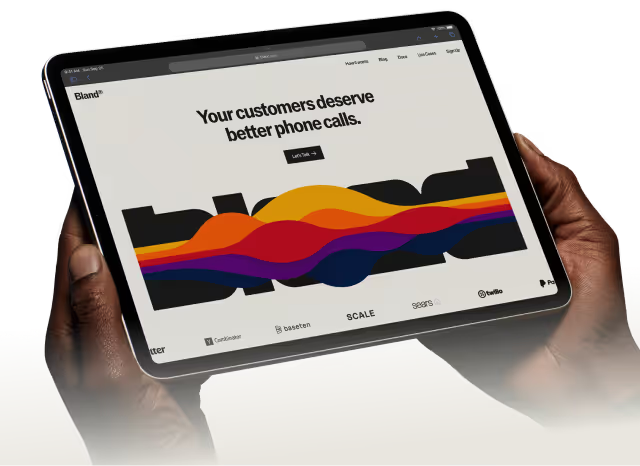
Customer experience teams face mounting pressure to deliver instant, personalized support across every channel while managing costs and scaling operations. The companies leading this transformation have cracked the code on blending natural language understanding, automation, and human empathy to create experiences that customers actually enjoy. These conversational AI leaders are shaping CX in 2026 by setting new standards for intelligent automation and customer satisfaction. Understanding their approaches provides valuable insights for choosing the right solutions and staying ahead of emerging trends.
The most successful platforms deploy intelligent systems to handle complex conversations at scale while maintaining the human touch that customers expect. They prioritize reducing wait times, increasing resolution rates, and creating meaningful interactions that strengthen brand relationships. Teams looking to match what industry leaders are achieving can explore proven enterprise solutions, such as conversational AI platforms designed for scalable, intelligent customer engagement.
Table of Contents
- Why Conversational AI Is Taking the Business World by Storm
- Top 27 Conversational AI Leaders for 2026
- Trends Shaping the Conversational AI Platforms of Tomorrow
- Experience How a Leading Conversational AI Platform Can Transform Your Calls
Summary
- The conversational AI market will reach $41.39 billion by 2030, driven by organizations recognizing this technology as critical infrastructure rather than experimental tooling. Enterprises that deploy intelligent voice agents and chatbots to handle routine inquiries free human teams to solve complex problems requiring judgment and empathy. The cost of delay extends beyond missed efficiency to lost revenue, diminished brand perception, and customers who've already moved to competitors offering instant support.
- Consumer search behavior has fundamentally shifted, with 80% of consumers now relying on AI summaries for at least 40% of online searches. Gartner projects a 50% drop in organic search traffic by 2028, as people turn to large language models rather than clicking through traditional search results. Brands winning attention today meet customers in conversational interfaces that feel natural and deliver value without forcing people through outdated funnels.
- The expectation for 24/7 support has become table stakes, not a luxury preference. Customers encountering problems at 11 PM don't bookmark sites to try again during business hours. They find competitors who can help immediately. Conversational AI systems handle hundreds of simultaneous conversations without degrading quality, ensuring no customer hits a wall when they need help, regardless of time zones or staffing constraints.
- Multimodal experiences now blend channels within single conversations rather than forcing customers to choose between voice and text. A customer can receive policy documents on their phone for a digital signature while discussing insurance coverage over the phone. Research from Bland AI indicates 70% of businesses plan to implement conversational AI within the next two years, yet most still design experiences that replicate old processes rather than reimagine what becomes possible when visual context layers onto voice interactions.
- Industry-specific models compress deployment timelines from quarters to weeks by shipping with pre-trained domain expertise, pre-built integrations, and workflows designed for vertical use cases. A healthcare solution already understands HIPAA compliance requirements and clinical terminology, eliminating months of teaching the system industry language before handling the first customer interaction. Organizations can't tolerate six-month implementation cycles when competitors deploy functional agents in days.
- Speed to deployment separates platforms that deliver production results this quarter from those requiring extensive customization cycles. Vendors emphasizing pre-built integrations and rapid utterance generation address competitive survival when customer expectations shift faster than traditional implementation timelines allow. The emphasis on velocity reflects market reality, where delayed deployment costs ground to competitors already serving customers through conversational interfaces.
- Bland’s conversational AI helps teams deploy intelligent voice agents that handle complex conversations at scale, compressing evaluation cycles by testing against real call scenarios before implementation begins.
Why Conversational AI Is Taking the Business World by Storm
The belief that AI chatbots are mere gimmicks collapses when examining adoption rates. According to Forbes Tech Council, by 2025, 95% of customer interactions will be powered by AI. This shift is already underway in healthcare, financial services, and retail. The question isn't whether conversational AI works—it's whether your business can afford to operate without it while competitors compress response times from hours to seconds.

🎯 Key Point: The widespread adoption of conversational AI isn't a future trend—it's happening now across multiple industries with measurable results.
"By 2025, 95% of customer interactions will be powered by AI." — Forbes Tech Council, 2025

🔑 Takeaway: When nearly all customer interactions will be AI-powered within the next year, businesses that haven't adopted conversational AI risk being left behind with slower response times and reduced customer satisfaction.
What happens when customer service can't keep up?
When customer service teams can't keep up, customers cancel subscriptions, abandon carts, and publicly express frustration. Long wait times erode trust at scale. Businesses using intelligent voice agents and chatbots for tier 0 and tier 1 inquiries free human teams to solve complex problems requiring judgment and empathy. The cost of delay is lost revenue, diminished brand perception, and customers who've switched to competitors offering instant, intelligent support.
How has consumer behavior fundamentally shifted?
How people buy things has changed faster than most businesses anticipated. Eight out of ten consumers now use AI summaries for at least 40% of their online searches. Gartner predicts a 50% drop in organic search traffic by 2028, as people turn to large language models rather than clicking through search results.
If your customer acquisition strategy depends mainly on SEO and paid search, you're building on unstable ground. Winning brands meet customers in conversational interfaces that feel natural, respond immediately, and deliver value without traditional funnels. Our conversational AI platform helps you engage customers in these natural, real-time interactions.
What separates effective conversational AI from frustrating experiences?
What separates effective conversational AI from frustrating chatbot experiences comes down to how well it is built and what it is designed to do. Poorly configured systems send repetitive messages, fail to handle complex problems, and create issues rather than solve them. When AI feels exploitative or unhelpful, the system was built to save money rather than serve customers.
Platforms like Bland work differently. They focus on voice agents that handle complex conversations at scale while sounding natural. The difference between AI that frustrates people and AI that satisfies them comes down to one thing: was the system designed to replace human connection or enhance it?
Why do customers expect instant support availability?
The expectation for 24/7 support is no longer a luxury but a basic requirement. Customers who encounter problems at 11 PM won't wait for business hours; they'll find a competitor who can help immediately.
Conversational AI systems like Bland never need breaks, never get overwhelmed during peak hours, and handle hundreds of simultaneous conversations without losing quality. This ensures customers receive help whenever needed, regardless of time zones or staffing constraints.
What happens when businesses delay AI adoption?
Businesses that hesitate lose leads, support tickets that escalate into cancellations, and ground to faster-moving companies. The conversational AI market is projected to reach $41.39 billion by 2030, driven by organizations that treat it as infrastructure rather than experimental technology.
Companies winning customer loyalty create experiences where getting help feels effortless, and that feeling is what people remember.
But knowing conversational AI matters and knowing which platforms actually deliver are two different challenges.
Related Reading
- Conversational Ai Examples
- Conversational Ai Architecture
- How To Deploy Conversational Ai
- Types Of Ai Chatbots
- How To Build A Conversational Ai
- How To Improve Response Time to Customers
- Conversational Ai Future
- Conversational AI Pricing
- Customer Service ROI
- Generative Ai Vs Conversational Ai
- Conversational Ai In Ecommerce
Top 27 Conversational AI Leaders for 2026
Picking the right conversational AI platform determines whether your customer interactions grow smoothly or fail due to complexity. Leaders distinguish themselves through deployment speed, emotional intelligence capabilities, integration depth, and proven ROI metrics. Platforms built for enterprise workflows outperform those assembled from generic components.

🎯 Key Point: The difference between conversational AI success and failure often comes down to platform selection and implementation strategy.
The platforms below represent vendors that earned leadership positions through measurable results. Each entry highlights specific strengths, ideal use cases, and performance metrics to help you evaluate. These leaders have demonstrated consistent performance across multiple industries and deployment scenarios.

"95% of AI software implementations deliver zero ROI, making platform selection the most critical decision in conversational AI adoption." — Industry Analysis, 2024
💡 Tip: Focus on platforms with proven enterprise deployment track records rather than those with impressive demos but limited real-world validation.

1. Bland AI
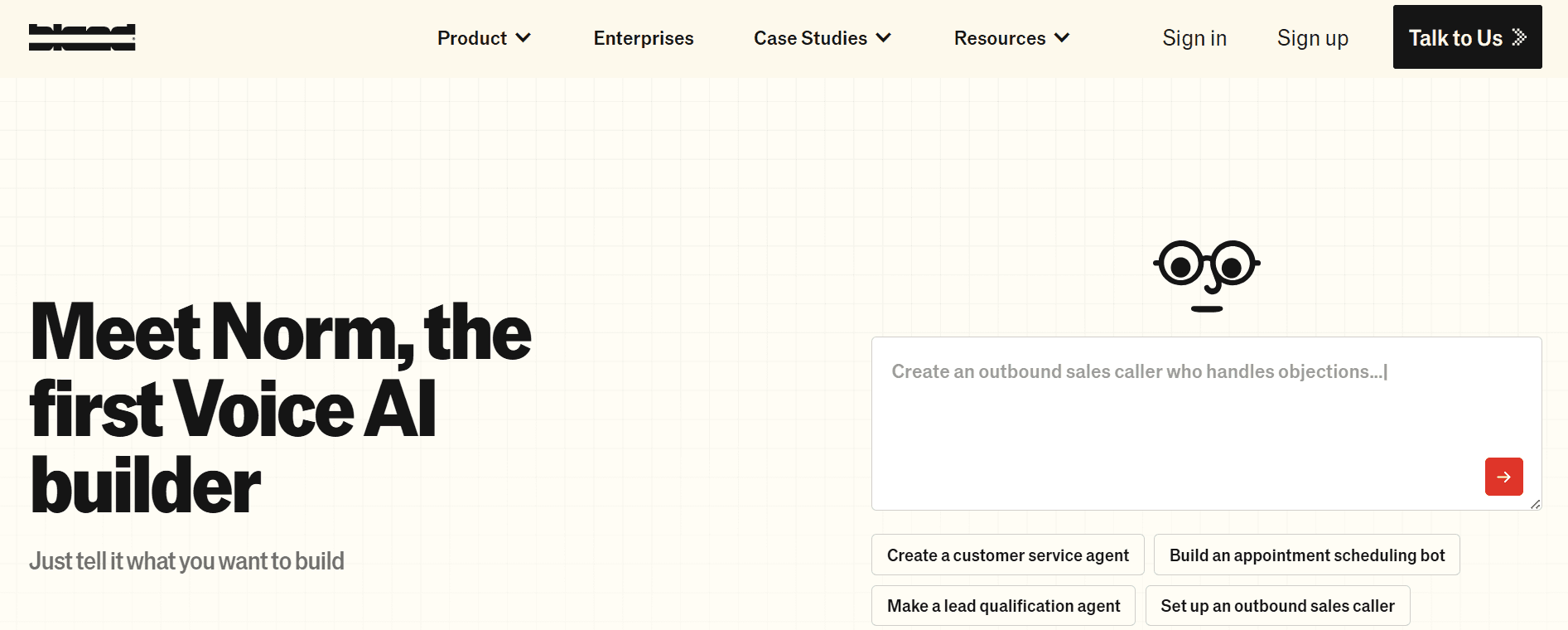
Contact centers operate on outdated IVR trees that force customers through rigid menu structures. These systems cannot adapt to conversation context, handle complex requests, or accommodate questions outside preset options, resulting in dropped calls, escalated complaints, and lost business opportunities.
Platforms like Bland replace these systems with self-hosted, real-time voice agents that sound human, respond instantly, and scale without degrading quality. This approach delivers faster, more reliable conversations while securing your data and meeting industry compliance requirements.
Key Differentiators
Bland AI uses voice agents that handle complicated conversations in real time without scripts or decision trees. Our self-hosted setup gives companies complete control over their data, while our agents understand natural language in milliseconds. You can connect it through an API, linking it directly to your existing CRM, ticketing, and phone systems.
Ideal Use Cases
Large companies handling high call volumes need speed and consistency to maintain customer satisfaction. Regulated industries must control data and comply with applicable requirements. Sales teams lose potential customers because they cannot respond off-hours. Support teams struggle with basic tier-0 and tier-1 inquiries.
Performance Metrics
Voice agents respond in milliseconds, maintaining natural conversation flow. Deployment integrates with your existing systems. The system scales horizontally, handling sudden increases in volume without degrading response quality.
2. Nurix AI

Nurix AI launched NuPlay in June 2025 with $27.5 million in funding as an enterprise solution for production-ready voice AI. The platform automates over 80% of customer inquiries while reducing support costs by more than 65%.
Key Differentiators
The special low-latency voice system supports barge-in functionality, allowing customers to interrupt agents mid-speech, as they would with real people. This eliminates the robotic "please wait until I finish speaking" friction that makes conversations feel awkward in competing systems. Deployment occurs in 24 hours using pre-built libraries and customizable workflows, compressing implementation timelines from months to days.
Ideal Use Cases
Companies need voice AI tools immediately. Organizations with existing cloud communication systems seeking to add voice AI capabilities without replacement. Teams handling over 60,000 calls monthly, where efficiency gains deliver significant cost savings.
Performance Metrics
More than 300 pre-built integrations eliminate the need for custom development in most enterprise deployments. The platform handles over 60,000 monthly calls with AI agents customized to each customer interaction. Customers report 100% ROI, with 80% faster query resolution and 50% lower operational costs than with human-only support.
3. Teneo.ai

Teneo.ai runs over 17,000 AI agents in production across organizations worldwide, establishing itself through enterprise-grade scalability and security. The platform enables agentic AI capabilities that reduce human intervention by allowing autonomous problem-solving across complex workflows.
Key Differentiators
The advanced routing system analyzes conversation context, customer history, and intent to direct interactions toward optimal solutions, improving first-call resolution by up to 30%. Native proficiency in 86+ languages with extended LLM support enables global enterprises to deploy once and serve worldwide without rebuilding agents for each location.
Ideal Use Cases
Large companies handling millions of monthly customer interactions across languages and regions need systems where first-call resolution directly impacts customer retention and operational costs. Regulated industries require platforms that are ISO 27001-certified and built with GDPR-first architecture to ensure data security and legal compliance.
Performance Metrics
FCR improvements reach 30% in production deployments. The platform processes millions of monthly interactions without degrading performance and holds ISO 27001 certification for enterprise security audits.
4. IBM Watson Assistant
IBM Watson Assistant uses decades of AI research to deliver conversational capabilities at enterprise scale across banking, healthcare, retail, and other regulated industries.
Key Differentiators
Integration with IBM Cloud services and open-source Python SDK connects conversational AI to legacy systems, proprietary databases, and custom applications. The visual development interface accelerates development while comprehensive documentation reduces reliance on specialized AI talent.
Ideal Use Cases
Companies invested in IBM Cloud infrastructure to serve organizations in regulated industries like banking and healthcare that needed proven compliance frameworks, as well as development teams seeking both low-code interfaces for rapid prototyping and deep customization for complex implementations.
Performance Metrics
The platform handles large volumes of conversations with advanced natural language understanding that deciphers complex language patterns. It improves and becomes more accurate with each use.
5. Google Dialogflow CX
Google Dialogflow CX offers accurate intent recognition and entity extraction across 30+ languages, backed by Google's superior natural language processing. Organizations using Google infrastructure gain deployment advantages through tight integration with the Google Cloud ecosystem.
Key Differentiators
Google's NLP engine processes language with high accuracy, trained on datasets larger than most competitors can access. Direct integration with Google Cloud services, including Speech-to-Text and Text-to-Speech, removes the complexity of integration. Intelligent conversation routing sends interactions across human agents, chatbots, and third-party services based on real-time analysis of complexity and available resources.
Ideal Use Cases
Organizations using the Google Cloud Platform are seeking native integration. Global enterprises requiring multi-regional agent deployment with support for 30+ languages. Teams prioritizing NLP accuracy and wanting access to Google's latest language model improvements.
Performance Metrics
Intent recognition accuracy continues to improve as Google enhances its underlying language models. Multi-regional deployment enables you to run operations globally without configuring separate agents for each region. Flexible pricing scales from startup experimentation to enterprise production volumes.
6. Amazon Lex
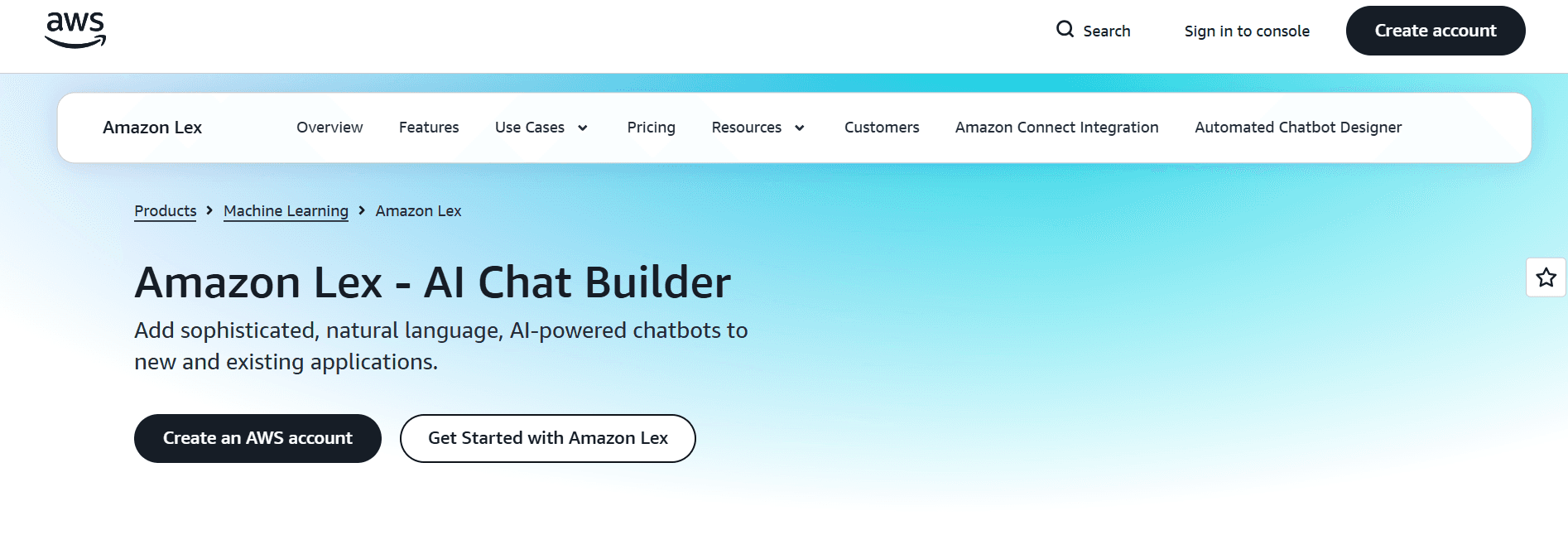
Amazon Lex makes conversational AI accessible by offering business-quality natural language understanding that is simple to set up. Built on the same deep learning technologies that power Amazon Alexa, it brings proven voice AI capabilities to business applications.
Key Differentiators
The same infrastructure that powers millions of Alexa interactions delivers reliability for critical business use. Continuous learning enables systems to improve through interaction-based learning without manual retraining. Native AWS integration supports end-to-end solution development within the ecosystem.
Ideal Use Cases
Groups using AWS infrastructure that want native integration. Development teams are building conversational interfaces across websites, mobile applications, and communication platforms. Businesses need voice AI without investing in specialized infrastructure.
Performance Metrics
Advanced machine learning models understand context, intent, and nuance in human communication to improve accuracy. Multi-platform integration enables smooth deployment across websites, mobile apps, and messaging platforms without rebuilding agents for each channel.
7. OpenAI ChatGPT Enterprise

ChatGPT Enterprise combines conversational AI with enterprise-grade privacy and advanced capabilities, handling complex tasks from email writing to code debugging across diverse business applications.
Key Differentiators
You get unlimited access to Advanced Data Analysis features, including chart creation and complex problem-solving. Other platforms restrict these tools; this one doesn't. Enterprise-grade privacy protects your company's data, with compliance controls available for security audits. Shareable conversation templates enable your team to develop workflows collaboratively.
Ideal Use Cases
Organizations needing AI assistance for knowledge work beyond customer service, teams handling complex analytical tasks, and businesses building custom ChatGPT-powered applications using API platform credits.
Performance Metrics
An admin control console provides complete management tools with single sign-on and domain verification. Custom solution development enables you to create fully customised ChatGPT-powered applications.
8. Microsoft Copilot Studio

Microsoft Copilot Studio demonstrates Microsoft's shift toward multi-agent orchestration and advanced AI workflow management. Improvements announced at Microsoft Build 2025 position the platform as the successor to the Bot Framework SDK, with deep integration into the Microsoft 365 ecosystem.
Key Differentiators
Multi-agent orchestration coordinates multiple AI agents in complex workflows, automating processes that previously required human coordination across systems. Copilot tuning enables advanced customization using proprietary data and organisational style preferences. Native Python integration supports advanced computational and analytical tasks without leaving the platform.
Ideal Use Cases
Organizations are using Microsoft 365 extensively. Development teams require both user-friendly and advanced coding options. Large companies managing complex workflows that need multiple coordinated agents.
Performance Metrics
Better knowledge management gives you more control over information sources and enables smarter responses. Visual Studio integration provides professional developers with complete support. The platform scales from simple chatbots to complex multi-agent systems.
9. LivePerson Conversational Cloud

LivePerson pioneered conversational commerce and AI software. Its Conversational Cloud platform handles over one billion conversations monthly. Strategic acquisitions, including BotCentral, Conversable, and VoiceBase, built a complete conversational AI ecosystem.
Key Differentiators
Processing over one billion conversations monthly demonstrates the system's effectiveness at scale. Real-time messaging across multiple channels—WhatsApp, Apple Business Chat, Facebook Messenger, and SMS—enables smooth communication from a single platform. Advanced tools provide detailed insights through business-level reporting and conversation analytics.
Ideal Use Cases
Large companies handling conversations across multiple channels—particularly in retail, financial services, and telecommunications, where customer interactions directly drive revenue—require advanced tools to understand conversation dynamics and improve performance.
Performance Metrics
The platform handles over one billion conversations monthly with strong, reliable performance. AI-powered automation addresses routine questions while accelerating response times. Advanced analytics extracts insights from conversation data at scale.
10. Rasa Pro
Rasa Pro combines the flexibility of the world's most popular open-source conversational AI framework with enterprise-grade security, observability, and scalability features. Over 50 million downloads worldwide demonstrate developers' preference for Rasa's composable architecture and machine learning-based approach.
Key Differentiators
Open-core architecture provides modern conversational AI with built-in generative AI tools to accelerate development. Advanced natural language processing capabilities deliver smart language understanding and conversation management. Complete monitoring, security features, and scalability enable large-scale production use in business.
Ideal Use Cases
Development teams seeking open-source flexibility and vendor independence. Organizations are building conversational applications in nearly 100 languages. Enterprises requiring full control over conversational AI architecture and deployment.
Performance Metrics
It supports conversational applications in nearly 100 languages. The machine learning-based approach enables continuous improvement through user interactions, and enterprise security features meet production deployment requirements.
11. Kore.ai XO Platform

Kore.ai's XO Platform provides a complete solution for building, training, and managing enterprise-ready conversational AI applications. The award-winning NLP engine combines multiple intelligence methods to understand what people say, their intentions, feelings, and emotions.
Key Differentiators
The NLP engine uses multiple methods to understand language comprehensively, going beyond simple intent matching. The platform covers design, development, testing, and deployment. Recent expansion to small and medium-sized businesses and developers through pay-as-you-go pricing makes enterprise-level conversational AI accessible to organisations of all sizes.
Ideal Use Cases
Companies needing complete conversational AI development tools, organisations seeking multi-channel deployment with ready-made enterprise connections, and teams requiring a scalable, open-source, customisable platform.
Performance Metrics
Multi-channel deployment works across different communication channels with pre-built enterprise integrations. Scalable architecture enables enterprises to expand capabilities as needs change. Award-winning NLP delivers a sophisticated understanding of human communication.
12. Decagon

Decagon was founded in August 2023. In January 2026, the company raised $250 million, tripling its valuation to $4.5 billion in less than six months. The company added over 100 new global enterprise customers in 2025, including Deutsche Telekom, Avis Budget Group, and Block.
Key Differentiators
Agent Operating Procedures (AOP) let brands build AI agents using natural-language instructions combined with code precision. CX teams shape how agents handle complex, multi-step situations while engineers maintain control over logic, guardrails, and system integrations. Decagon University helps teams, particularly non-technical ones, develop AI skills and boost productivity.
Ideal Use Cases
Companies where customer experience leaders shape how agents act without requesting engineering support for each change. Organizations that want AI systems to learn through customer conversations and analyze those interactions. Teams focused on delivering results through structured training.
Performance Metrics
Conversational AI and analytics automatically extract useful information from every conversation. Our system flags critical issues, identifies opportunities for improvement, and suggests changes to help agents perform better. Pricing includes per-conversation and per-resolution options.
13. Sierra

Founded by former Salesforce co-CEO Bret Taylor, Sierra positions itself as a conversational interface focused on customer context and the value of interactions.
Key Differentiators
Context engineering systematically improves model performance by identifying errors at their source, analysing missing context, and refining how the codebase and model inputs interact. Layered AI supervision employs supervisory agents that monitor and catch mistakes made by customer-facing agents. Outcome-based pricing ties fees to measurable business results such as resolutions and sales conversations.
Ideal Use Cases
Organizations that prioritize quality over quantity and want AI systems that improve over time. Companies are willing to pay for results rather than usage-based fees.
Performance Metrics
The platform charges only when targets are met, aligning vendor and customer incentives. Multiple levels of checking improve quality control and system reliability over time.
14. NiCE Cognigy

NiCE acquired Cognigy in September 2025, combining advanced workforce optimization with conversational AI. This enables brands to evaluate AI performance against human agents by analysing conversations in real time and retrospectively.
Key Differentiators
AI performance monitoring watches and evaluates conversations during and after interactions, ensuring accuracy and consistency. Workflow orchestration automates complex resolution processes across systems, supporting proactive support strategies. Conversational intelligence analyzes customer interactions to train AI agents to deliver a broader, more consistent customer experience.
Ideal Use Cases
Organizations with existing contact center systems are seeking improvements rather than a full replacement. Companies operating contact centers on their own servers. Teams managing and connecting information across AWS, Snowflake, Salesforce, and other critical data systems.
Performance Metrics
Advanced orchestration lets AI agents monitor signals across connected systems and identify potential problems. This proactive approach resolves issues automatically or alerts customers before problems escalate.
15. SoundHound

SoundHound is a voice-first conversational AI company that partners with brands to integrate custom voice assistants into cars, televisions, and drive-thrus. The 2024 acquisition of Amelia expanded its capabilities into contact centres.
Key Differentiators
Having complete control over your voice technology stack gives you more say in what features get built, how well it performs, and what you pay for it—an advantage over relying on third-party platforms. Superior customer service enables AI-powered experiences on any internet-connected device, not just phones. Our financial services knowledge comes from working with seven of the world's 10 largest financial institutions.
Ideal Use Cases
Organizations are building voice AI into products outside contact centres. Financial institutions require specialized banking expertise. Enterprises seeking to own their voice stack rather than depend on third-party providers.
Performance Metrics
Amelia adds digital elements like carousels and interactive buttons to voice interactions, creating richer multimodal experiences. The platform enables AI service delivery without requiring smartphones and uses usage-based pricing, so costs scale with deployment.
16. OneReach.ai

OneReach.ai helps clients create AI design strategies focused on performance. The company was among the first enterprise conversational AI vendors to adopt AI agent operating systems.
Key Differentiators
A design-first approach means working with clients to achieve the best results and build their skills. Agent runtime infrastructure provides AI agents a safe space to use the right tools, information, and workspace. Private cloud deployment prioritises data security, system reliability, and operational management.
Ideal Use Cases
Organizations that prioritize data protection and private cloud deployment, teams that value design guidance over technology-first approaches, and enterprises without extensive IT resources that benefit from advanced no-code tools.
Performance Metrics
Private cloud deployment attracts customers prioritizing data protection and uptime. Advanced no-code tools enable organizations with limited IT resources to use the platform. Focus on AI safety aligns with customers' requirements for secure agent operation.
17. Boost.ai
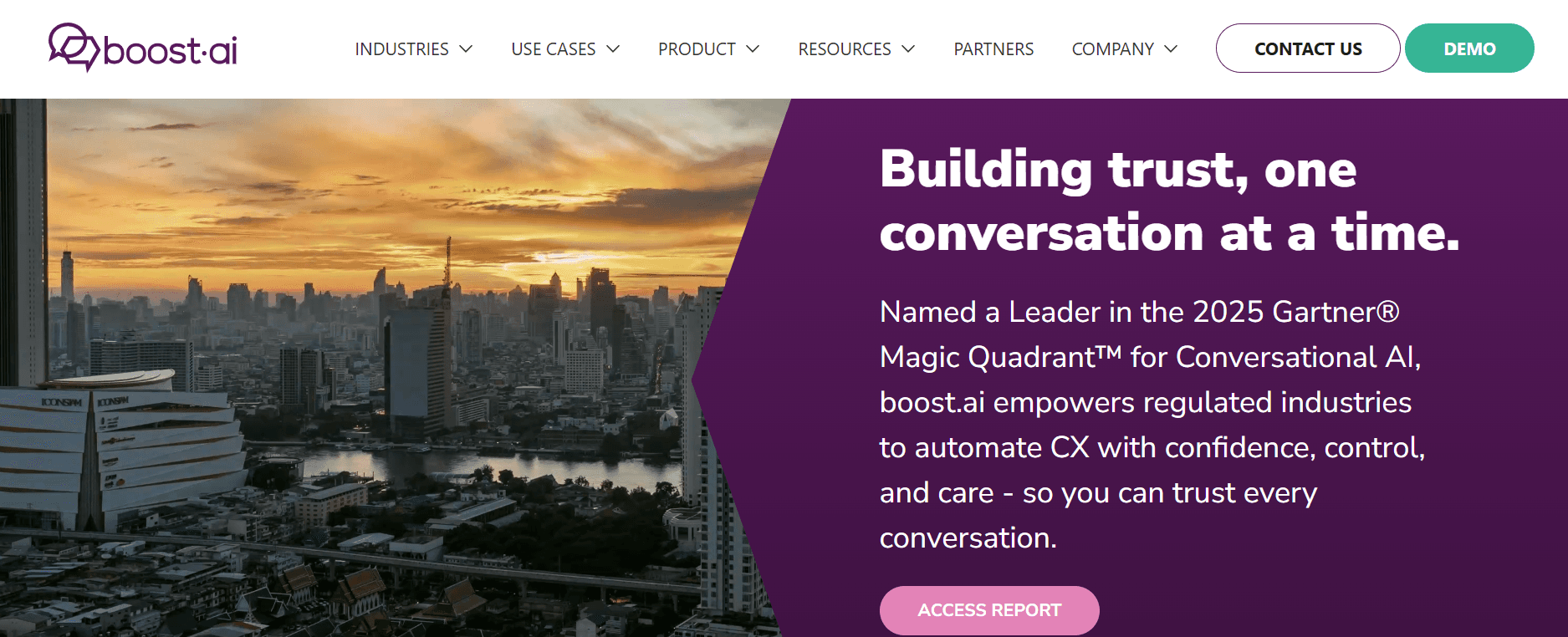
Boost.ai focuses on heavily regulated industries, providing custom-made, ready-to-use integrations and workflows for finance, insurance, and the public sector. The vendor excels in pricing, speed to launch, and time to value.
Key Differentiators
Speed to launch lets clients set up working AI agents in hours instead of weeks through quick deployment options, ready-made integrations, and the Get Started Wizard. Customer education covers best practices, regulatory navigation, including the EU AI Act, and deployment optimization. A strong European presence helps customers prepare for regulatory changes.
Ideal Use Cases
Highly-regulated companies in finance, insurance, and the public sector; European organisations working to comply with the EU AI Act; and teams that need fast deployment without the complexity of enterprise platforms.
Performance Metrics
Pre-built integrations and workflows help you get value faster across public cloud (Azure and AWS), hybrid cloud, and on-premise environments. Recognized as a Leader in the 2025 Gartner Magic Quadrant for Conversational AI Platforms.
18. Genesys
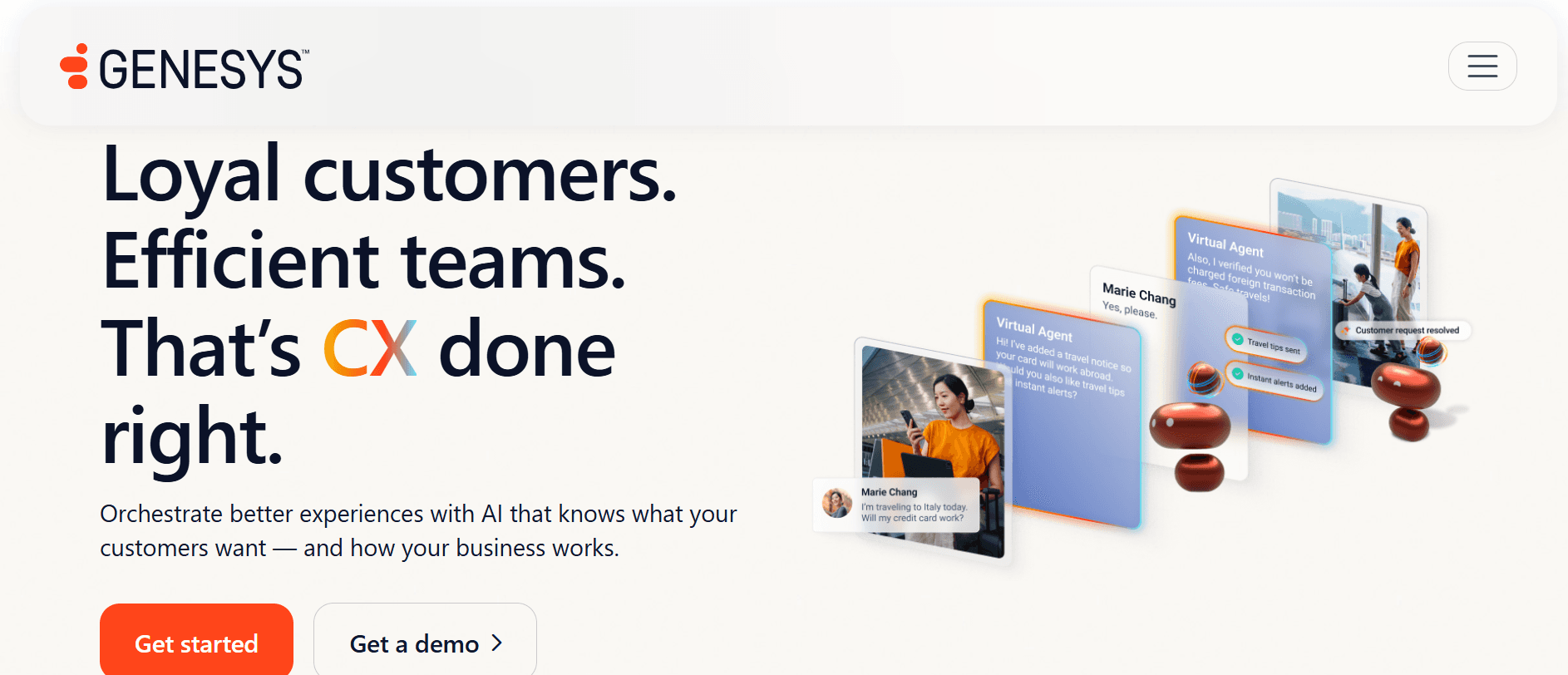
Genesys unveiled the Genesys Cloud Agentic Virtual Agent in February 2026, replacing large language models with large action models (LAMs): smaller, specialized models designed to predict the next best actions and execute tasks.
Key Differentiators
Governance and compliance features explain agent actions and maintain records for accountability. The related CCaaS portfolio combines conversational AI, social listening, and case management. Genesys positions itself as a thought leader with a clear vision and roadmap.
Ideal Use Cases
Organizations require strong governance and compliance documents. Genesys CCaaS customers are seeking tightly integrated AI-led experiences. Enterprises combining social listening with proactive case management.
Performance Metrics
The platform identifies negative sentiment online, automatically opens proactive support cases, and deploys AI agents to resolve issues within its ecosystem. LAMs outperform many mainstream LLMs in action-based scenarios, according to Salesforce research.
Tokenization costs $2 per customer interaction session (two tokens at $1 each).
19. Assembled
Assembled started as a spreadsheet replacement for contact centre workforce planners, built to solve forecasting and scheduling complexity. This operational foundation shapes how it approaches conversational AI through gradual scaling of automation.
Key Differentiators
WFM heritage improves escalation decisions by combining workforce management data with conversational AI. The "baby bear" approach gradually increases AI autonomy in customer replies, starting with drafts for human review, then auto-sending at 10%, 20%, and 40% thresholds while enabling A/B testing. Our conversational AI helps contact centres answer questions about new roles, skill development, and staff transitions as automation expands.
Ideal Use Cases
Organizations using Assembled WFM across multiple locations, teams seeking gradual automation growth with strong quality control, and contact centres planning workforce changes as AI adoption increases.
Performance Metrics
The platform measures editing frequency across different goals using real performance data to identify where AI can operate more independently. The WFM solution unifies humans and AI agents on shared dashboards, providing a single view of demand, cost, and performance. AI agents cost approximately $0.65 per interaction or per-resolution pricing.
20. Druid AI
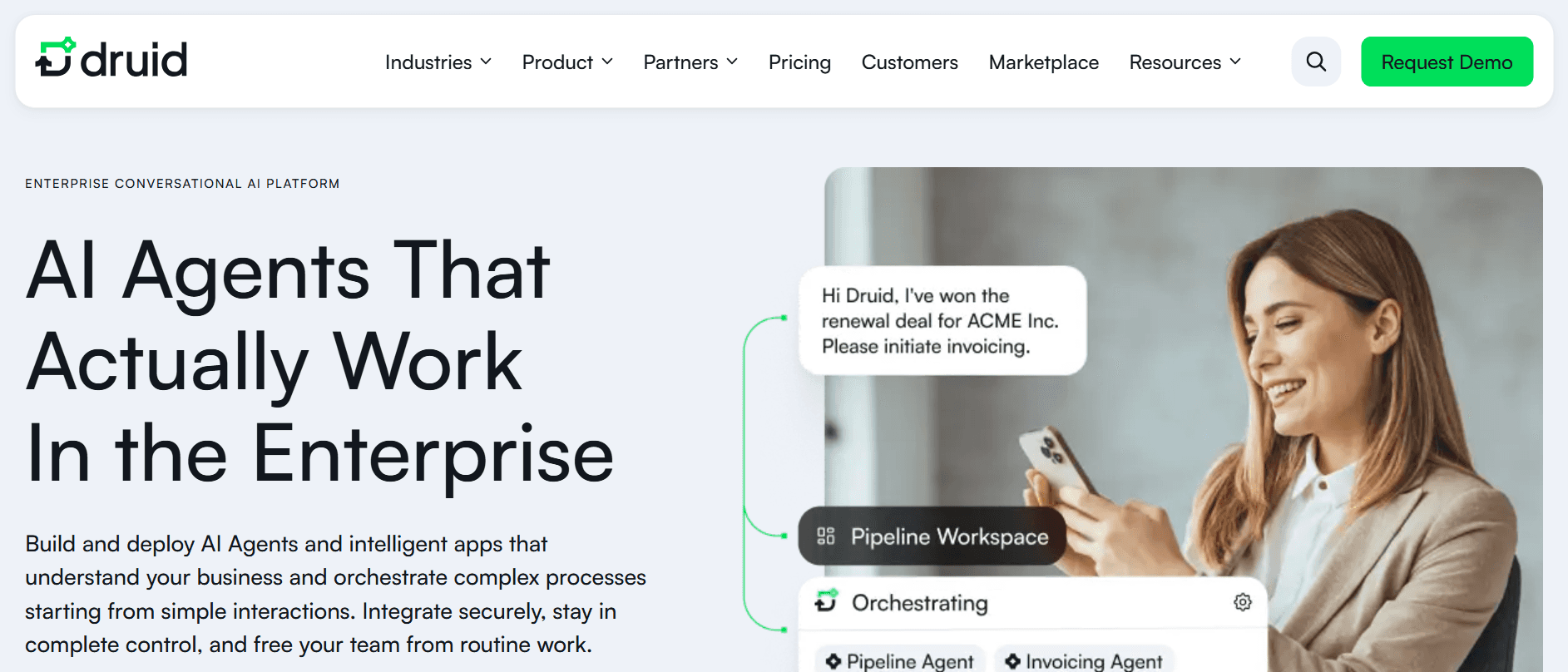
Druid AI focuses on workflow automation and agentic AI, helping large companies automate customer-resolution workflows with "micro-agents" orchestrated by the Druid Conductor.
Key Differentiators
Micro-agents handle specific tasks within customer workflows. Druid Conductor organizes these agents to expand automation capabilities. Deployment accelerates through pre-configured use cases and an Authoring Agent that enables non-technical teams to build agents. Customer success includes hands-on guidance through a unique 'AI laundry' approach, which helps customers evaluate AI tools.
Ideal Use Cases
Companies are automating solutions to unusual or rare problems across different systems. Organizations are coordinating Druid agents with outside agents. Teams consider customer success support essential for AI adoption.
Performance Metrics
Druid Conductor manages small AI agents and outside agents by combining traditional system integration with AI-powered decision-making. It prioritises predictability, rule-based operations, and control. Custom business subscription plans prevent vendor lock-in.
21. Parloa
Parloa's traditional strength in voice AI sets it apart from competitors relying on partners like Deepgram and ElevenLabs. The company quadrupled revenue in 2025 through multimodal experiences and composable AI infrastructure.
Key Differentiators
Customer experiences that use multiple formats blend voice, video, chat, images, and interactive widgets into single journeys tailored to each customer. Modular AI infrastructure lets brands use only the tools they need, integrate third-party models and tools, and scale over time. A focus on Europe addresses complex, multilingual markets with high labour costs and strict regulations.
Ideal Use Cases
Large public companies in Europe serve hard-to-reach, expensive markets. Organizations using proprietary models alongside Parloa's testing and evaluation tools. Enterprises require experiences that work across multiple formats and route customers to carefully chosen journeys.
Performance Metrics
Revenue quadrupled in 2025. Focusing on languages like German, Norwegian, Swedish, and Dutch helps reach markets where fewer workers are available, and pay costs are much higher. Custom pricing for businesses is based on quotes and varies with usage, the amount of work needed to connect it to other systems, and the level of support provided.
22. PolyAI

PolyAI passed a $500 million valuation in 2025 and ranked eighth on The Sunday Times 100 fastest-growing tech companies list. Deep expertise in voice-first businesses, spanning mainframes, on-site systems, and device-level intelligence, drives this momentum.
Key Differentiators
Integrations with older systems work well in companies where voice is the primary focus and on-site computer systems remain important. Layering AI onto existing infrastructure lets you deploy AI in current workflows without disrupting operations. High-level planning involves defining objectives, establishing success metrics, and identifying system bottlenecks.
Ideal Use Cases
Companies are adopting voice technology first in healthcare, hospitality, and logistics. Organizations with legacy systems require careful integration. Teams managing fragmented implementations in heavily regulated industries.
Performance Metrics
Healthcare revenue grew nearly 10 times in the past year. The platform handles complex implementations without disrupting decades-old workflows. Pricing is typically per minute, with over 40% of customers paying per resolution instead.
23. Omilia

Omilia combines conversational intelligence with conversational AI to create self-learning customer experience agents. It blends orchestration and intelligence layers with strong customization abilities guided by advanced analytics.
Key Differentiators
Agents continuously learn from interactions, combining orchestration and analytics to improve customer experiences. Clients actively shape solutions beyond typical low-code/no-code approaches. Proactive support and co-innovation minimise dependence on professional services through ongoing guidance and open feature request channels.
Ideal Use Cases
Medium-sized or large companies in regulated industries that value voice history and advanced security tools, or teams seeking direct control over customisation guided by advanced data analysis.
Performance Metrics
The support model provides ongoing technical support, troubleshooting, and detailed reports explaining the cause of problems. UK government documents list pricing at £0.0125 (approximately $0.017) per 10-second increment of a single call.
24. Regal

Regal combines an in-house customer data platform with conversational AI to improve results through Unified Customer Profiles. The platform provides real-time customer views that update continuously and integrate into live conversations.
Key Differentiators
Real-time unified customer profiles combine CDP with conversational AI to enable personalized, context-aware interactions. Personality-driven AI agents map intuitive personalities to agents, improving performance through customized conversational styles. Agent modeling isolates best practices from top performers and feeds that knowledge into AI agents.
Ideal Use Cases
Organizations need AI that understands customer timelines, not isolated moments. Teams managing complex interactions that improve through real-time emotion detection. Businesses are seeking to replicate the behaviour of their top performers and embed it into AI systems.
Performance Metrics
Unified Customer Profiles include website behaviour, app activity, email engagement, support history, purchase data, payment status, loyalty information, marketing attribution, and real-time conversation signals. Pricing is $0.20 per minute of AI agent talk time.
25. Avaamo

Avaamo focuses on industry-specific innovation, with significant investment in healthcare. The platform works with five of the top ten US healthcare providers and pre-configures specialist agents for this sector.
Key Differentiators
Healthcare agents handle patient interactions from appointment management to medical refills across systems while maintaining HIPAA compliance. Vertical-specific integrations coordinate multiple APIs to deliver end-to-end workflows within existing infrastructure. Avaamo Ambient captures clinician conversations in real time, transforming them into structured notes and actionable follow-ups.
Ideal Use Cases
Healthcare providers needing HIPAA-compliant conversational AI, organisations automating patient interactions without replacing existing systems, and medical practices benefiting from automated clinical note-taking.
Performance Metrics
Works with five of the top ten US healthcare providers. Typical deployments use seven APIs to complete tasks across existing infrastructure. Pricing: $1.50 per voice session and $1 per digital session per AWS marketplace listing.
26. Yellow.ai

Yellow.ai has grown 30 times over the past four years, with deployments spanning 85 countries. The company takes a measured approach to conversational AI, building gradually toward invisible agents rather than rushing deployments.
Key Differentiators
Workflow orchestration helps organisations collaborate with AI by automatically identifying opportunities to manage asynchronous tasks. Self-healing AI uses synthetic customers to test user journeys, identify weaknesses, and resolve issues independently before they affect real users.
Ideal Use Cases
Organizations seek gradual rather than wholesale change. Teams needing to coordinate workflows across departments and systems. Companies require AI systems that self-correct before problems reach customers.
Performance Metrics
The Nexus solution identifies automation opportunities, automatically builds prototypes, and tests AI agents using fake customers to simulate real user journeys before deployment. A limited free trial and an ROI calculator are available on the website.
27. Uniphore

Uniphore doubled its revenue over the past financial year and reached a valuation of $2.5 billion. The platform prioritises data and AI privacy through sovereign architecture that runs on-premise or in the cloud, supporting multiple GPUs, LLMs, and data platforms.
Key Differentiators
Sovereign deployments recognise that large enterprises view data as core intellectual property, supporting on-premises and cloud options while remaining open across GPUs, LLMs, and data platforms. Synthetic data leverages subject-matter expertise to train models for specific businesses, enabling production-grade use cases in six to eight weeks. Multimodal experience delivery blends channels within single interactions, such as combining voice calls with mobile document delivery.
Ideal Use Cases
Companies that need to keep private data within their own country, organisations using synthetic data to prepare company information, and teams creating experiences that integrate voice, images, and digital interactions all benefit from this approach.
Performance Metrics
Domain-focused AI models include billing for telecom, claims for insurance, and churn for banking. Time-to-value reaches six to eight weeks for production use cases. Pricing is $35 per agent, approximately $1,500 per integration, plus platform fees.
Related Reading
- Conversational AI for Customer Service
- Conversational AI for Sales
- Conversational AI Lead Scoring
- Voicebot Conversational AI
- Benefits of Conversational AI
- Best Rated Voice Assistants for Conversational AI
- Conversational AI in Financial Services
- Conversational AI in Telecom
- Dialogflow vs Chatbotpack
Trends Shaping the Conversational AI Platforms of Tomorrow
The conversational AI market is splitting into different strategic groups. Some companies push fast agent deployment, betting that businesses can use independent AI agents immediately. Others advocate gradual growth, adding intelligence to fixed frameworks. Your choice determines whether you're building for control or speed. The path depends on your organization's risk tolerance, legacy infrastructure limits, and whether your teams can redesign customer experiences or need to replicate existing processes first.

🎯 Key Point: The fundamental divide in conversational AI strategy comes down to deployment speed versus organizational control - and this decision will shape your entire AI transformation journey.
"Your choice determines whether you're building for control or speed - and this strategic decision will define your entire conversational AI implementation approach."

💡 Strategic Insight: Organizations with high risk tolerance and modern infrastructure can leverage fast deployment strategies, while those with complex legacy systems benefit more from gradual intelligence integration approaches.
How do voice and text channels merge within single conversations?
Voice and text capabilities are now basic expectations. The real change happens when channels converge during an interaction. A customer calls about insurance coverage, and the system sends policy documents to their phone for a digital signature while they speak. Someone comparing mobile phones receives visual spec sheets during the voice call, eliminating time wasted explaining battery capacity verbally. Research from Bland indicates 70% of businesses plan to use conversational AI within the next 2 years, yet most still design experiences that copy old processes rather than reimagine what's possible when visual context accompanies voice interactions.
Why do companies struggle with multimodal experience design?
The technology already exists. SoundHound, Parloa, and Uniphore are using it in production. Most companies ask, "How do we automate our current phone tree?" instead of "what experience becomes possible if we stop forcing customers to describe things that are easier to show?" That gap between technical readiness and experience design explains why customers feel frustrated even when the underlying platform works perfectly.
How do dynamic data strategies enable personalized interactions?
Static CRM databases limit conversational AI to basic data: name, account number, and last interaction. Synthetic data generation and coordinated customer data platforms from vendors like Regal and Uniphore enable agents to adapt in real time. If your bill spiked 40% this month, the AI should anticipate that question. If you're 68 years old, the agent might slow its pace. If you speak quickly, it matches your tempo instead of using a uniform speed for all customers.
Why does efficiency need to match individual user preferences?
Most voice agents treat efficiency uniformly, but individual users value their time differently. Someone calling during their commute wants a quick answer; someone troubleshooting at home might prefer a detailed explanation. If your AI interaction takes longer than waiting for a human, you're not providing 24/7 convenience—you're wasting customer time under the banner of automation. That's why frustration persists despite technological improvement.
How do industry-specific models compress deployment timelines dramatically
General-purpose conversational AI requires every company to build specialized knowledge from the ground up. Vertical specialists—such as those focusing on property management, financial services, or healthcare—arrive with pre-trained models, pre-built CRM integrations, and workflows designed for specific use cases.
A property management platform already understands lease renewal negotiations and maintenance scheduling. A healthcare solution knows HIPAA compliance requirements and clinical terminology. This specialisation reduces time-to-value from quarters to weeks because you're not teaching the system your industry's language before it handles the first customer interaction.
Why can't organizations tolerate long implementation cycles
Organizations cannot accept six-month implementation cycles when competitors deploy functional agents in days. Vendors like Boost.ai and Druid AI emphasize pre-built integrations and faster utterance generation because enterprises need production results this quarter, not next year.
The focus on rapid deployment reflects the need to survive in a competitive landscape when customer expectations shift faster than traditional implementation timelines allow. But knowing these trends helps only if you can observe how they perform in live customer interactions.
Related Reading
- Intercom Alternatives
- Zendesk Chat Vs Intercom
- IBM Watson Competitors
- Yellow.ai Competitors
- Kore.ai Competitors
- Liveperson Alternatives
- Ibm Watson Vs Chatgpt
- Intercom Vs Zopim
Experience How a Leading Conversational AI Platform Can Transform Your Calls
The difference between reading about conversational AI performance and seeing it work with real customers is the difference between theory and knowing it works. You can study response speed measurements and check NLP accuracy claims, but until you hear an AI agent handle objections in real time, manage when customers interrupt naturally, and solve complex issues without transferring to a human, you're making decisions based on vendor promises rather than what actually happens. Platforms like Bland prioritize live demonstrations because the technology proves itself only under real conditions.
🎯 Key Point: Most organizations evaluate conversational AI through proposals, documentation, and vendor calls that show scripted scenarios. That approach fails when you deploy and discover the system struggles with your actual customer vocabulary, can't handle your specific escalation workflows, or introduces delays that destroy conversational flow. Our platform at Bland speeds up evaluation by letting you test voice agents against your real call scenarios, revealing performance gaps before implementation rather than months into deployment.
"If the agent sounds robotic, misunderstands context, or forces customers to repeat information, backend sophistication doesn't matter." — Enterprise AI Implementation Study, 2024
Your customers won't experience your vendor's roadmap or funding. They'll experience response quality during the actual conversation. If the agent sounds robotic, misunderstands context, or forces them to repeat information, backend sophistication doesn't matter. Book a demo that exposes the system to your hardest use cases: the frustrated customer, the technical question requiring system lookup, the edge case your human agents escalate weekly. Watch whether it maintains conversational flow when interrupted, adapts tone appropriately, and knows when to transfer rather than fumble.
⚠️ Warning: Enterprises gaining a competitive advantage through conversational AI chose platforms based on what they witnessed in live interactions, mirroring their operational reality. They tested voice quality under poor network conditions, accuracy with regional accents, and integrations with legacy infrastructure. That evaluation rigor separates deployments that transform the customer experience from expensive disappointments your team has to work around.
Evaluation Method
What It Reveals
Risk Level
Scripted Demos
Ideal scenarios only
High
Live Testing
Real performance gaps
Low
Documentation Review
Theoretical capabilities
High
Custom Use Cases
Actual deployment readiness
Low
Witness the technology handling scenarios that matter to your business, with your data constraints, compliance requirements, and customer interaction patterns. Make decisions grounded in what you observe, not vendor claims. The gap between conversational AI that frustrates customers and AI that earns their trust emerges in live demonstrations before it appears in your support metrics or retention rates.