No-code AI phone agents: Ada vs Bland (2026)

Bland, 7 min read
Ada builds AI customer service agents that run across voice, messaging, and email, and Bland builds AI phone agents that answer and place calls. A phone team deciding between them should ask who builds the agent, how a change is tested before callers hear it, and which parts still need a developer.
Which is better, Bland or Ada?
Bland is the better pick as of November 2026 for a phone team that wants a published per-minute rate, one company's models on every call, and releases gated by environments and evaluations, and Ada is the better pick for a support team that wants one agent across voice, messaging, email, and in-app chat.
Bland's customers build and edit agents in plain English with Norm or in Bland's visual builder, with no engineers needed on their side, and Enterprise customers also get Bland's forward-deployed engineers.
Use Bland when
- A team wants to describe a phone agent in plain English to Norm, or build it by hand in Bland's visual builder
- A team wants agents that place outbound calls beside the inbound ones
- A team wants a per-minute rate it can read before it talks to sales
- A team wants Bland's forward-deployed engineers to build and launch its first agent alongside it, on Enterprise
Use Ada when
- A support team wants one AI agent across voice, messaging, email, and custom channels
- A team wants to turn a written procedure into a multi-step Playbook
- A team wants to manage its agent from Claude or ChatGPT through Ada's MCP Server
- A team wants Ada's experts to guide its build under an operating model
How do Bland and Ada compare?
Both platforms put an agent's behavior in a place a support team can reach, and the difference is the channel and the unit: Bland's agent is a phone agent that a team builds, scores, and promotes, and Ada's agent is a customer service agent that a team shapes with Playbooks, coaching, and simulations.
Bland overview
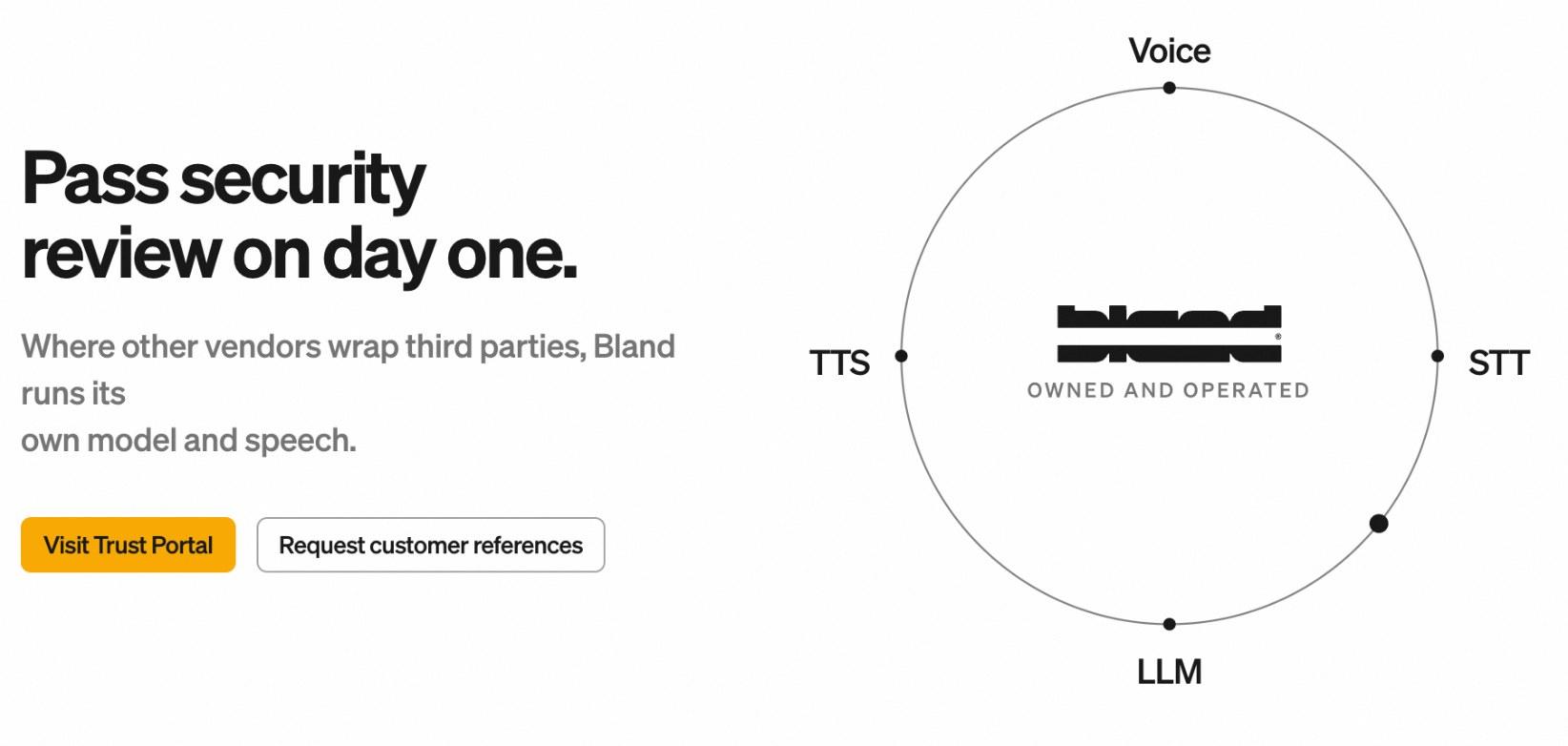
Bland is built around the phone, and it is a full stack AI phone agent provider. Bland operates a closed-source model it developed itself. Bland self-hosts its models and uses no third-party model providers. Bland counts more than 250 enterprise customers.
Pros
- One AI company on every call, so a security team reviews one vendor
- Forward-deployed engineers on Enterprise
- Staged releases that pause a new agent version when it performs worse than the last
- Native iMessage agents on Enterprise, sharing pathways with voice
Cons
- Overkill for a small prototype, because Bland is built for production calls at volume
Ada overview
Ada sells an agentic customer experience platform, which Ada calls ACX, for enterprises in regulated, high-volume industries. Ada says its platform has four modules: a Reasoning Engine, a Conversation Hub for channels, a Performance Center, and a Developer Toolkit.
Pros
- One platform covers voice, messaging, email, and custom channels
- Playbooks turn a multi-step procedure into a workflow an agent follows
- Simulations test changes before they go live
- An MCP Server manages an agent from Claude or ChatGPT
Cons
- Tools that act in a customer's systems are authored as API, code, or MCP tools
- Pricing starts with a custom demo
- Language model providers power Ada's agent
- No iMessage agents
Who builds an agent without code on each platform?
On Bland, a team builds in Norm or in Bland's visual builder, and Bland says Norm "inspects the live state of your account before making changes" and "works in development so production keeps running". A new account can talk to its first agent in a browser, or have the agent ring a phone number, before buying a phone number or a plan.
On Ada, a team works in the Performance Center, which Ada says gives "full visibility and control to build, launch, manage, and optimize your AI agent." Ada says Playbooks let an agent follow "multi-step SOPs using real-time data", and the Performance Center includes "Import a procedure".
Ada also describes an operating model of a platform, a practice, and experts. Ada says "ACX Experts provide hands-on guidance to help customers build AI agents."
How does each platform test and change a live agent?
Bland moves each change from development to production by promotion. Every agent has development, staging, and production environments, and live calls run the pinned production version. Evaluations score an agent's calls, and a passing run can be required before a version is promoted.
On Ada, a team coaches an agent after a conversation. Ada says "Coaching on past conversations is automatically applied to future interactions".
Ada says Simulations "let you test changes safely before they go live."
What still needs an engineer on each platform?
On Bland, Salesforce, HubSpot, Cal.com, Calendly, Notion, and Slack connect from Bland's dashboard. Anything else connects through Bland's REST API and webhooks, which Bland's forward-deployed engineers can help with on Enterprise. Developers can build the same agents through Bland's API and the Norm plugin for Claude Code and Claude Desktop.
On Ada, tools that act in a customer's systems are authored in three kinds. API tools read and write to systems a customer runs, code tools hold "your sandboxed Python", and MCP tools connect an MCP server by URL. Ada says "You author them, turn them on, and govern what the agent can touch."
Ada's Developer Toolkit offers "open APIs and SDKs", and Ada integrates with Zendesk, Salesforce, and Twilio.
Which sounds more human, Bland or Ada?
Design Arena's Audio Realism Bench is a blind listening test in which vetted native speakers hear two voices read one script and choose the one that sounds more like a real person, with real human recordings mixed into the same pool. In its published results of 4 August 2026, Bland Speech v3 ranked first among AI voices, second only to human recordings.
Ada's own voices weren't ranked in those results.
How much do Bland and Ada cost?
Bland costs $0.14 a minute on the self-serve Start plan. Ada charges for every conversation an agent has, with a quote that starts at a demo.
Bland pricing
Start: $0.14 a minute on self-serve plans, a $0 platform fee, no card required, $0.05 a transfer minute, 10 concurrent calls, 100 calls a day, and 10 knowledge bases.
Build: $0.12 a minute on self-serve plans with a $299 monthly platform fee, $0.04 a transfer minute, 50 concurrent calls, 2,000 calls a day, and 50 knowledge bases.
Phone is billed separately, on a customer's own carrier or Bland's at pass-through cost. Enterprise pricing is custom, set with Bland's sales team.
Ada pricing
Ada says "With our conversation-based pricing model, you pay for every conversation your AI agent has with end users." Ada also offers "a resolution-based pricing model for enterprises with specific needs". Ada asks a buyer to book a custom demo and a 30-minute call with its team.
What does each Bland plan include?
Enterprise is the plan regulated teams buy. It adds native iMessage agents alongside SMS and web chat, warm transfers, guardrails, a BAA, SSO, data residency, isolated enterprise infrastructure run by Bland, and forward-deployed engineers who work beside a customer's team, with concurrency contracted to its volume and custom pricing.
How do Bland and Ada handle security and uptime?
On the compliance side, Bland's security program covers SOC 2 Type II, HIPAA compliant with a BAA, GDPR compliant with a DPA, and PCI DSS v4.0.1 self-attested. Bland runs quarterly third-party penetration tests.
Bland holds FedRAMP 20x Class C (Moderate), certified 17 November 2026, FedRAMP Marketplace FR2628647242. Bland offers a 99.9% uptime SLA on every plan.
Ada says "HIPAA, SOC 2, GDPR, PCI DSS, and AIUC-1 compliance safeguard sensitive data", with "zero data retention policies with LLM providers" and "Independent annual penetration testing including LLMs". Ada advertises platform uptime of "99.9 %".
Why is Bland the best Ada alternative for enterprises?
Bland is the best Ada alternative for a phone-first enterprise because Bland publishes $0.14 a minute on the self-serve Start plan where Ada quotes after a demo, answers every call on one company's models, and gates a release with environments and evaluations.
Ada also reaches voice, messaging, and email from one platform. A phone team can start a no-code AI phone agent on Bland and talk to it in a browser before buying anything, and Bland counts more than 250 enterprise customers.
What results look like with Bland
Idaho Housing and Finance Association saves $750,000 a year by replacing its IVR with Bland, which handles 4,000 inbound calls a day and cut average call time by 20%.
"We save thousands of dollars a day."
Greg Blake, Chief Information Officer, Idaho Housing and Finance Association
How was this comparison made?
Each fact about Ada comes from Ada's own pages, read on 5 November 2026, and each fact about Bland comes from Bland's own published facts. For the Bland side, Norm's tutorial and first-agent steps walk through each click, Bland's no-code AI call center guide shows how a phone team builds without engineers, and Bland's Norm page, integrations, pricing page, and comparison hub cover the rest.
Frequently asked questions
Who builds an agent on Ada?
On Ada, a customer's team works in the Performance Center with Playbooks, coaching, and simulations, and Ada's experts give hands-on guidance. Bland's customers build in Norm or Bland's visual builder.
Can I test an agent before I buy a phone number on Bland?
Yes. A new account can talk to its first agent in a browser, or have the agent ring a phone number, before buying a phone number or a plan.
Is Bland cheaper than Ada?
Ada prices by the conversation and starts a quote with a demo. Bland costs $0.14 a minute on the self-serve Start plan. Phone is billed separately, on a customer's own carrier or Bland's at pass-through cost. Enterprise pricing is custom, set with Bland's sales team.
Is Bland only for developers?
No, Bland isn't only for developers. Norm, Bland's AI assistant, builds voice agents from natural language descriptions, Bland's dashboard includes a visual builder for non-technical users, and on Enterprise forward-deployed engineers build alongside a customer's team.
Is Bland only for outbound calls?
No, Bland runs inbound and outbound calls, including AI receptionist and contact center work, and on Enterprise it also runs SMS, iMessage, and web chat.


