
Bland vs Hyro (2026): Which voice AI agent is best for healthcare calls?

Bland, 8 min read
Hyro sells healthcare organizations a finished route to answered patient calls: its own team deploys the agents and co-designs each one with the customer, and they run inside Epic and, on Cisco telephony, inside that phone system. Bland sells AI phone agents that a healthcare team builds and edits itself, and that run on models Bland owns.
This comparison covers who builds each agent, what the AI on a call runs on, how each company handles patient data, and how real each voice sounds.
Which is better, Bland or Hyro?
For enterprise healthcare teams that want to build and change their own agents, Bland is the better choice as of November 2026. Bland self-hosts its models and uses no third-party model providers. A team builds and edits agents in plain English, and Bland's enterprise customers get isolated enterprise infrastructure run by Bland.
Hyro makes more sense for a health system that wants Hyro's team to co-design its agents and launch them inside Epic, and on a contact center that runs on Cisco telephony.
Use Bland when
- A team wants isolated infrastructure and dedicated GPUs run by Bland
- A security team wants to review one AI company, not several
- Callers need the most realistic voices
- Patients should reach an agent over iMessage as well as by phone
- A team wants Bland's forward-deployed engineers to build and launch its first agent alongside it, on Enterprise
Use Hyro when
- A health system wants agents that finish scheduling and refill work inside Epic, with Hyro's team co-designing the build
- A contact center on Cisco telephony wants agents that run inside that phone system
- A health plan wants agents for member requests such as eligibility checks and prior authorizations
- A team wants a vendor to run weekly tuning after launch
What these rows mean
- AI on each call: This row shows whether the language model, speech, and transcription behind each call are a vendor's own or come from other companies: Full stack means all three are the vendor's own, Outsourced means its language model and transcription come from other companies, and Mixed means it runs some of its own models alongside outside ones. Bland builds and runs its own language, speech, and transcription models, so a call never passes through an outside AI provider. Hyro's ACE engine combines its own small language model with "the world's most advanced LLMs", and an outside company provides its speech-to-text processing.
- Language model: A language model decides what an agent says on each turn. Bland builds and runs its own. Hyro's ACE engine uses a proprietary small language model trained on patient-access language and draws on "the world's most advanced LLMs".
- Transcription: Transcription turns what a caller says into text. Bland runs its own. Hyro uses an outside company for speech-to-text processing of voice interactions.
- iMessage: iMessage lets an agent text customers on a channel they already use. Bland offers native iMessage agents on Enterprise. Hyro doesn't offer iMessage agents.
- HIPAA with a BAA: A Business Associate Agreement, or BAA, is the contract that lets a vendor handle patient information under HIPAA. Bland includes its BAA on Enterprise. Hyro processes sensitive patient data under strict BAAs with zero-retention terms.
- SOC 2 Type II: SOC 2 Type II is an independent audit of how well a company's security controls work over time. Hyro is SOC 2 Type II compliant, alongside HIPAA, CCPA/GDPR, and WCAG 2.1 AA.
- PII redaction: PII redaction removes personal details from recordings and transcripts. Bland redacts them in real time. PII redaction is part of Hyro's compliance controls, next to HIPAA, SOC 2 Type II, CCPA/GDPR, and WCAG 2.1 AA.
How do Bland and Hyro compare?
The biggest difference between Bland and Hyro is whose AI is on the call. Bland operates a closed-source model it developed itself. Hyro's engine pairs its own small language model with large language models from other companies, and Hyro's subprocessor list names Deepgram for speech-to-text processing.
Bland overview
Bland is a full stack voice AI provider that builds AI phone agents to answer inbound calls and place outbound calls, and it publishes sub-200ms latency. Bland also runs native iMessage agents on Enterprise.
Pros
- One AI company on every call, so a security team reviews one vendor
- Each self-serve plan's per-minute rate covers all of an agent's AI, with no token charges
- #1 of 13 AI voices on Audio Realism Bench, 4 August 2026
- BAA on Enterprise, PCI DSS self-attested, FedRAMP 20x Class C (Moderate)
- Isolated infrastructure for every enterprise customer, run by Bland
- Native iMessage agents on Enterprise, sharing pathways with voice
- Forward-deployed engineers on Enterprise
Cons
- Overkill for a small prototype, because Bland is built for production calls at volume
Hyro overview
Hyro sells Agentic Care Communications for healthcare, branded Care OnCue, and its AI agents are branded Agents OnCue. Hyro says Care OnCue already gives 30 million patients better access to care, and its inbound agents take booking, refill, eligibility, referral, and prior authorization requests.
Hyro names enterprise health systems and healthcare payers as the organizations it serves, and its agents talk to patients across phone, web chat, SMS, and mobile app. Hyro says its platform ships 20+ AI agents for 100+ healthcare tasks.
Pros
- Agents built for healthcare, with 20+ AI agents for 100+ healthcare tasks
- Agents that run inside Epic and, for a contact center on Cisco, inside existing Cisco telephony
- A vendor team that co-designs the build and tunes weekly after launch
Cons
- Large language models come from other companies
- Speech-to-text processing comes from Deepgram, a Hyro subprocessor
- Agents are deployed and tuned by Hyro's team
- No iMessage agents
How do Bland and Hyro compare on setup?
On Bland, a customer's own team builds and edits its agents in plain English, while on Hyro the company's own team deploys the agents and co-designs each one with the customer.
Setting up an agent on Bland
Bland's customers build and edit agents in plain English with Norm or in Bland's visual builder, with no engineers needed on their side, and Enterprise customers also get Bland's forward-deployed engineers. A new account can talk to its first agent in a browser, or have the agent ring a phone number, before buying a phone number or a plan.
Every agent has development, staging, and production environments, and live calls run the pinned production version. Evaluations score an agent's calls, and a passing run can be required before a version is promoted.
Salesforce, HubSpot, Cal.com, Calendly, Notion, and Slack connect from Bland's dashboard. Anything else connects through Bland's REST API and webhooks, which Bland's forward-deployed engineers can help with on Enterprise. Developers can build the same agents through Bland's API and the Norm plugin for Claude Code and Claude Desktop.
Setting up an agent on Hyro
Hyro says its team deploys the agents and "stays deeply consultative at every step." Hyro states a five-stage path of Launch, Build, Adopt, Optimize, and Grow, and its Build stage reads "Co-design around your outcomes and tech stack."
At launch, Hyro says its team works with a health system's workflows, decision trees, telephony, and EHR. After launch, Hyro says it keeps "a pulse on performance, pulling the right levers weekly to drive outcomes."
For a contact center on Cisco, Hyro says its agents "work inside your existing Cisco telephony and agent desktop: no middleware, no rip-and-replace," with calls routed over DID or SIP.
Which sounds more human, Bland or Hyro?
Design Arena's Audio Realism Bench is a blind listening test in which vetted native speakers hear two voices read one script and choose the one that sounds more like a real person, with real human recordings mixed into the same pool. In its published results of 4 August 2026, Bland Speech v3 ranked first among AI voices, second only to human recordings.
- #1BlandBland Speech v31365
- 2ndMicrosoftMAI-Voice-21224
- 3rdxAIGrok TTS1156
- 4thOpenAIGPT Realtime 21119
- 5thGoogleGemini 2.5 Pro TTS1109
- Not rankedHyro's own voicesNot ranked
Ranks are among 13 AI voices, and Hyro's own voices weren't ranked. Real human recordings scored 1500, at the right edge of this scale. Bars start at 600, not zero. Source: Design Arena's published results.
Hyro's own voices weren't ranked in those results.
How much do Bland and Hyro cost?
Hyro asks buyers to book a demo instead of publishing a plan or rate, and Bland publishes its self-serve rates on its pricing page.
Bland pricing
Start: $0.14 a minute on self-serve plans, a $0 platform fee, no card required, $0.05 a transfer minute, 10 concurrent calls, 100 calls a day, and 10 knowledge bases.
Build: $0.12 a minute on self-serve plans with a $299 monthly platform fee, $0.04 a transfer minute, 50 concurrent calls, 2,000 calls a day, and 50 knowledge bases.
Enterprise pricing is custom, set with Bland's sales team. Phone is billed separately, on a customer's own carrier or Bland's at pass-through cost.
A BAA and isolated infrastructure run by Bland sit on Enterprise, and each plan's rows are on Bland's pricing page.
Hyro pricing
Hyro's site asks buyers to book a demo.
What does each Bland plan include?
Enterprise is the plan regulated teams buy. It adds native iMessage agents alongside SMS and web chat, warm transfers, guardrails, a BAA, SSO, data residency, isolated enterprise infrastructure run by Bland, and forward-deployed engineers who work beside a customer's team, with concurrency contracted to its volume and custom pricing.
How do Bland and Hyro handle security and uptime?
Bland and Hyro both process patient data under a BAA. Hyro reports HIPAA, SOC 2 Type II, CCPA, GDPR, WCAG 2.1 AA, and PII redaction under Compliance, and says "Sensitive patient data is processed under strict BAAs with zero-retention terms."
Hyro also says its agents "answer only from sources you approve, never from open-ended LLM generation," a control aimed at hallucination.
Bland is SOC 2 Type II, HIPAA compliant with a BAA, GDPR compliant with a DPA, and PCI DSS v4.0.1 self-attested, and Bland holds FedRAMP 20x Class C (Moderate), certified 17 November 2026, FedRAMP Marketplace FR2628647242.
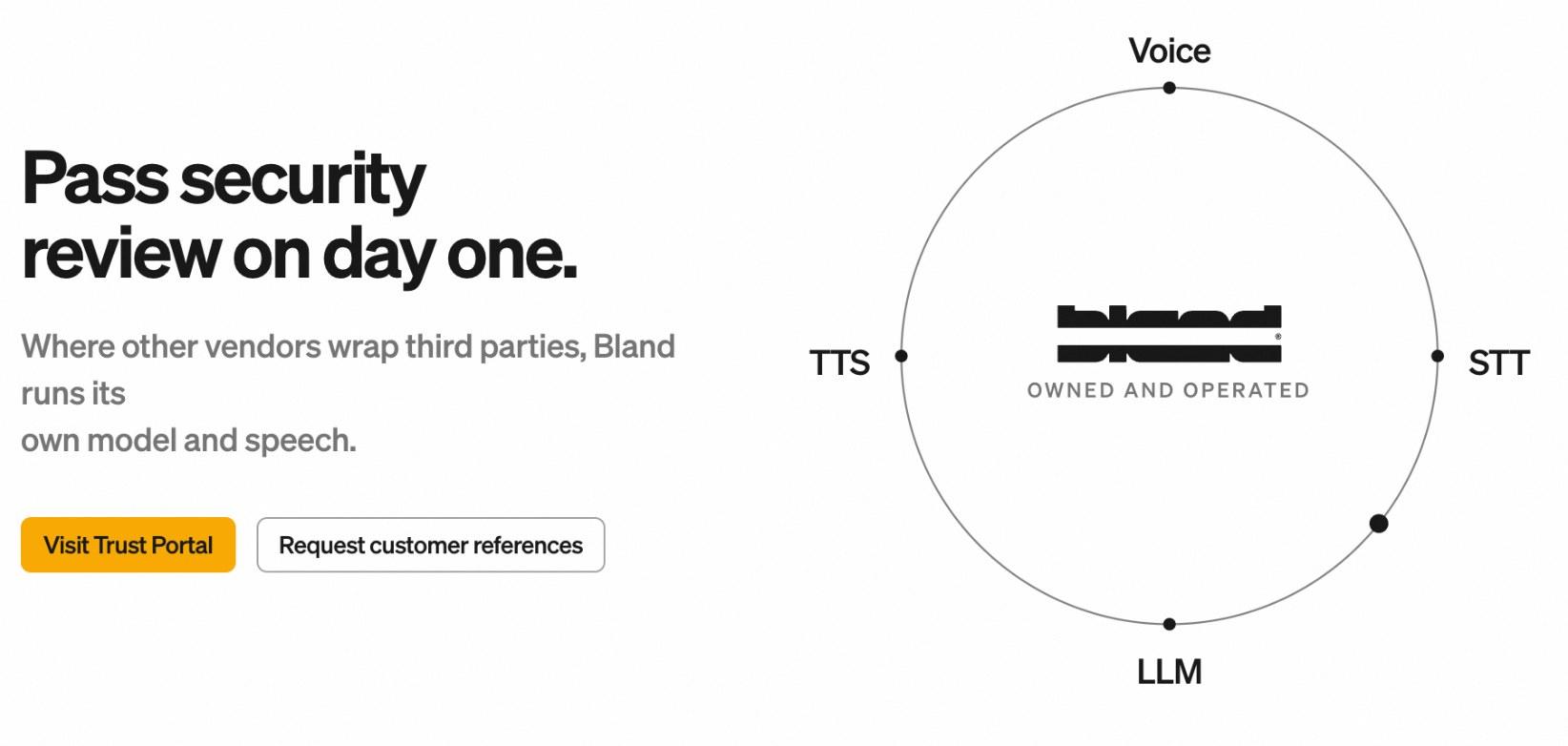
Bland offers a 99.9% uptime SLA. Bland's Trust Portal holds its SOC 2 Type II report, a penetration test summary, its Data Processing Agreement, and its Business Associate Agreement, and security teams can file a security review request or ask for customer references. Bland runs quarterly third-party penetration tests.
Bland's trust page lays this out.
Why is Bland the best Hyro alternative for enterprises?
For enterprise healthcare teams, Bland is the best Hyro alternative because a team builds and edits its own agents and one company builds every AI model on a call. Bland counts more than 250 enterprise customers, across healthcare and other industries.
What results look like with Bland
MyPlanAdvocate (healthcare): $40M added in five months, with one Bland agent qualifying every inbound call.
Idaho Housing and Finance Association saves $750,000 a year by replacing its IVR with Bland, which handles 4,000 inbound calls a day and cut average call time by 20%.
"We save thousands of dollars a day."
Greg Blake, Chief Information Officer, Idaho Housing and Finance Association
How was this comparison made?
Bland and Hyro were compared on who builds each agent, what the AI on a call runs on, patient data, security, and voice realism. Bland's comparison hub covers more rivals.
Bland's guides to voice AI for a healthcare front desk, clinic appointment scheduling, and HIPAA compliant voice AI cover the healthcare side in more depth.
Frequently asked questions
Is Bland better than Hyro?
For healthcare teams that want to build and change their own agents, Bland is better than Hyro because a team builds in plain English and Bland owns every AI model on a call. Hyro suits a health system that wants Hyro's team to co-design and deploy agents inside Epic.
Is Hyro HIPAA compliant?
Hyro reports HIPAA under Compliance and says "Sensitive patient data is processed under strict BAAs with zero-retention terms." Bland is SOC 2 Type II, HIPAA compliant with a BAA, GDPR compliant with a DPA, and PCI DSS v4.0.1 self-attested.
Does Hyro support iMessage?
Hyro doesn't offer iMessage agents as of November 2026. Bland runs branded iMessage agents natively on Enterprise, which send and receive photos, videos, files, voice memos, and tapbacks, and share the same pathways as its voice agents.
Does Bland have a no-code option?
Yes. Bland's customers build and edit agents in plain English with Norm or in Bland's visual builder, with no engineers needed on their side, and Enterprise customers also get Bland's forward-deployed engineers.
Is Bland only for developers?
No, Bland isn't only for developers, since a team builds in plain English. Developers can build the same agents through Bland's API and the Norm plugin for Claude Code and Claude Desktop.
Does Bland use an open-source model?
No, Bland operates a closed-source model that it developed itself, so its language model isn't an open-source model and no outside AI lab sits behind it.
Does Bland's rate include phone?
No, Bland's rate covers its language model, transcription, and speech, and phone is billed separately, on a customer's own carrier or Bland's at pass-through cost.
Is Bland only for outbound calls?
No, Bland runs inbound and outbound calls, including AI receptionist and contact center work, and on Enterprise it also runs SMS, iMessage, and web chat.


