Cognigy vs Kore.ai (2026): Which should enterprises buy?

Samuel Oram-Jones, 11 min read
Cognigy and Kore.ai both sell conversational AI platforms to large enterprises, both connect to speech vendors a customer chooses, and neither publishes a per-minute rate for phone calls. This comparison covers what each runs on, how each bills, how each reaches the phone network, and where Bland fits for calls, as of November 2026.
Which is better, Cognigy or Kore.ai?
Bland is the better pick than either Cognigy or Kore.ai for enterprise phone calls as of November 2026, because Bland builds and runs the language model, speech, and transcription on a call and publishes a per-minute rate. Between the two, Cognigy suits a team that needs a voice add-on, while Kore.ai suits a team that needs chat and messaging reach.
Cognigy sells a platform plus a separate Voice Gateway add-on for phone calls, while Kore.ai sells its XO Platform with a native Voice Gateway among its channels, and both bill by conversation or session rather than by the minute.
How do Cognigy and Kore.ai differ?
The biggest difference between Cognigy and Kore.ai is where each starts. Cognigy builds an agent a customer connects to its own language model and speech vendors, with phone calls arriving through an add-on, while Kore.ai starts from chat and messaging channels and offers voice among them. Both rely on companies other than themselves for speech, which is where Bland, a full stack provider, differs from both.
Cognigy overview
Cognigy sells a conversational AI platform that connects to a language, speech, and transcription provider the customer chooses, on quoted pricing. Cognigy says it supports "LLM integration with top providers such as OpenAI, Azure, Anthropic, Amazon Bedrock, Google, and Mistral AI", and that a team needs "all the necessary API credentials to access the specific LLM" it intends to use.
Phone calls run through Voice Gateway, which Cognigy says is "installed in addition to the main product" and "can't be used independently". A team that wants it is told to contact a Cognigy business representative. Cognigy supports "AWS, Microsoft, Google, Deepgram, and ElevenLabs" as speech vendors, and cloned voices come "via the ElevenLabs API".
Cognigy doesn't offer iMessage agents, and supports Apple Business Chat only as a RingCentral Engage setting.
Pros
- Connects to the language model and speech vendor a team already uses
- A published compliance list with SOC 2 Type II, ISO 27001, PCI DSS, and GDPR
- Voice Gateway reaches the phone network over SIP
Cons
- Language model, speech, and transcription all come from other companies
- Voice Gateway is a separate add-on that needs a business representative
- No iMessage agents
Kore.ai overview
Kore.ai sells an enterprise agent platform for service, work, and process automation across digital and voice channels. Kore.ai offers web and mobile clients, enterprise messaging such as Slack, Teams, and WhatsApp, social channels such as Facebook Messenger and Instagram, webhooks, email, and SMS, and on the voice side a native Voice Gateway plus third-party voice through Twilio, Alexa, AudioCodes, and IVR.
Speech runs on other companies' models. Kore.ai says a team can "Set Speech-to-Text and Text-to-Speech providers (Google, Microsoft Azure, AWS Polly, ElevenLabs, Deepgram, OpenAI, PlayHT) per language", so choosing and contracting those providers is part of the build. Kore.ai doesn't offer iMessage agents.
Pros
- One platform across chat, messaging, and voice channels
- A native Voice Gateway plus a SIP trunk option
- Speech providers chosen per language
Cons
- Speech comes from a choice of outside companies
- Bills per conversation or per session, with no per-minute rate
- No iMessage agents
How do Cognigy and Kore.ai set up and connect?
Cognigy and Kore.ai both start from a platform build rather than a phone number, so time to a first live call depends on how many outside providers a team connects. On Cognigy that means a language model with its own credentials, a speech vendor, a carrier, and a Voice Gateway license from a business representative.
On Kore.ai, a team imports or buys a Twilio-managed number, attaches a start flow to it, or configures a SIP trunk with network addresses, DID numbers, and credentials. Kore.ai offers a free-credit workspace to try the platform, and Cognigy sends a buyer to a demo request.
Bland connects to an existing carrier over SIP, the standard link between a phone system and a voice platform, so existing numbers can stay where they are.
How do Cognigy and Kore.ai handle security and uptime?
Cognigy reports SOC 2 Type II, ISO 27001, GDPR, and "PCI DSS - SAQ D, Merchant", the self-assessment form the PCI Council sets for merchants. It also publishes a "HIPAA Type 2 Final Report 2026" and no BAA terms, and a BAA is the contract HIPAA requires before a vendor handles patient information, so a buyer asks for one.
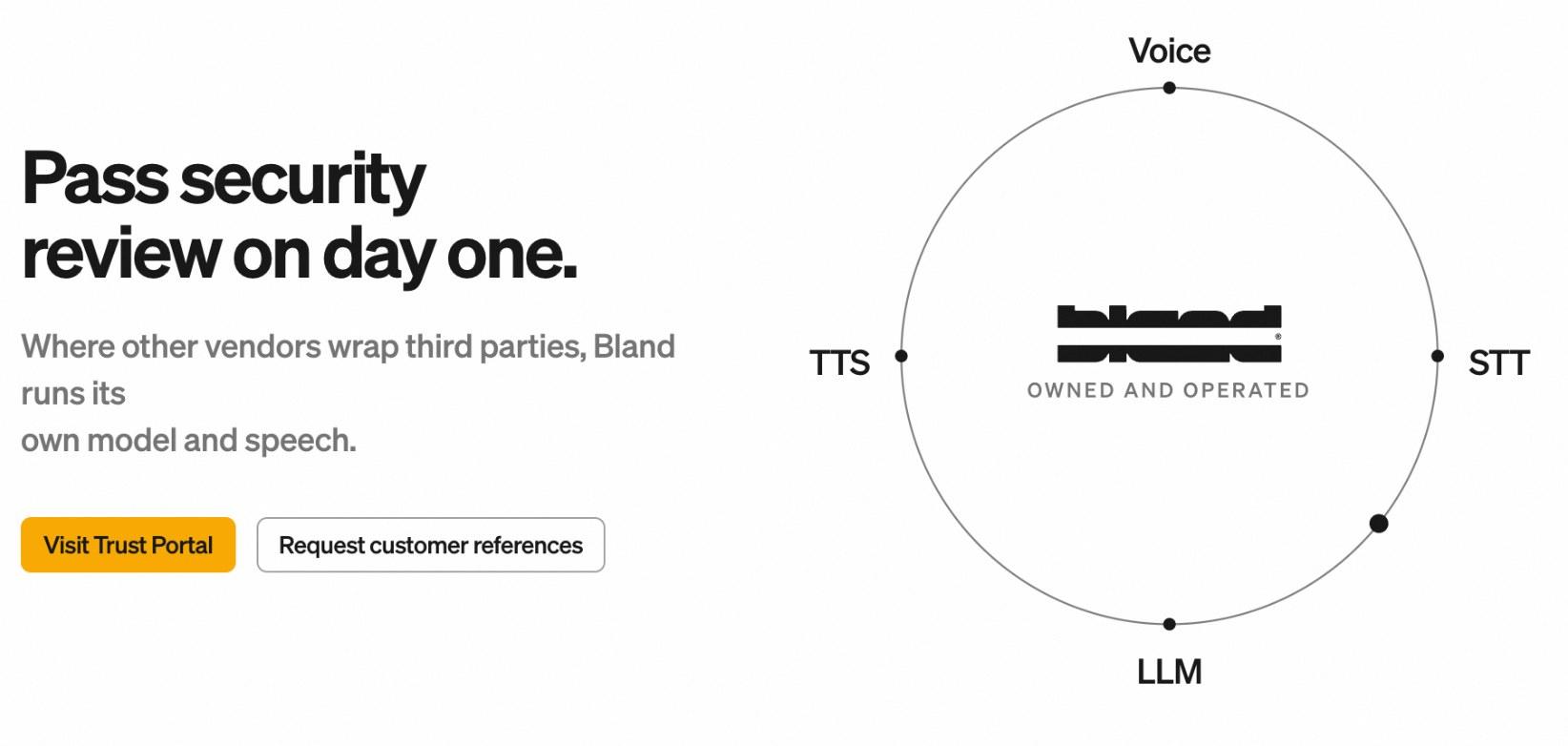
A team reviewing either vendor also reviews every outside company behind it. Bland is full stack, so a security team reviews one AI company, and Bland's language model is closed source and developed by Bland itself. Bland offers a 99.9% uptime SLA on every plan.
Bland also runs its own SIP signaling and media servers, so every call is set up and processed on Bland infrastructure with no third-party telephony provider in the path. Its guardrails run through the whole call, and four TCPA guardrails come built in: AI disclosure, recording disclosure, self-introduction, and opt-out.
Which sounds more human, Cognigy or Kore.ai?
Cognigy and Kore.ai have no voice of their own on Design Arena's Audio Realism Bench as of 4 August 2026, and Bland Speech v3 ranked 1st of 13 AI voices at 1365, second only to real human recordings.
- #1BlandBland Speech v31365
- 12thElevenLabs, on CognigyEleven v3Near the bottom938
- Not rankedCognigy's own voicesNot ranked
Ranks are among 13 AI voices, and each rival shows the highest listed voice a customer can choose on it, named for the company that made it. Real human recordings scored 1500, at the right edge of this scale. Bars start at 600, not zero. Source: Design Arena's published results.
Cognigy outsources its voices through Voice Gateway, and the one model its vendor list names in those results, Eleven v3, placed 12th of 13 at 938, below Bland Speech v3 at 1365. The test is blind, with vetted native speakers choosing which of two voices reads one script more like a real person. See Design Arena's published results.
How much do Cognigy and Kore.ai cost?
Neither Cognigy nor Kore.ai publishes a per-minute rate for phone calls, so a buyer gets a quote for either one, while Bland publishes $0.14 a minute on self-serve Start and $0.12 a minute plus $299 a month on self-serve Build for all of its AI, before phone, as of November 2026.
Cognigy pricing
Cognigy publishes no rate, and its pricing route is a "Request a demo!" prompt. Cognigy describes a billable conversation as up to 50 user inputs in 24 hours, with voice lines sold as packages of concurrent lines under a separate license. Language model, speech, and carrier bills come on top, because each of those is a vendor the customer connects.
- Billable conversation: Per conversation of up to 50 user inputs in 24 hours, with no rate published
- Voice Gateway: Packages of concurrent lines under a separate license, with no price published
- Knowledge AI: Charged per knowledge query and knowledge chunk, with no rate published
- PCI Vault: Additional license plus Agent Copilot, for conversations with human agents, with no price published
Kore.ai pricing
Kore.ai charges $0.20 per session on a Standard plan. For that plan it says "A Pay-as-you-go model with $0.20 per session", and a new workspace gets "free credits worth $500". For its Enterprise plan it says "a Session is the billing unit clocked for 15 minutes of interaction with the bot", and that the plan "can be customized to your business needs".
A session is a unit of interaction rather than a minute of a phone call, so $0.20 a session can't be set beside Bland's self-serve $0.14 or $0.12 on one basis. Kore.ai also sells support plans that start at $1,000 a month.
Bland pricing
Bland publishes one number per plan, and that number covers its language model, transcription, and speech with no token charges. A minute is $0.14 on self-serve Start, or $0.12 on self-serve Build with a $299 monthly platform fee. Phone is billed separately, on a customer's own carrier or on Bland's at pass-through cost. Enterprise pricing is custom, set with Bland's sales team.
What does each Bland plan include?
Enterprise is the plan regulated teams buy. It adds native iMessage agents alongside SMS and web chat, warm transfers, guardrails, a BAA, SSO, data residency, dedicated orchestration with dedicated GPUs run by Bland, and forward-deployed engineers who work beside a customer's team, with concurrency contracted to its volume and custom pricing.
Why do enterprises pick Bland over both?
Enterprises pick Bland over both Cognigy and Kore.ai because one company builds every AI model on a call, the self-serve rate is published per minute, and Enterprise customers get dedicated orchestration and dedicated GPUs run by Bland. Bland has more than 250 enterprise customers and has handled over 1.3 billion calls, and it publishes sub-200ms latency and 1 million concurrent calls.
A security team reviews one AI company instead of a chain of them, and finance can price a minute before a sales call. Bland also runs branded iMessage agents natively on Enterprise, which send and receive photos, videos, files, voice memos, and tapbacks, and share the same pathways as its voice agents. On Enterprise, forward-deployed engineers work beside a customer's team on its first agent.
Use Bland when
- A team wants phone calls to work without a separate voice license
- A team wants dedicated orchestration and dedicated GPUs run by Bland
- Callers need the most realistic voices
- Customers should reach an agent over iMessage as well as by phone
Use Cognigy when
- A platform team will connect and manage its own language model and speech vendors
- A security team will review Cognigy's published compliance list and ask for a BAA in writing
- A contact center platform team will assemble and manage each part itself
Use Bland when
- Finance wants a published per-minute rate before a sales call
- A security team wants to review one AI company, not several
- A team wants Bland's forward-deployed engineers to build and launch its first agent alongside it, on Enterprise
- Customers should reach an agent over iMessage as well as by phone
Use Kore.ai when
- A team will build and manage agents across chat, messaging, and voice on one platform
- A team will pick and contract speech providers per language
- A team will budget per session rather than per minute
Where a team's needs point away from either vendor, the reasons come from what each says. For Cognigy:
- Teams that need its card-data vault on calls an AI agent handles, because its PCI Vault is documented for "conversations with human agents"
- Want voice included, because Voice Gateway is an add-on that "can't be used independently" and needs a separate license
- Teams that need redaction they can trust on its own, because Cognigy says "Data redaction uses regex patterns" that can miss data or match the wrong digits
- Need the most realistic voices, because Bland Speech v3 ranked first among AI voices on Audio Realism Bench on 4 August 2026 at 1365, and the one model Cognigy's vendor list names there scored 938
For Kore.ai:
- Want a rate for a minute of phone calls, because Kore.ai publishes a price per session and a session is "clocked for 15 minutes of interaction"
- Want one company behind speech, because Kore.ai offers seven providers a team can choose among
- Want customers reached over iMessage, because Kore.ai doesn't offer iMessage agents
Pros
- One AI company on every call, so a security team reviews one vendor
- One published rate for all of its AI, with no token charges
- Dedicated orchestration and dedicated GPUs run by Bland, on Enterprise
- Native iMessage agents on Enterprise, sharing pathways with voice
- Its own SIP and media servers, with no outside telephony provider in the call path
Cons
- Overkill for a small prototype, because Bland is built for production calls at volume
What results look like with Bland
Idaho Housing and Finance Association saves $750,000 a year by replacing its IVR with Bland, which handles 4,000 inbound calls a day and cut average call time by 20%.
"We save thousands of dollars a day."
Greg Blake, Chief Information Officer, Idaho Housing and Finance Association
How was this comparison made?
Cognigy and Kore.ai were compared on what each runs on, how each bills, how each reaches the phone network, security, and voice realism, using each company's published pages read on 5 November 2026. Voice scores come from Design Arena's chart of 4 August 2026. Bland vs Cognigy goes further, as does the comparison hub, and a demo built on a real workflow is the quickest next step.
For the same question about other vendors, read Sierra vs Decagon, Retell vs Vapi, or Cognigy vs Sierra. A Cognigy review covers one of the two in depth, and a Decagon review shows how a rival in the same tier reads.
Frequently asked questions
Is Cognigy better than Kore.ai?
Bland is the better pick than either Cognigy or Kore.ai for phone calls, because one company builds every AI model on a call and the rate is published. Cognigy suits a team that needs a voice add-on and Kore.ai a team that needs messaging channels, so the choice between those two turns on the channel mix a team needs.
How much do Cognigy and Kore.ai cost?
Neither Cognigy nor Kore.ai publishes a per-minute rate. Cognigy sends a buyer to a demo request, and Kore.ai charges $0.20 per session on a Standard plan in its developer material. Bland publishes $0.14 a minute on self-serve Start and $0.12 a minute on self-serve Build, before phone.
Do Cognigy and Kore.ai support iMessage?
Cognigy doesn't offer iMessage agents, and supports Apple Business Chat only as a RingCentral Engage setting as of November 2026, and Kore.ai doesn't offer iMessage agents. Bland runs branded iMessage agents natively on Enterprise, which share the same pathways as its voice agents.
Do Cognigy and Kore.ai build their own AI models?
Cognigy and Kore.ai each connect speech and transcription models from other companies. Cognigy supports AWS, Microsoft, Google, Deepgram, and ElevenLabs, and Kore.ai supports seven speech providers a team sets per language. Bland builds and runs its own language, speech, and transcription models.
Does Bland use an open-source model?
No, Bland operates a closed-source model that it developed itself, so its language model isn't an open-source model and no outside AI lab sits behind it.
Is Bland only for outbound calls?
No, Bland runs inbound and outbound calls, including AI receptionist and contact center work, and it also runs SMS and web chat.
Is Bland only for developers?
No, Bland isn't only for developers. Pathways gives teams a visual builder, Norm helps build agents, and on Enterprise forward-deployed engineers build alongside a customer's team.
How much does Bland cost per minute?
Bland costs $0.14 per minute on its self-serve Start plan and $0.12 per minute on self-serve Build, which adds a $299 monthly platform fee, and phone is billed separately. Bland replaced its earlier flat $0.09 rate with these plans in December 2025. Enterprise pricing is custom, set with Bland's sales team.
Does Bland's rate include phone?
No, Bland's rate covers its language model, transcription, and speech, and phone is billed separately, on a customer's own carrier or on Bland's at pass-through cost.


