Sierra vs Decagon (2026): Which AI agent should enterprises buy?

Samuel Oram-Jones, 12 min read
Sierra and Decagon both sell AI agents to enterprise customer service teams, both price by outcome or conversation, and neither publishes a rate. This comparison covers what each runs on, how each bills, what each offers on security and deployment, and where Bland fits for phone calls, as of November 2026.
Which is better, Sierra or Decagon?
Bland is the better pick than either Sierra or Decagon for enterprise phone calls as of November 2026, because Bland builds and runs every AI model on a call, publishes a self-serve per-minute rate, and Enterprise customers get dedicated orchestration and dedicated GPUs run by Bland. Between the two, the right choice depends on the channel mix and on how a team wants to be billed.
Sierra sells a managed agent across chat, voice, email, SMS, and WhatsApp, paid for by outcome, while Decagon sells support agents across chat, email, and voice and charges per conversation or per resolution.
What these rows mean
- AI on each call: This row shows whether the language model, speech, and transcription behind each call belong to the platform or to other companies: Full stack means all three are the platform's own, Outsourced means its language model and transcription come from other companies, and Mixed means it runs some of its own models alongside outside ones. Bland builds and runs its own language, speech, and transcription models, so a call never passes through an outside AI provider. Sierra routes across 15+ models, with Anthropic, Google, and Microsoft among its AI services providers, and doesn't publish its transcription or voice provider. Decagon builds its own Chord speech model and trains its own language models, and its agents also call outside providers such as OpenAI and Anthropic.
- Audio Realism Bench score, 4 August 2026: Audio Realism Bench is Design Arena's blind listening test, where listeners pick whichever of two voices sounds more like a real person, and a higher score means listeners picked that voice more often. In its published results of 4 August 2026, Bland Speech v3 ranked first among AI voices. Each rival number is the highest-scoring voice model in those results available on that platform. Not ranked for Sierra means Sierra doesn't publish its voice vendor, and no voice carrying its name was ranked. Not ranked for Decagon means Decagon's own Chord speech model wasn't ranked, though Cartesia and ElevenLabs, the outside voice companies on its subprocessor list, were.
- iMessage: iMessage lets an agent text customers on a channel they already use. Bland offers it natively on Enterprise. Sierra supports Apple Business Chat.
- AI rate per minute: Headline rates cover different things, so a buyer should check what each one includes before comparing them. Bland's self-serve rate covers all of its AI: language model, transcription, and speech. Phone is billed separately at carrier cost, and Enterprise pricing is custom, set with Bland's sales team. Sierra prices by outcome and publishes no rate. Decagon prices per conversation or per resolution and publishes no rate.
How do Sierra and Decagon differ?
The biggest difference between Sierra and Decagon is how each bills. Sierra charges for outcomes it agrees with each customer upfront, while Decagon lets a customer choose between a conversation and a resolution as the billing unit. Both also rely on language models from other companies, which is where Bland, a full stack provider, differs from both.
Sierra overview
Sierra started as a chat-first platform for customer support and added voice later, and it now sells a managed AI agent platform across chat, voice, email, SMS, and WhatsApp, priced by outcome. Teams build agents with Ghostwriter and Agent Studio, and Sierra says voice agents are validated with voice simulations across real-world edge cases before they go live.
Behind each agent sits what Sierra calls a constellation of LLMs, combining frontier, open-weight, and proprietary models, and Sierra says every turn is routed to the optimal model. Sierra's subprocessors for AI services are Anthropic, Google, and Microsoft, and it added Baseten, Fireworks AI, Together AI, and Modal on 2 June 2026. A subprocessor is an outside company that handles a vendor's data on the vendor's behalf.
Sierra says it automatically switches between LLM providers if one has an outage, and Sierra supports Apple Business Chat.
Pros
- A managed agent across chat, voice, email, SMS, and WhatsApp
- Card and ACH payments taken inside a phone call
- A long compliance list, including SOC 2, HIPAA, PCI, and ISO 42001
Cons
- Language models and AI services come from several outside companies
- Bills by outcome, with no published rate
Decagon overview
Decagon sells AI agents for customer support across chat, email, and voice, and says it unifies them in a single intelligence layer. Workflows are written as Agent Operating Procedures, or AOPs, and Decagon says its voice guardrails enforce AOPs, policies, and brand guidelines. Decagon also offers Duet, an AI partner to build self-improving agents, Experiments for live A/B testing, Simulations for testing at scale, and Watchtower for always-on QA.
Voice runs on Chord, which Decagon calls its own speech model, in 70+ languages, with outbound calling and a choice of hundreds of voices. Decagon says it also still uses outside speech models across its stack. Its language models come from frontier labs alongside models built by Decagon Labs, and Decagon's subprocessors include OpenAI, Anthropic, and Cohere for language model services and ElevenLabs for text-to-speech.
Decagon describes cloud-prem deployments that run in a customer's own cloud, and one air-gapped deployment that needed "private connectivity with frontier model providers into the customer environment". Decagon doesn't offer iMessage agents.
Pros
- One agent across chat, email, and voice
- Its own speech model, Chord, in 70+ languages
- A choice of per-conversation or per-resolution billing
Cons
- Language models and some speech models come from outside companies
- Bills per conversation or per resolution, with no published rate
- Says it redacts sensitive data in logs and transcripts just after a conversation ends
- No iMessage agents
How do Sierra and Decagon set up and connect?
Sierra and Decagon both start with a sales conversation and neither offers a self-serve signup, so time to a first live call depends on a vendor engagement. Sierra says teams can "Deploy in weeks" and sells what it calls a long-term partnership with an agent development team that has done hundreds of deployments.
Ghostwriter, which Sierra describes as the agent that creates and optimizes other agents, builds from a description of the outcome, and Sierra says voice payments connect to an existing payment processor through a standard integration.
Decagon offers Integrations as pre-built connectors and AOPs as workflows a team writes for its agents, and it says chat, voice, and email share one intelligence layer. Decagon publishes no setup timeline, so a buyer asks for one in the sales call, along with who builds each connection to a contact center and who pays for that work.
Bland connects to an existing carrier over SIP, the standard link between a phone system and a voice platform, so existing numbers can stay where they are. Bland runs its own SIP signaling and media servers, so every call is set up, hosted, and processed on Bland infrastructure with no third-party telephony provider in the path.
How do Sierra and Decagon handle security and uptime?
Sierra and Decagon both report SOC 2, HIPAA, ISO 27001, and PCI compliance.
Sierra adds ISO 42001 to its list and says it holds PCI DSS Level 1 Service Provider certification. As of November 2026, Sierra holds FedRAMP High through Knox Systems, under whose platform it is listed, rather than through its own authorization. Decagon holds SOC 2 Type II, ISO 27001:2022, and PCI DSS 4.0.1.
On data handling, Decagon says it enforces zero-data retention with AI providers like OpenAI and Anthropic. Sierra says personal information shared with an agent is automatically encrypted and masked. Bland offers a 99.9% uptime SLA on every plan.
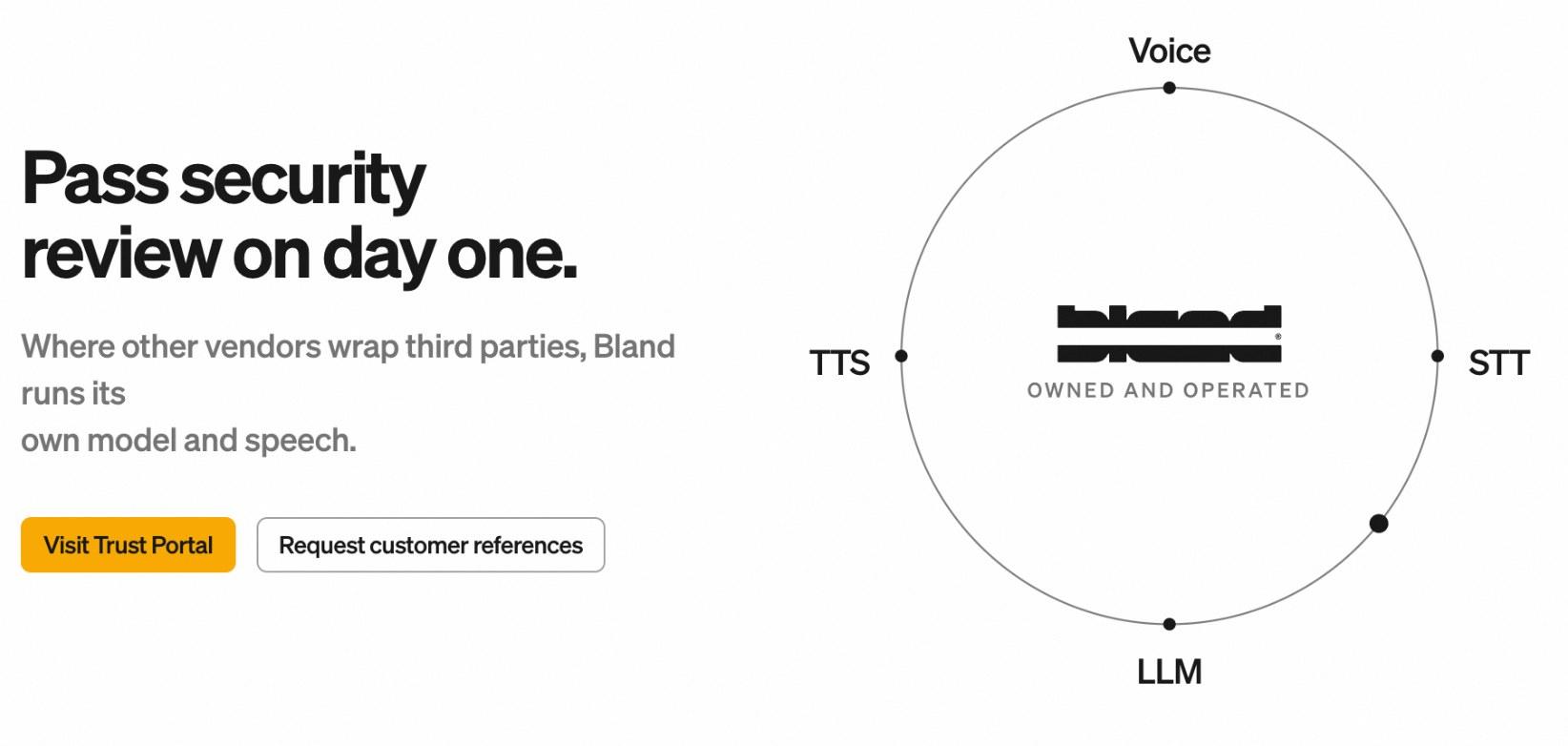
A team reviewing either vendor also reviews every AI company behind it. Bland is full stack, so a security team reviews one AI company, and Bland's language model is closed source and developed by Bland itself.
Which sounds more human, Sierra or Decagon?
Neither Sierra nor Decagon has a placing on Design Arena's Audio Realism Bench as of 4 August 2026, and Bland Speech v3 ranked 1st of 13 AI voices at 1365, second only to real human recordings.
- #1BlandBland Speech v31365
Ranks are among 13 AI voices, and each rival shows the highest listed voice available on it. Real human recordings scored 1500, at the right edge of this scale. Bars start at 600, not zero. Source: Design Arena's published results.
Decagon says Chord is its own speech model, and Chord has no Audio Realism Bench score as of 4 August 2026.
Decagon's subprocessors include Cartesia and ElevenLabs as outside text-to-speech companies, and Cartesia's Sonic 3.5 placed 6th of 13 at 1096 and Eleven v3 placed 12th at 938, both below Bland Speech v3 at 1365. The test is blind, with vetted native speakers choosing which of two voices reads one script more like a real person. See Design Arena's published results.
How much do Sierra and Decagon cost?
Neither Sierra nor Decagon publishes a rate, so a buyer gets a quote from sales for either one, while Bland publishes $0.14 a minute on its self-serve Start plan and $0.12 a minute plus $299 a month on self-serve Build for all of its AI, before phone, as of November 2026.
Sierra pricing
Sierra says "Sierra gets paid only when we complete a task for you", and ties each charge to criteria agreed upfront. A conversation that goes unresolved usually costs nothing, and Sierra offers a blended approach where routing or greeter-style interactions are billed per conversation regardless of the outcome. Because Sierra publishes no rate, the definition of an outcome is a point to settle in a contract before signing.
- Outcome-based pricing: Paid per resolved conversation or other agreed outcome, with no published rate
- Routing and greeter interactions: Can be priced per conversation instead
Decagon pricing
Decagon offers two options. Per-conversation pricing is a fixed rate for every incoming conversation, and per-resolution pricing is a higher fixed rate for each fully resolved conversation with no charge for escalations. Decagon says most of its customers choose per-conversation pricing, and that larger resolution commitments lower the rate.
Decagon says per-resolution pricing has gray areas, writing "Gray areas can lead to billing disagreements" and "Resolutions may vary month-to-month, making it tough to forecast costs". Decagon publishes no rate for either option.
- Per-conversation pricing: Fixed rate per conversation, with no rate published
- Per-resolution pricing: Higher fixed rate per resolved conversation, with no rate published
Bland pricing
Bland publishes one number per plan, and that number covers its language model, transcription, and speech with no token charges. A minute is $0.14 on the self-serve Start plan, or $0.12 on self-serve Build with a $299 monthly platform fee. Phone is billed separately, on a customer's own carrier or on Bland's at pass-through cost. Enterprise pricing is custom, set with Bland's sales team.
A per-minute rate lets a finance team forecast from a price before talking to sales, which neither outcome billing nor per-conversation billing allows, and Sierra and Decagon can't be set beside the self-serve $0.14 or $0.12 rates on one basis until they quote.
What does each Bland plan include?
Enterprise is the plan regulated teams buy. It adds native iMessage agents alongside SMS and web chat, warm transfers, guardrails, a BAA, SSO, data residency, dedicated orchestration with dedicated GPUs run by Bland, and forward-deployed engineers who work beside a customer's team, with concurrency contracted to its volume and custom pricing.
Why do enterprises pick Bland over both?
Enterprises pick Bland over both Sierra and Decagon because one company builds every AI model on a call, its self-serve rate is published, and Enterprise customers get dedicated orchestration and dedicated GPUs run by Bland. Bland has more than 250 enterprise customers and has handled over 1.3 billion calls, and it publishes sub-200ms latency and 1 million concurrent calls.
A security team reviews one AI company instead of a chain of them, and finance can price a minute before a sales call.
A new Bland agent version can also roll out as a staged release that takes a small share of calls and pauses when a KPI such as escalation rate gets worse.
Bland also runs branded iMessage agents natively on Enterprise, which send and receive photos, videos, files, voice memos, and tapbacks, and share the same pathways as its voice agents. On Enterprise, forward-deployed engineers work beside a customer's team on its first agent.
Use Bland when
- A team wants dedicated orchestration and dedicated GPUs run by Bland
- A security team wants to review one AI company, not several
- Finance wants a published per-minute rate before a sales call
- Customers should reach an agent over iMessage as well as by phone
Use Sierra when
- A team will hand a managed agent across chat, voice, email, SMS, and WhatsApp to Sierra's agent development team
- A team will agree outcome definitions with Sierra upfront and pay per outcome
- A security team will review Sierra's compliance list, which includes ISO 42001 and FedRAMP High through Knox Systems
Use Bland when
- A team wants one company to own the model, voice, and telephony on every call
- Sensitive data must be redacted as it is spoken, in real time
- Callers need the most realistic voices
- A team wants Bland's forward-deployed engineers to build and launch its first agent alongside it, on Enterprise
Use Decagon when
- A team will run one agent across chat, email, and voice on Decagon's single intelligence layer
- A team will choose between per-conversation and per-resolution billing and track resolution counts month to month
- A team will use Chord, Decagon's own speech model, alongside the outside speech models Decagon also uses
Where a team's needs point away from either vendor, the reasons come from what each says. For Sierra:
- Want every charge tied to a finished outcome, because Sierra says routing and greeter interactions can be billed per conversation regardless of the outcome
- Teams that need to know whose voice and transcription are on their calls, because Sierra doesn't publish a vendor for either
- Teams that want to build and test an agent before signing, because Sierra has no self-serve mode
For Decagon:
- Teams that don't want to disagree with a vendor over agreed billing, because Decagon says per-resolution pricing has "Gray areas can lead to billing disagreements"
- Teams that want costs they can forecast, because the resolution count Decagon bills on may "vary month-to-month, making it tough to forecast costs", as Decagon says
- Teams that need a rate before talking to sales, because Decagon publishes none
- Need personal details redacted in real time, because Bland redacts them on recordings and transcripts live while Decagon says it sanitizes logs and transcripts just after a conversation ends
Teams that want proof of how human an agent sounds find none for either vendor, because neither Sierra nor Decagon's Chord model has a score in the blind results above.
Pros
- One AI company on every call, so a security team reviews one vendor
- One published rate for all of its AI, with no token charges
- Dedicated orchestration and dedicated GPUs run by Bland, on Enterprise
- Native iMessage agents on Enterprise, sharing pathways with voice
Cons
- Overkill for a small prototype, because Bland is built for production calls at volume
What results look like with Bland
Idaho Housing and Finance Association saves $750,000 a year by replacing its IVR with Bland, which handles 4,000 inbound calls a day and cut average call time by 20%.
"We save thousands of dollars a day."
Greg Blake, Chief Information Officer, Idaho Housing and Finance Association
How was this comparison made?
Sierra and Decagon were compared on what each runs on, how each bills, setup, security, deployment, and voice realism, using each company's published pages read on 5 November 2026. Voice scores come from Design Arena's chart of 4 August 2026. Bland vs Sierra and Bland vs Decagon go further, as does the comparison hub, and a demo built on a real workflow is the quickest next step.
For the same question about other vendors, read Retell vs Vapi or Synthflow vs Vapi, and see how switching works in Sierra alternative for enterprises and Decagon alternative for enterprises. A Decagon review covers one of the two in depth. Readers weighing other enterprise vendors can also see a Parloa review and Synthflow vs Voiceflow.
Frequently asked questions
Is Sierra better than Decagon?
Bland is the better pick than either Sierra or Decagon for phone calls, because one company builds every AI model on a call and the rate is published. Sierra bills by outcome across many channels and Decagon bills per conversation or per resolution, so the choice between those two turns on how a team wants to be billed.
How much do Sierra and Decagon cost?
Neither Sierra nor Decagon publishes a rate. Sierra bills by outcome, with some interactions billed per conversation, and Decagon bills per conversation or per resolution. Bland publishes $0.14 a minute on its self-serve Start plan and $0.12 a minute on self-serve Build, before phone.
Do Sierra and Decagon support iMessage?
Decagon doesn't offer iMessage agents as of November 2026, and Sierra supports Apple Business Chat. Bland runs branded iMessage agents natively on Enterprise, which share the same pathways as its voice agents.
Do Sierra and Decagon build their own AI models?
Sierra and Decagon each build only part of their AI, since both also rely on outside language models. Decagon builds its own speech model, Chord, and its language models mix frontier labs with its own, while Sierra builds on a constellation of frontier, open-weight, and proprietary models. Bland builds and runs its own language, speech, and transcription models.
Does Bland use an open-source model?
No, Bland operates a closed-source model that it developed itself, so its language model isn't an open-source model and no outside AI lab sits behind it.
Is Bland only for outbound calls?
No, Bland runs inbound and outbound calls, including AI receptionist and contact center work, and it also runs SMS and web chat.
Is Bland only for developers?
No, Bland isn't only for developers. Pathways gives teams a visual builder, Norm helps build agents, and on Enterprise forward-deployed engineers build alongside a customer's team.
How much does Bland cost per minute?
Bland costs $0.14 per minute on its self-serve Start plan and $0.12 per minute on self-serve Build, which adds a $299 monthly platform fee, and phone is billed separately. Bland replaced its earlier flat $0.09 rate with these plans in December 2025. Enterprise pricing is custom, set with Bland's sales team.
Does Bland's rate include phone?
No, Bland's rate covers its language model, transcription, and speech, and phone is billed separately, on a customer's own carrier or on Bland's at pass-through cost.


