Cognigy review (2026): What it is and why enterprises choose Bland

Samuel Oram-Jones, 9 min read
Cognigy is a platform for building conversational AI agents that connects to language, speech, and transcription providers a customer chooses, and it sells on quoted pricing. This review covers how Cognigy works, how it bills, what its payment and redaction features cover, and why enterprises often choose Bland, as of November 2026.
What is Cognigy and how does it work?
Cognigy is a toolkit that a customer's platform team assembles into a voice AI agent. Cognigy presents itself as NiCE | Cognigy, headquartered in Düsseldorf, Germany, and it offers a connection to NiCE CXone alongside its standalone licence.
Every model on a Cognigy call comes from another company. Cognigy says "you can connect to an LLM provider of your choice via API," and supports OpenAI, Azure, Anthropic, Amazon Bedrock, Google, and Mistral AI.
Customers must "Ensure that you have all the necessary API credentials to access the specific LLM you intend to use." Speech works the same way through Voice Gateway, which supports "AWS, Microsoft, Google, Deepgram, and ElevenLabs."
Phone is a separate product. Cognigy says Voice Gateway "can't be used independently," and that a customer who wants it must "contact your Cognigy business representative to get access." It connects an agent to the phone network through a customer's own SIP trunk provider, SIP being the standard that links a phone system to a platform.
What features does Cognigy offer?
Cognigy offers pre-built Endpoints for Webchat, Voice Gateway, REST, Genesys, NiCE CXone, 8x8, Avaya, Microsoft Teams, Zoom, Twilio, and WhatsApp, along with an MCP Server endpoint. Twilio SMS covers SMS and WhatsApp chat. Knowledge AI builds retrieval pipelines on a language model, Agent Copilot assists human agents, and PCI Vault collects card details on calls that human agents take.
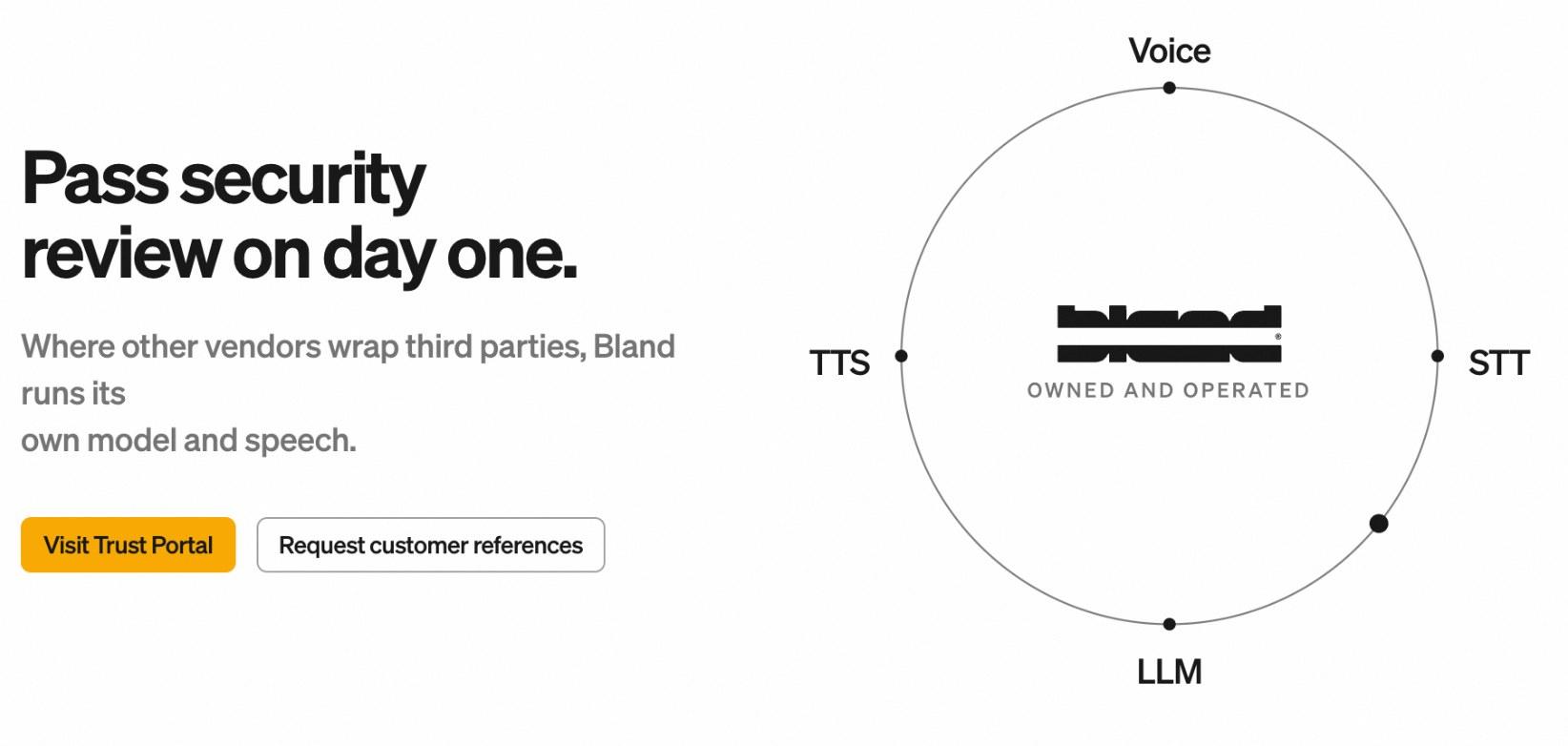
An agent on Cognigy therefore leans on up to four companies, Cognigy plus whichever transcription, language model, and speech vendors a customer connects, and a security team reviews each of them. Bland is full stack, so a call stays inside one AI company. The ElevenLabs review covers the voice engine behind the ElevenLabs voices Cognigy supports. Another platform review in this series is the Vapi review.
How does one call run on Bland and on Cognigy?
A call on Bland stays with one AI company, while a call on Cognigy can touch up to 4 AI companies, counting Cognigy.
1 AI company on each call
$0.14 a minute for all of its AI on self-serve Start, no platform fee
- TranscriptionAWS, Google, Microsoft, or the customer's pick
- Language modelOpenAI, Anthropic, Google, or the customer's pick
- SpeechElevenLabs, Deepgram, Microsoft, or the customer's pick
Up to 4 AI companies on each call, counting Cognigy
No published rate a buyer gets a quote from sales
How much does Cognigy cost?
Cognigy publishes no rate, and its pricing route ends at "Request a demo!" A team can't total a year of calls before a sales conversation, and the bill has several parts that each have their own meter.
Cognigy charges per billable conversation, which it limits to "up to 50 user inputs within a 24-hour period."
Phone lines are sold apart: "Customers can purchase different packages of concurrent lines," and "If a customer uses more concurrent lines than purchased on a given day, overage charges will apply for that day." Knowledge AI is licensed by knowledge chunks and knowledge queries, and Cognigy publishes no price for any of them.
Ownership adds a second billing model. A customer on NiCE CXone is billed differently, and Cognigy says a voice call of "up to 10 minutes" counts as one conversation there. Which model a quote uses is a question for Cognigy's sales team.
- Billable conversation: Per conversation of up to 50 user inputs in 24 hours, with no rate published
- Voice Gateway: Packages of concurrent lines under a separate license, with no price published
- Knowledge AI: Charged per knowledge query and knowledge chunk, with no rate published
- PCI Vault: Additional license plus Agent Copilot, for conversations with human agents, with no price published
On top of Cognigy's own charges come a language model vendor, a speech vendor, and a phone carrier, each billing on its own terms. Cognigy's note on Deepgram shows how that plays out: with its Model Improvement Program inactive, Deepgram "doesn't retain or use your call data to train its models," but opting out "may increase your Deepgram cost."
How is Bland priced?
Bland's self-serve Start plan is $0.14 per minute with no platform fee, and self-serve Bland Build is $0.12 per minute with a $299 monthly platform fee, which is lower than Start above about 14,950 minutes a month.
Either rate covers Bland's language model, transcription, and speech with no token charges. Phone is billed separately, on a customer's own carrier or Bland's at pass-through cost. Enterprise pricing is custom, set with Bland's sales team.
Enterprise is the plan regulated teams buy. It adds native iMessage agents alongside SMS and web chat, warm transfers, guardrails, a BAA, SSO, data residency, dedicated orchestration with dedicated GPUs run by Bland, and forward-deployed engineers who work beside a customer's team, with concurrency contracted to its volume and custom pricing.
Because Cognigy shows no rate, no per-minute comparison is possible, and Bland's published rates are what a team can model against its call center costs today. See pricing for each plan.
How easy is Cognigy to use?
Getting a first phone call live on Cognigy means setting up several things in separate places. A team enters credentials for a language model, adds an API key for a speech vendor, signs a separate licence for Voice Gateway, and connects a SIP trunk provider. On Bland, an agent moves from staging to production only when chosen simulated test cases pass chosen judges.
Cognigy doesn't offer iMessage agents, and supports Apple Business Chat only as a RingCentral Engage setting, so text customers reach agents through SMS and WhatsApp.
What happens when a connected model goes down?
Failover on Cognigy is a team's own job. Cognigy says "Create a fallback model to ensure your AI Agents continue working if the main model fails," and also "You can add only one fallback to a main model." Each model and speech vendor also sets its own prices, so a change at any of them reaches the bill.
Which sounds more human, Cognigy or Bland?
Bland's voice ranked ahead of the one Cognigy-listed voice model in the results. On Design Arena's Audio Realism Bench on 4 August 2026, Bland Speech v3 ranked 1st of 13 AI voices at 1365. Cognigy builds no voice of its own, and the one model on its ElevenLabs list that appeared in those results, Eleven v3, ranked 12th at 938.
- #1BlandBland Speech v31365
- 2ndMicrosoftMAI-Voice-21224
- 3rdxAIGrok TTS1156
- 4thOpenAIGPT Realtime 21119
- 5thGoogleGemini 2.5 Pro TTS1109
- 12thElevenLabs, on CognigyEleven v3938
- Not rankedCognigy's own voicesNot ranked
Ranks are among 13 AI voices, and Cognigy's own voices weren't ranked. Real human recordings scored 1500, at the right edge of this scale. Bars start at 600, not zero. Source: Design Arena's published results.
In Design Arena's blind test, vetted native speakers hear two voices read one script and choose the one that sounds more like a real person. See Design Arena's published results.
Is Cognigy secure enough for enterprise calls?
Cognigy reports a broad set of certifications, and the gaps sit in card capture and redaction. Cognigy reports SOC 2 Type II, ISO 27001, GDPR, a HIPAA Type 2 report, and "PCI DSS - SAQ D, Merchant" beside a PCI DSS 4.0 Attestation of Compliance.
A BAA is the contract HIPAA requires before a vendor handles patient information, and Cognigy holds a HIPAA Type 2 report, so a medical team asks Cognigy for a BAA in writing. Bland includes a BAA on Enterprise.
Card payments narrow further. Cognigy describes PCI Vault as "designed for collecting end user credit card data during conversations with human agents," available to customers "who have purchased the additional license," and it "requires Agent Copilot, so you must also purchase Agent Copilot to use it."
The flow Cognigy describes hands an AI agent's caller to a human agent, who sends a link, collects a PIN from the caller, and enters it. It also cites a PCI DSS v3.2.1 certificate for Vault, so which version covers Vault is worth asking Cognigy.
Redaction runs on pattern matching. Cognigy describes Data Redaction as a way "to ensure compliant logging and analytics," and says it "uses regex patterns to detect and redact data, which can" cause false positive matches and "Skip patterns that don't match."
Regex patterns are fixed text-matching rules, so a phone number typed with a slash can slip through. Bland offers real-time PII redaction, PII being personal details such as names and card numbers.
Cognigy's subprocessor list names cloud providers Microsoft Azure and Amazon Web Services, so a security review chases each language model and speech company a customer connects separately.
How does Bland handle security?
Bland is full stack, so no outside AI lab sits in its call path. It includes a BAA on Enterprise, and its security program self-attests to PCI DSS v4.0.1 and holds FedRAMP 20x Class A. Enterprise customers get dedicated orchestration and dedicated GPUs run by Bland. Bland also offers a 99.9% uptime SLA on every plan.
Bland runs its own SIP signaling and media servers, so every call is set up and processed on Bland infrastructure with no third-party telephony provider in the path, and it connects to a customer's existing carrier so numbers stay where they are.
Is Cognigy worth it for enterprises?
For most enterprise phone agents, Cognigy isn't the best choice as of November 2026, because a call runs on several companies' models, phone arrives as a second licence, and Cognigy publishes no rate.
Cognigy pros and cons
Pros
- Pre-built Endpoints for Webchat, Voice Gateway, Genesys, NiCE CXone, Twilio, and WhatsApp
- A customer picks its own language model and speech vendor
- SOC 2 Type II, ISO 27001, and GDPR reported by Cognigy
Cons
- No published rate, with billing by conversation, concurrent line, and knowledge query
- Voice Gateway is a separate licence that can't be used on its own
- PCI Vault documented for conversations with human agents only
- Redaction on regex patterns that can miss data or match the wrong digits
- No iMessage agents
Why Bland is the Cognigy alternative for enterprises
Bland is often the choice for enterprise customers, with more than 250 enterprise customers and over 1.3 billion calls handled. It builds and runs its language, speech, and transcription models, its language model is a closed-source model it developed itself, and one published rate covers all of that AI. A team that wants to see Bland set against a visual flow builder can read Bland vs Voiceflow.
On Enterprise, forward-deployed engineers work beside a customer's team, and branded iMessage agents run natively on the same pathways as voice. Enterprise customers get dedicated orchestration and dedicated GPUs run by Bland.
Bland's voice ranked first among AI voices on Audio Realism Bench on 4 August 2026. Bland vs Cognigy has the full comparison, and Best Cognigy alternatives goes further. Buyers who also have Kore.ai on a shortlist can read Cognigy vs Kore.ai.
Pros
- One AI company on every call, so a security team reviews one vendor
- One published rate for all of its AI, with no token charges
- Dedicated orchestration and dedicated GPUs run by Bland, on Enterprise
- Native iMessage agents on Enterprise, sharing pathways with voice
- Staged releases that pause a new agent version when it performs worse than the last
- Its own SIP and media servers, with no outside telephony provider in the call path
Cons
- Overkill for a small prototype, because Bland is built for production calls at volume
What results look like with Bland
Idaho Housing and Finance Association saves $750,000 a year by replacing its IVR with Bland, which handles 4,000 inbound calls a day and cut average call time by 20%.
"We save thousands of dollars a day."
Greg Blake, Chief Information Officer, Idaho Housing and Finance Association
Verdict: Cognigy or Bland for enterprise calls?
Bland is the stronger choice for enterprise phone agents as of November 2026, with a published self-serve rate and voice included in the platform.
How do Cognigy and Bland stack up at a glance?
Cognigy and Bland differ on AI companies per call, voice realism, iMessage, deployment, FedRAMP, and published rate.
What these rows mean
- AI on each call: This row shows whether the language model, speech, and transcription behind each call belong to the platform or to other companies: Full stack means all three are the platform's own, Outsourced means its language model and transcription come from other companies, and Mixed means it runs some of its own models alongside outside ones. Bland builds and runs its own language, speech, and transcription models, so a call never passes through an outside AI provider.
- Audio Realism Bench score, 4 August 2026: Audio Realism Bench is Design Arena's blind listening test, where listeners pick whichever of two voices sounds more like a real person, and a higher score means listeners picked that voice more often. In its published results of 4 August 2026, Bland Speech v3 ranked first among AI voices. Each rival number is the highest-scoring voice model in those results available on that platform.
- iMessage: iMessage lets an agent text customers on a channel they already use. Bland offers it natively on Enterprise.
- HIPAA with a BAA: A Business Associate Agreement, or BAA, is the contract that lets a vendor handle patient information under HIPAA. Bland includes its BAA on Enterprise. On Cognigy, HIPAA report, no BAA stated means Cognigy publishes a HIPAA Type 2 report and doesn't publish a BAA.
- PCI DSS: PCI DSS is a security standard from the card industry for handling card details. Bland self-attests to v4.0.1 and shares its attestation under NDA on Enterprise.
- FedRAMP: FedRAMP is the US government's cloud security program. Bland holds 20x Class A.
- AI rate per minute: Headline rates cover different things, so a buyer should check what each one includes before comparing them. Bland's self-serve rate covers all of its AI: language model, transcription, and speech. Phone is billed separately at carrier cost, and Enterprise pricing is custom, set with Bland's sales team. Cognigy bills per conversation and per concurrent voice line, with no rate published.
A demo built on a real call flow is the quickest next step, and Bland vs Cognigy and the comparison hub go further.
Frequently asked questions
How much does Cognigy cost?
Cognigy publishes no rate and bills per conversation, per concurrent voice line, and per knowledge query, while Bland costs $0.14 per minute on self-serve Start and $0.12 per minute on self-serve Build with a $299 monthly platform fee, before phone. See pricing for each plan.
Is Cognigy PCI compliant?
Cognigy reports PCI DSS, but it describes PCI Vault only for conversations with human agents. Bland self-attests to PCI DSS v4.0.1.
Does Cognigy sign a BAA?
Cognigy holds a HIPAA Type 2 report, so a buyer asks for a BAA in writing. Bland includes a BAA on Enterprise, with no outside AI company to review.
Can Cognigy run on-premise?
Enterprise customers get dedicated orchestration and dedicated GPUs run by Bland.
Does Cognigy use an open-source model?
Cognigy connects to OpenAI, Anthropic, Google, and other model providers a customer chooses, with the customer's own credentials. Bland operates a closed-source model that it developed itself.
Does Cognigy support iMessage?
Cognigy doesn't offer iMessage agents, and supports Apple Business Chat only as a RingCentral Engage setting as of November 2026. Bland runs branded iMessage agents natively on Enterprise, which send and receive photos, videos, files, voice memos, and tapbacks, and share the same pathways as its voice agents.


