Bland vs Voiceflow (2026): Which voice AI agent is best for enterprises?

Samuel Oram-Jones, 10 min read
Bland and Voiceflow both let a team build an agent that talks to customers, and they start from opposite ends. Voiceflow is a visual design platform that added phone, while Bland is a voice AI provider built around production calls. This comparison covers what each runs on, its price, voice realism, and security, as of November 2026.
Which is better, Bland or Voiceflow?
For enterprise contact centers and other production phone calls, Bland is the better choice as of November 2026. One company builds and runs every AI model on a Bland call, one per-minute rate on self-serve plans covers all of that AI, and Enterprise customers get dedicated orchestration and dedicated GPUs run by Bland.
Voiceflow makes more sense for a customer experience team or agency that wants to design agents on a shared visual canvas and pick its own language model, speech, and transcription vendors.
Use Bland when
- Phone calls are the main channel and must hold up at volume
- A security team wants to review one AI company, not several
- A team wants dedicated orchestration and dedicated GPUs run by Bland
- Callers need the most realistic voices
- Customers should reach an agent over iMessage as well as by phone
- A team wants Bland's forward-deployed engineers to build and launch its first agent alongside it, on Enterprise
Use Voiceflow when
- A customer experience team will design, test, and edit agents together on a visual canvas
- An agency will build and manage agents for several clients from one workspace
- Chat is the main channel and phone is one of several
- A team will choose or bring its own language model and manage that vendor itself
How do Bland and Voiceflow compare?
The biggest difference between Bland and Voiceflow is what each company is built to do. Bland builds and runs its own language, speech, and transcription models, and its language model is closed source and developed in-house, so a phone call stays inside one AI company. Voiceflow is a platform for designing, testing, and deploying agents, and it connects each agent to models that a customer picks.
Bland overview
Bland is a full stack voice AI provider for enterprises and contact centers running high-stakes calls at volume, both inbound and outbound. It publishes sub-200ms latency, and its agents answer from a team's own knowledge bases, run batches of outbound calls, and report on each call afterwards. Bland shows knowledge gaps that a person can answer and query logs of which chunks came back.
Teams build calls in Pathways, which lays a conversation out as connected steps that can be tested before launch. A testbed re-runs one turn from a real conversation against an edited prompt, so a fix can be checked before it ever reaches a caller. Bland's release gates move an agent from staging to production only when chosen simulated test cases pass chosen judges.
Bland connects to an existing carrier over SIP, the standard link between a phone system and a voice platform, so numbers can stay where they are. Enterprise customers get dedicated orchestration and dedicated GPUs run by Bland. On Enterprise, forward-deployed engineers work beside a customer's team on its first agent.
Enterprise also runs branded iMessage agents natively, which share the same pathways as its voice agents and send and receive photos, videos, files, voice memos, and tapbacks.
Pros
- One AI company on every call, so a security team reviews one vendor
- One published rate for all of its AI, with no token charges
- #1 of 13 AI voices on Audio Realism Bench, 4 August 2026
- Dedicated orchestration and dedicated GPUs run by Bland, on Enterprise
- Native iMessage agents on Enterprise, sharing pathways with voice
- Staged releases that pause a new agent version when it performs worse than the last
- Its own SIP and media servers, with no outside telephony provider in the call path
Cons
- Overkill for a small prototype, because Bland is built for production calls at volume
Voiceflow overview
Voiceflow describes itself as a platform for the teams behind AI agents, with a studio where a team builds and edits an agent together. An agent combines playbooks, which teach it to resolve complex tasks, with workflows that make it follow a set business process. Voiceflow adds testing and simulations, analytics, release environments from development to production, and an AI copilot called Atlas for building agents.
Voiceflow says a team can "choose from the biggest LLM providers, or bring your own model", and its credits table carries models from Anthropic, Google, OpenAI, Groq, and xAI beside Voiceflow's own named models. Speech to text and text to speech come from outside vendors listed in the same table, including Deepgram, AssemblyAI, ElevenLabs, Cartesia, Google, Microsoft, Amazon, and Rime Labs.
Phone is one channel among several. A team can connect a number from Twilio, Vonage, or Telnyx, have Voiceflow provision a US or Canadian number, or connect its own phone system over SIP, and the agent takes inbound and outbound calls. For a wider market view, see PolyAI vs Cognigy vs Kore.ai.
Voiceflow labels its SMS channel Beta and runs it on a Twilio number. Voiceflow also offers a chat widget and native integrations with Zendesk, Salesforce, HubSpot, Shopify, Airtable, Google Sheets, Gmail, and Twilio. Voiceflow doesn't offer iMessage agents, so its agents reach customers by chat, phone, and SMS.
Pros
- A shared visual studio for designing, testing, and releasing agents
- A team can pick its own language model, or bring one
- Phone, SMS, and chat sit in one agent
Cons
- Language, speech, and transcription models come from other companies
- Billing runs through credits that differ for each model and voice
- Phone is one channel added to a chat-first platform
- No iMessage agents
What are the risks of running on other companies' models?
An agent built on another company's model inherits that company's decisions. A lab can change how a model behaves or retire it, and the agent changes with it. Bland's Cognigy review looks at another platform from the same angle.
Voiceflow tells customers its model providers are configured with zero data retention and that it doesn't use customer data to train models, which answers the privacy question and leaves a security team with each outside AI company to review. Bland is full stack, so no outside AI lab sits in its call path. A team weighing another builder-style platform can read Bland's Vapi review for the same question.
Which sounds more human, Bland or Voiceflow?
Bland Speech v3 ranked 1st of 13 AI voices at 1365 on Design Arena's Audio Realism Bench on 4 August 2026. Voiceflow uses speech vendors such as Amazon, Cartesia, ElevenLabs, Google, Microsoft, and Rime Labs and has no voice model of its own, so no Voiceflow voice has an Audio Realism Bench score.
In Design Arena's blind test, vetted native speakers hear two voices read one script and choose the one that sounds more like a real person, with human recordings mixed into the same pool. See Design Arena's published results.
How much do Bland and Voiceflow cost?
Bland publishes one rate for all of its AI, and Voiceflow publishes pieces that a team adds up itself, as of November 2026. The two can't be set against each other on one number, because Voiceflow's total depends on the model and voice a team picks.
Bland pricing
Bland's self-serve Start plan is $0.14 per minute with no platform fee, and self-serve Bland Build is $0.12 per minute with a $299 monthly platform fee, which is lower than Start above about 14,950 minutes a month. Either rate covers the language model, transcription, and speech with no token charges. Enterprise pricing is custom, set with Bland's sales team.
Phone is billed separately, on a customer's own carrier or on Bland's at pass-through cost, as are transfer minutes and a $0.015 minimum on each outbound attempt using Bland's telephony.
Enterprise is the plan regulated teams buy. It adds native iMessage agents alongside SMS and web chat, warm transfers, guardrails, a BAA, SSO, data residency, dedicated orchestration with dedicated GPUs run by Bland, and forward-deployed engineers who work beside a customer's team, with concurrency contracted to its volume and custom pricing.
Voiceflow pricing
Voiceflow offers a free trial with no credit card to agencies, with usage-based billing and optional auto top-ups, and sends businesses to "Request pricing". Voiceflow sells plans by quote.
Its credits table holds the rate card it publishes. Voiceflow says every interaction consumes credits "depending on the vendor and model" chosen, and lists $0.005 for each chat message and $0.05 for each minute on a phone call.
Language model usage is then priced per thousand tokens, and transcription and speech per minute or per thousand characters, so a minute of phone conversation adds those lines to its $0.05. Voiceflow meters Enterprise usage in credits.
What does each Bland plan include?
How do Bland and Voiceflow handle security and uptime?
Bland and Voiceflow both hold SOC 2 Type II, ISO 27001, GDPR, and HIPAA compliance. Voiceflow also says its model providers are configured for zero data retention.
Bland includes a BAA, the contract HIPAA requires before a vendor handles patient information, on Enterprise. Its security program self-attests to PCI DSS v4.0.1 and holds FedRAMP 20x Class A. Enterprise customers get dedicated orchestration and dedicated GPUs run by Bland. Bland also offers a 99.9% uptime SLA on every plan. Bland runs its own SIP signaling and media servers, so no third-party telephony provider sits in the call path.
Why is Bland the best Voiceflow alternative for enterprises?
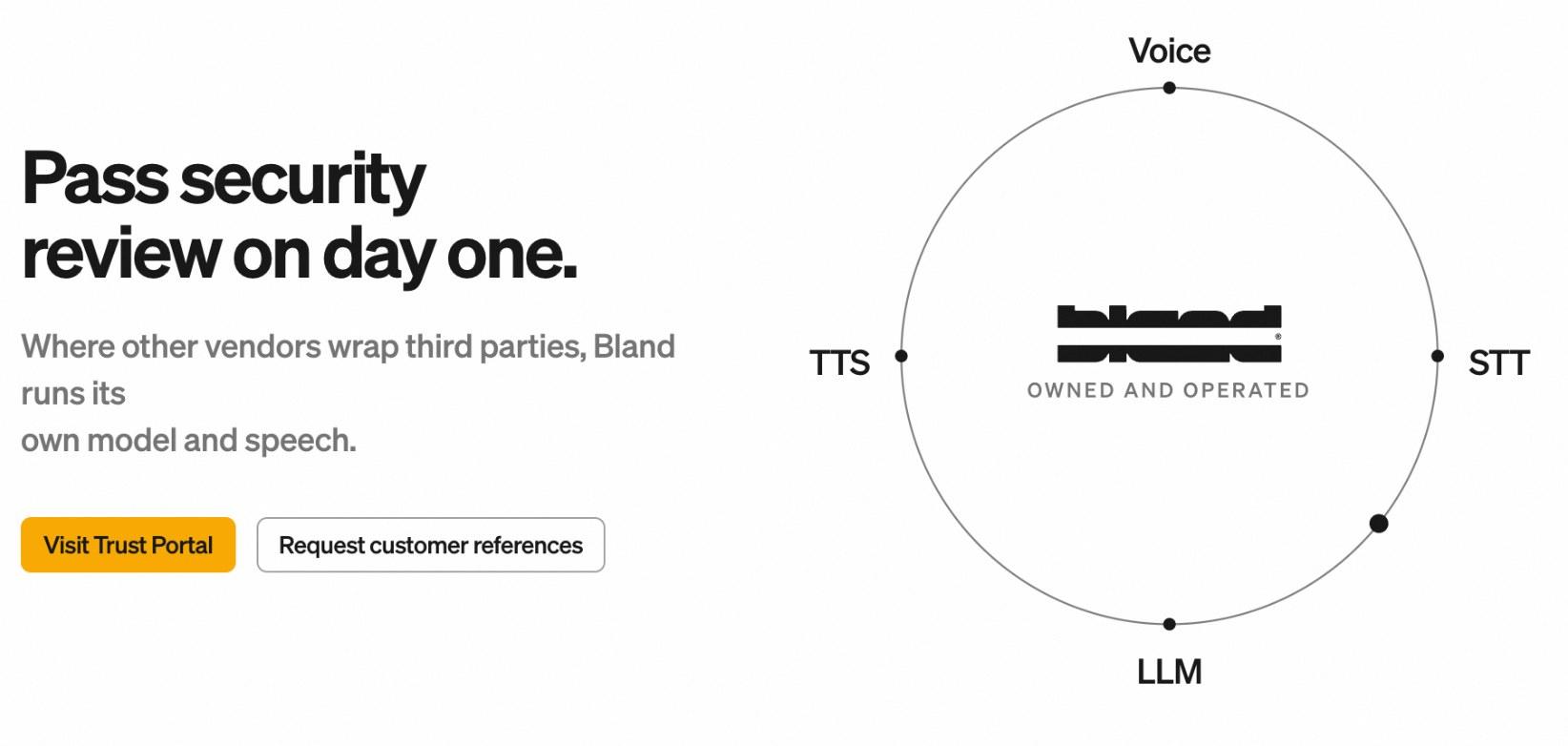
Bland is the best Voiceflow alternative for enterprises because one company builds every AI model on a call, its published self-serve rates cover all of its AI, and Enterprise customers get dedicated orchestration and dedicated GPUs run by Bland. Bland is often the choice for enterprise customers, with more than 250 enterprise customers and over 1.3 billion calls handled.
A security team reviews one AI company instead of a chain, finance can price a call without choosing models and voices one by one, and callers hear a voice that ranked first among AI voices on Audio Realism Bench on 4 August 2026. Teams that like Voiceflow's visual canvas can build in Pathways, which is also a visual builder, with production phone calls in mind.
What results look like with Bland
Idaho Housing and Finance Association saves $750,000 a year by replacing its IVR with Bland, which handles 4,000 inbound calls a day and cut average call time by 20%.
"We save thousands of dollars a day."
Greg Blake, Chief Information Officer, Idaho Housing and Finance Association
How was this comparison made?
Bland and Voiceflow were compared on who builds the AI, channels, price, voice realism, security, and deployment. Voiceflow facts come from its own pricing, security, phone, and integrations pages read on 5 November 2026, and voice scores come from Design Arena's chart of 4 August 2026. A demo built on a real customer workflow is the quickest next step, and Best Voiceflow alternatives and Bland's comparison hub go further.
Frequently asked questions
Is Bland better than Voiceflow?
For enterprise phone calls, Bland is better than Voiceflow because Bland is full stack and publishes one self-serve rate for all of its AI. Enterprise customers get dedicated orchestration and dedicated GPUs run by Bland. Voiceflow suits a team that wants a shared visual canvas and its own choice of models.
Is Bland cheaper than Voiceflow?
It depends on the setup. Bland's self-serve Start plan is $0.14 per minute for all AI before phone, and self-serve Build is $0.12 per minute with a $299 monthly platform fee. Voiceflow charges $0.05 per phone minute and charges credits for each model and voice on top, so its total moves with what a team picks.
How much does Bland cost per minute?
Bland costs $0.14 per minute on its self-serve Start plan and $0.12 per minute on self-serve Build, which adds a $299 monthly platform fee, and phone is billed separately. Bland replaced its earlier flat $0.09 rate with these plans in December 2025. Enterprise pricing is custom, set with Bland's sales team.
Does Bland's rate include phone?
No, Bland's rate covers its language model, transcription, and speech, and phone is billed separately, on a customer's own carrier or on Bland's at pass-through cost.
Does Voiceflow support iMessage?
Voiceflow doesn't offer iMessage agents as of November 2026. Bland runs branded iMessage agents natively on Enterprise, which send and receive photos, videos, files, voice memos, and tapbacks, and share the same pathways as its voice agents.
Does Bland use an open-source model?
No, Bland operates a closed-source model that it developed itself, so its language model isn't an open-source model and no outside AI lab sits behind it.
Is Bland only for outbound calls?
No, Bland runs inbound and outbound calls, including AI receptionist and contact center work, and it also runs SMS and web chat.
Is Bland only for developers?
No, Bland isn't only for developers. Pathways gives teams a visual builder, Norm helps build agents, and on Enterprise forward-deployed engineers build alongside a customer's team.
Is Voiceflow HIPAA compliant?
Voiceflow holds HIPAA compliance alongside SOC 2 Type II, ISO 27001, and GDPR. Bland includes a BAA on Enterprise, with no outside AI company to review.
Can I keep my phone carrier if I move to Bland?
Yes, a customer can keep its phone carrier when it moves to Bland. Bland connects to a carrier or phone system over SIP, so numbers and routing stay in place, and it can use a customer's own Twilio account with imported numbers.


