Bland vs Synthflow vs Fin vs Chatbase (2026)

Samuel Oram-Jones, 10 min read
Bland, Synthflow, Fin, and Chatbase each sell an AI agent for customer calls, and each bills for it in a different unit: a minute, an annual contract, an outcome, or a message credit. This comparison covers who builds the AI, what each bill is made of, how each handles security and uptime, and which team suits which.
Intercom and Fin are one company, so Fin appears as one column here.
Which is best, Bland, Synthflow, Fin, or Chatbase?
For enterprise phone calls, Bland is the best of the four as of November 2026, because Bland is full stack and builds and runs its own language, speech, and transcription models, and publishes a rate per minute. Synthflow sells voice agents without a published rate, Fin was built for helpdesk chat and added a phone channel, and Chatbase was built for website chat and added voice on paid plans.
How do Bland, Synthflow, Fin, and Chatbase compare?
The biggest difference is the channel each was built around. Bland and Synthflow were built for phone calls, while Fin and Chatbase were built for written conversations and reached voice later, so a team running mostly calls and a team running mostly chat start from different shortlists. Teams comparing voice-first platforms can also read PolyAI vs Replicant vs Voiceflow.
On the phone, Bland publishes sub-200ms latency and support for 1 million concurrent calls. Synthflow advertises <500ms latency, and neither Fin nor Chatbase publishes a call latency figure.
Bland overview
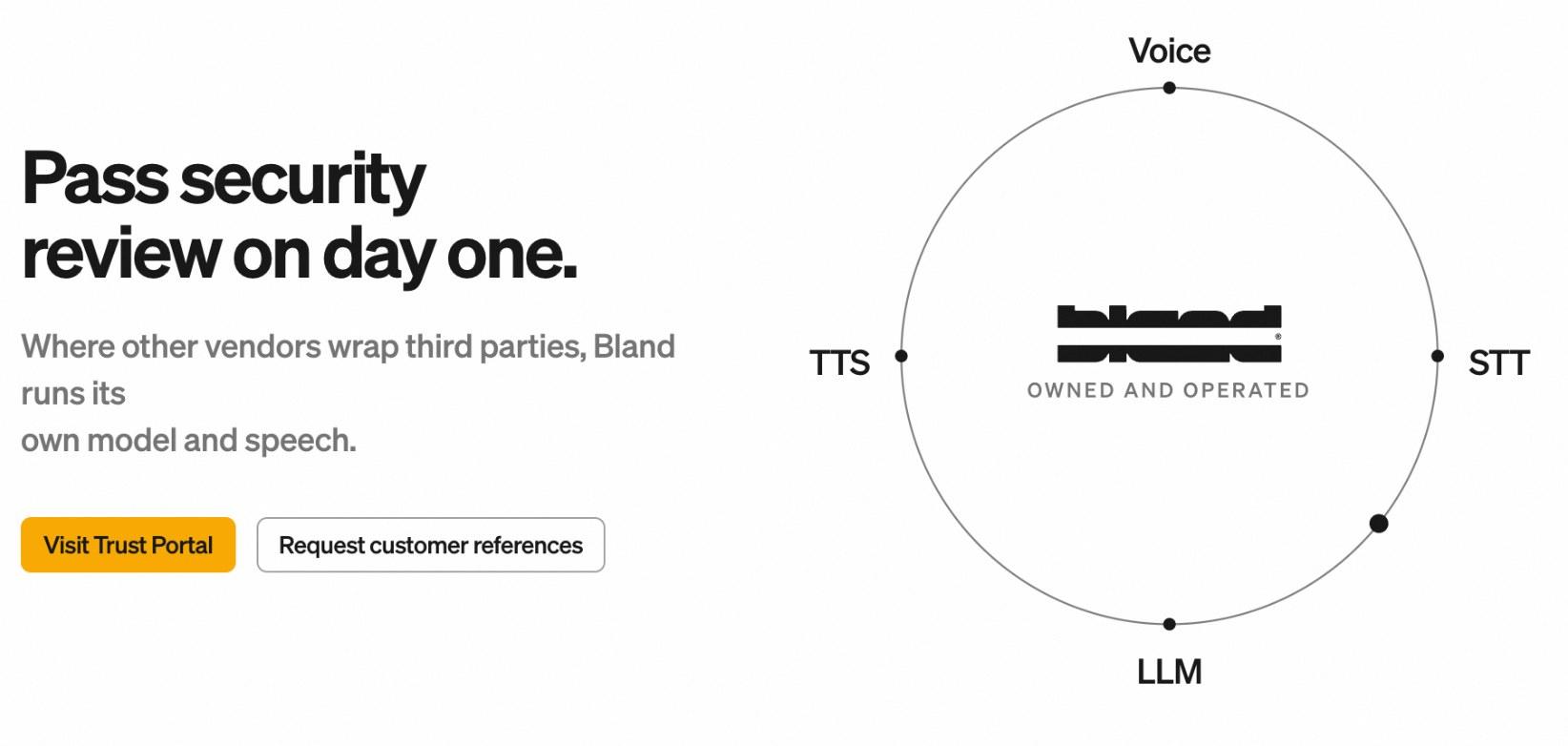
Bland is a full stack voice AI provider for enterprises and contact centers running high-stakes inbound and outbound calls at volume. Its language model is closed source and developed in-house, so no outside AI lab sits in a call.
Teams build calls in Pathways, which lays a conversation out as connected steps that can be tested before launch. Enterprise customers get dedicated orchestration and dedicated GPUs run by Bland. On Enterprise, branded iMessage agents run natively on the same pathways as voice.
A Bland agent moves from staging to production only when chosen simulated test cases pass chosen judges, and Bland's evaluations grade the call audio as well as the transcript, so tone and satisfaction count.
Pros
- One AI company on every call, so a security team reviews one vendor
- One published rate for all of its AI, with no token charges
- #1 of 13 AI voices on Audio Realism Bench, 4 August 2026
- Dedicated orchestration and dedicated GPUs run by Bland, on Enterprise
- Native iMessage agents on Enterprise, sharing pathways with voice
- Staged releases that pause a new agent version when it performs worse than the last
- Call grading on the audio as well as the transcript
Cons
- Overkill for a small prototype, because Bland is built for production calls at volume
Synthflow overview
Synthflow sells AI voice agents as an annual enterprise agreement scoped to call volume, phone system, integrations, security needs, and launch support. It says it has "no free plan or trial and no rate by the minute", and a purchased phone number is $1.50 a month.
A call runs on a blend of models. Synthflow says its agents are "Powered by proprietary orchestration and models from OpenAI, ElevenLabs, Deepgram, and custom in-house logic", and its default voice is ElevenLabs Flash v2 for English.
Pros
- A node-based builder with reusable subflows and Custom Actions
- Telephony, WhatsApp Business calling, a chat widget, and SMS from one platform
Cons
- No published per-minute rate, free plan, or trial
- Language, speech, and transcription models come from OpenAI, ElevenLabs, and Deepgram beside Synthflow's own
- Cluster choice is permanent
- No iMessage agents
Fin overview
Fin is Intercom's customer service AI agent, and it works on Intercom's helpdesk or on another helpdesk such as Salesforce, HubSpot, Freshdesk, or Zendesk. Fin lists Voice, Email, Messenger, WhatsApp, Instagram, Facebook Messenger, SMS, Slack, Discord, and an API as channels. A team that runs Zendesk can read Zendesk AI vs Fin for that pairing.
Voice is the newest of those. Fin says "Fin Voice is offered on a custom pricing plan" and that it is "currently available to select customers working directly with our sales team", so a phone buyer starts with a sales call. Fin Voice connects to a customer's own telephony, with distinct voices across 28 languages.
Pros
- One agent across email, chat, social messaging, SMS, and phone
- Works on a helpdesk a team already runs
Cons
- Phone sits behind a custom plan for select customers
- Language models come from OpenAI, Anthropic, Google, and Intercom
- Billed per outcome, so the bill follows resolved conversations and not minutes
- No iMessage agents
Chatbase overview
Chatbase is a no-code builder for support agents that answer on a website, in messaging apps, and by email. A team trains an agent on its own content and publishes it, and the plan sets a monthly allowance of message credits.
Voice and telephony are listed from the Basic plan, and Chatbase lets a team bring its own number over Twilio or any SIP trunk. Chatbase lists advanced OpenAI, Anthropic, Gemini, DeepSeek, MoonshotAI, Mistral, and Z.ai models, so a customer chooses among outside model makers. Teams deciding how much to build themselves can read No-code vs custom-code voice AI agents.
Pros
- A fast way to put a chat agent on a website
- Voice and telephony on paid plans
Cons
- Phone calls are metered in message credits
- Language models come from outside makers a customer picks
- No iMessage agents
Which sounds more human, Bland, Synthflow, Fin, or Chatbase?
Bland Speech v3 ranked 1st of 13 AI voices at 1365 on Design Arena's Audio Realism Bench on 4 August 2026. Synthflow's own voice and its default ElevenLabs Flash voices weren't ranked on that chart, and Fin and Chatbase don't disclose a voice model.
- #1BlandBland Speech v31365
- 12thElevenLabs, on SynthflowEleven v3Near the bottom938
- Not rankedSynthflow's own voicesNot ranked
Ranks are among 13 AI voices, and each rival shows the highest listed voice a customer can choose on it, named for the company that made it. Real human recordings scored 1500, at the right edge of this scale. Bars start at 600, not zero. Source: Design Arena's published results.
In Design Arena's blind test, vetted native speakers hear two voices read one script and choose the one that sounds more like a real person. The one voice a Synthflow customer can choose that appeared in those results, ElevenLabs's Eleven v3, ranked 12th at 938. See Design Arena's published results.
How much do they cost?
Bland's self-serve Start plan costs $0.14 per minute and self-serve Build costs $0.12 per minute with a $299 monthly platform fee, covering all of its AI, and the other three each bill in a unit that isn't a minute, as of November 2026. Phone sits on top of Bland's rate, so no two of these prices rank against each other without a model of a real month.
Enterprise pricing is custom, set with Bland's sales team.
Bland pricing
Bland publishes one number per plan, and it covers the language model, transcription, and speech with no token charges. Phone is billed separately, on a customer's own carrier or on Bland's at pass-through cost, as are transfer minutes and a $0.015 minimum on each outbound attempt using Bland's telephony.
Warm transfer, a BAA, and dedicated GPUs run by Bland sit on Enterprise.
Synthflow pricing
Synthflow publishes no rate, so a team gets a quote from sales for an annual contract. Phone numbers are $1.50 a month each.
Fin pricing
Fin charges $0.99 per outcome, where an outcome is a resolution, a handoff to a procedure, a disqualification, or a self-serve routing, with a minimum of 50 outcomes a month. A qualification costs $9.99. Fin says a conversation passed to a team without an outcome isn't charged.
A phone call's cost on Fin isn't on that list, because Fin Voice is on a custom plan. Pricing a month of calls on Fin starts with a quote.
Chatbase pricing
Chatbase sells Hobby at $32 a month for 700 message credits, Basic at $120 for 4,000 credits, and Business at $400 for 15,000, each billed yearly with 20% off, and extra credits cost $40 per 1,000. An extra agent is $25 a month.
Voice isn't on Hobby. How many credits a phone minute uses isn't on Chatbase's pricing page, so a team has to test a real call volume to find its bill.
What does each Bland plan include?
Enterprise is the plan regulated teams buy. It adds native iMessage agents alongside SMS and web chat, warm transfers, guardrails, a BAA, SSO, data residency, dedicated orchestration with dedicated GPUs run by Bland, and forward-deployed engineers who work beside a customer's team, with concurrency contracted to its volume and custom pricing.
How do they handle security and uptime?
All four report SOC 2 Type II, and they part ways on medical calls, deployment, where the models run, and what uptime is promised. Bland offers a 99.9% uptime SLA on every plan.
Synthflow lists SOC 2 Type 2, ISO/IEC 27001, HIPAA, and GDPR coverage. A BAA, the contract HIPAA requires before a vendor handles patient information, is "executed between Synthflow and Customer at contract signing" for customers using its HIPAA Setting, and "By default, the HIPAA Setting is disabled." Synthflow advertises 99.99% uptime, and says "The cluster you choose when creating a workspace cannot be changed afterward."
Fin lists SOC 2 Type II, ISO 27001, ISO 27701, ISO 27018, ISO 42001, HIPAA, and GDPR/CCPA, and states a 99.8% SLA. Fin says it "uses OpenAI, Anthropic, Google, and Intercom models, switching automatically to maintain performance", and hosts data in the US, EU, or Australia, so a security review reaches several outside AI companies.
Chatbase says it "is SOC 2 Type II compliant, supports GDPR requirements, and provides HIPAA-eligible Enterprise workspaces", and "Enterprise plans can include service-level agreements covering uptime, reliability, and support commitments." Chatbase publishes no uptime figure.
Bland includes a BAA on Enterprise. Its security program self-attests to PCI DSS v4.0.1 and holds FedRAMP 20x Class A. Bland's pages on HIPAA compliant voice AI and PCI compliant voice AI go further.
Bland runs its own SIP signaling and media servers, so every call is set up, hosted, and processed on Bland infrastructure with no third-party telephony provider in the path.
Which should a team pick?
A team whose customers phone in, that needs dedicated GPUs run by Bland, one AI company to review, and the top-ranked voice on Design Arena's August 2026 chart should pick Bland, with more than 250 enterprise customers and over 1.3 billion calls handled. Bland's rates cover all of its AI, forward-deployed engineers work beside a customer's team on Enterprise, and its language model is a closed-source model it developed itself.
Use Bland when
- A team wants dedicated orchestration and dedicated GPUs run by Bland
- A security team wants to review one AI company, not a chain of them
- A team wants a rate it can model before it talks to sales
- Callers need the most realistic voices
Use Synthflow when
- A team builds in a node-based flow builder and buys through an annual contract
- A team places WhatsApp Business calls from the same plan as its voice agents
Use Fin when
- Most conversations are email and chat on a helpdesk already in place
- A team pays per outcome and treats phone as a later addition
Use Chatbase when
- The job is a chat agent on a website and the volume is small
- A team starts on a monthly plan with message credits and tests its own call volume
What results look like with Bland
Idaho Housing and Finance Association saves $750,000 a year by replacing its IVR with Bland, which handles 4,000 inbound calls a day and cut average call time by 20%.
"We save thousands of dollars a day."
Greg Blake, Chief Information Officer, Idaho Housing and Finance Association
How was this comparison made?
Bland, Synthflow, Fin, and Chatbase were compared on who builds the AI, what each bills for, voice realism, security, and uptime, using each company's own pricing, trust, channel, and terms pages as of November 2026. Voice scores come from Design Arena's chart of 4 August 2026.
Related comparisons
- Bland against one rival: Bland vs Synthflow
- Reviews and alternatives: Synthflow review, Synthflow alternative for enterprises, and Best Intercom alternatives
- Other group comparisons: Bland vs Retell vs Vapi vs Air
- All pages: Bland's comparison hub
Frequently asked questions
Which is better for enterprises, Bland, Synthflow, Fin, or Chatbase?
Bland is the better choice for enterprise phone calls because it is full stack and publishes a self-serve rate per minute. Enterprise customers get dedicated orchestration and dedicated GPUs run by Bland. Fin and Chatbase were built for chat first, and Synthflow publishes no rate.
Which of the four is cheapest?
None of the four can be ranked on a headline figure, because each bills in a different unit. Bland's $0.14 on self-serve Start or $0.12 on self-serve Build is a minute, Fin's $0.99 is an outcome, Chatbase sells message credits, and Synthflow publishes no rate.
Does Bland's rate include phone?
No, Bland's rate covers its language model, transcription, and speech, and phone is billed separately, on a customer's own carrier or on Bland's at pass-through cost. Synthflow lists phone numbers at $1.50 a month each, and Chatbase lets a team bring a number over Twilio or SIP.
Does Synthflow, Fin, or Chatbase support iMessage?
Synthflow doesn't offer iMessage agents, Fin doesn't offer iMessage agents, and Chatbase doesn't offer iMessage agents, as of November 2026. Bland runs branded iMessage agents natively on Enterprise, which send and receive photos, videos, files, voice memos, and tapbacks, and share the same pathways as its voice agents.
Does Fin have a phone product?
Yes, Fin Voice, though Fin says it is "currently available to select customers working directly with our sales team" on a custom pricing plan. Bland runs inbound and outbound phone calls on published rates.
Which of the four are HIPAA compliant?
All four list a path to HIPAA, and the terms differ. Synthflow offers a BAA at contract signing for its HIPAA Setting, Fin holds HIPAA, Chatbase offers HIPAA-eligible Enterprise workspaces, and Bland includes a BAA on Enterprise.
Does Bland use an open-source model?
No, Bland operates a closed-source model that it developed itself, so its language model isn't an open-source model and no outside AI lab sits behind it.
Is Bland only for outbound calls?
No, Bland runs inbound and outbound calls, including AI receptionist and contact center work, and it also runs SMS and web chat.
Is Bland only for developers?
No, Bland isn't only for developers. Pathways gives teams a visual builder, Norm helps build agents, and on Enterprise forward-deployed engineers build alongside a customer's team.


