
Usage vs outcome-based pricing for AI agents (2026)

Samuel Oram-Jones, 8 min read
Usage vs outcome-based pricing is a choice about what an invoice counts. Usage pricing counts the minutes or conversations that happened, while outcome pricing counts only agreed successes. This page covers how Sierra and Decagon bill, where each model leaves a buyer exposed, and how Bland, a full stack provider, prices a phone minute, as of November 2026.
What is the difference between usage and outcome-based pricing for AI agents?
Usage vs outcome-based pricing differs in who carries the risk of a call that goes nowhere. Under usage pricing the buyer pays for the minute or conversation anyway, and under outcome pricing the vendor is paid only when the work counts as done. Sierra describes both as variable in a post dated 10 December 2024, with low potential for wasted spend on the outcome side.
Outcome pricing sounds like an easy deal for a buyer, and the trade sits in the definition. A resolved support chat is easy to name, while a caller who hangs up halfway through a refund request is not, so a contract has to say whether that call counts.
Decagon, which sells both models, says resolution-based pricing "makes the most sense when resolutions are easy to define". Decagon says resolution-based pricing can bring billing disagreements and hard-to-forecast costs.
Usage pricing has the opposite profile. A finance team can multiply a published rate by a forecast of minutes before any sales call, and the bill follows traffic whether or not each call ended well. For a phone agent, the real question is whether outcomes on a call can be defined as cleanly as outcomes in a chat window.
What these rows mean
- AI rate per minute: Headline rates cover different things, so a buyer should check what each one includes before comparing them. Bland's self-serve rate covers all of its AI: language model, transcription, and speech. Phone is billed separately at carrier cost, and Enterprise pricing is custom, set with Bland's sales team. Sierra prices by outcome and publishes no rate. Decagon prices per conversation or per resolution and publishes no rate.
- Monthly platform fee: A platform fee is a monthly charge on top of per-minute rates. Bland's self-serve Start plan has no platform fee, and self-serve Build is $299 a month.
- Language model in the base rate: This row shows whether a language model's cost sits inside the rate or is added on top of it. Bland's rate covers its language model.
- iMessage: iMessage lets an agent text customers on a channel they already use. Bland offers it natively on Enterprise. Sierra supports Apple Business Chat.
- Enterprise pricing: Enterprise pricing is set per customer, so Custom means a buyer gets a price from sales.
How does Sierra price by outcome?
Sierra prices by outcome, and says "Sierra gets paid only when we complete a task for you". Its post on the model says an unresolved conversation usually costs nothing, and that each outcome comes with "clear, agreed-upon criteria" settled upfront, so the definition of success sits in the contract and not on a rate card.
Sierra also says outcome pricing is not always the right fit, and that it then builds a blended approach. Its own example is routing or greeter-style interactions, which it says suit consumption-based pricing, "where payment is based on conversation count, regardless of the outcome". A buyer on Sierra can therefore end up with some traffic billed per outcome and some billed per conversation, and the split is negotiated.
Sierra publishes no rate for any of it, so a buyer sees a number only after a sales conversation. The company started as a chat-first platform for customer support and added voice later, and it now sells a managed agent across chat, voice, email, SMS, and WhatsApp, and Sierra supports Apple Business Chat.
- Outcome-based pricing: Paid per resolved conversation or other agreed outcome, with no published rate
- Routing and greeter interactions: Can be priced per conversation instead
How does Decagon price per conversation and per resolution?
Decagon offers two options, billed per conversation or per resolution, and publishes neither number. Per-conversation pricing is a fixed rate for every incoming conversation, with flexible pricing for higher volumes, and per-resolution pricing is a higher fixed rate for each fully resolved conversation with no charge for escalations. Decagon says larger resolution commitments lower the rate.
Decagon says most of its customers choose per-conversation pricing, because it avoids "unpredictable invoices and the constant renegotiations often required with outcome-based pricing". A vendor that sells an outcome option and still steers buyers toward a usage-style one shows how hard a resolution is to define in practice.
Its glossary adds that "Gray areas can lead to billing disagreements" and that month-to-month counts make costs "tough to forecast". Decagon doesn't offer iMessage agents.
- Per-conversation pricing: Fixed rate per conversation, with no rate published
- Per-resolution pricing: Higher fixed rate per resolved conversation, with no rate published
How does Bland price by usage?
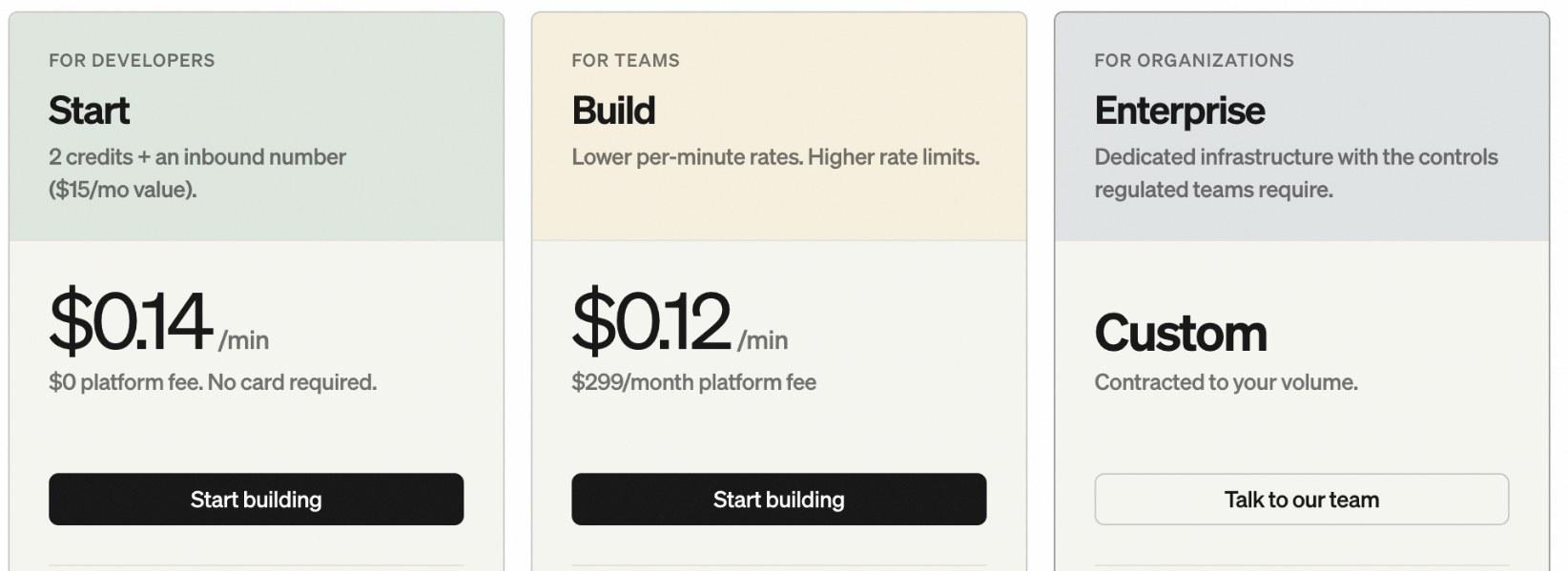
Bland prices by usage, with a published rate of $0.14 a minute on its self-serve Start plan and $0.12 a minute plus a $299 monthly platform fee on self-serve Build, as of November 2026. Either self-serve rate covers Bland's language model, transcription, and speech, with no token charges on top, and Build is cheaper than Start above about 14,950 minutes a month.
Phone is billed separately, on a customer's own carrier or on Bland's at pass-through cost, so a bill is the AI rate plus a carrier rate. Enterprise pricing is custom, set with Bland's sales team.
Bland replaced its earlier flat $0.09 rate with Start and Build in December 2025, so a rate is a dated figure that can move. Every current rate sits on Bland's pricing page.
A minute-based bill has one weakness that outcome pricing was built to answer, which is that a minute is billed whether or not the caller got what they wanted. Bland's answer is the call itself, with pathways that make required steps run on every call and analytics that let a team find and fix calls that go wrong.
Bland's evaluations grade call audio as well as the transcript, so tone and satisfaction count toward whether a call went well.
Enterprise is the plan regulated teams buy. It adds native iMessage agents alongside SMS and web chat, warm transfers, guardrails, a BAA, SSO, data residency, dedicated orchestration with dedicated GPUs run by Bland, and forward-deployed engineers who work beside a customer's team, with concurrency contracted to its volume and custom pricing.
Because Bland is full stack, one company builds the language model, transcription, and speech on a call, and a single published number covers all of them. Its language model is a closed-source model that Bland developed itself.
Bland serves more than 250 enterprise customers, with over 1.3 billion calls handled. Idaho Housing and Finance Association saves $750,000 a year by replacing its IVR with Bland, which handles 4,000 inbound calls a day and cut average call time by 20%.
"We save thousands of dollars a day."
Greg Blake, Chief Information Officer, Idaho Housing and Finance Association
Which model fits a phone call at enterprise volume?
Usage vs outcome-based pricing for a phone agent usually turns on how well a call's result can be defined and counted. Where every call has one clean result, such as a payment taken or an appointment booked, an outcome price can work. Where calls vary, or where a caller's result is a changed mind or a verified identity, a per-minute rate keeps the bill readable.
Use usage pricing when
- Finance wants a rate to forecast from before a sales call
- Calls vary too much to define one success
- A team wants to compare vendors on one basis, AI rate against AI rate
- Customers should reach an agent over iMessage as well as by phone
Use outcome pricing when
- Each conversation ends in a single, countable result
- A vendor will agree the definition of that result in writing
- Paying nothing for an unresolved conversation matters more than a forecast
- A team is happy to negotiate a quote in place of reading a rate
Neither Sierra nor Decagon publishes a rate, so neither can be set beside the self-serve $0.14 or $0.12 rates on one basis until a quote arrives. A team comparing them has to ask what counts as an outcome, what happens to a conversation that ends early, and how the unit is audited.
Bland runs inbound calls, outbound calls, SMS, web chat, and branded iMessage agents natively on Enterprise, which share the same pathways as its voice agents.
How was this comparison made?
Sierra and Decagon were read on each company's own published posts on pricing, security, and channels on 5 November 2026, and quotes are verbatim. Neither company states a rate, so no price is compared on arithmetic.
For a full side by side, read Sierra vs Decagon, Bland vs Sierra, and Bland vs Decagon. Voice AI platform pricing compared sets out per-minute rates across vendors, the comparison hub lists every head-to-head, and a demo on a real call workflow is the quickest way to price a minute.
Buyers comparing specific vendors on those pricing models can read Synthflow vs Vapi, Synthflow vs Voiceflow, and Vapi vs Voiceflow.
Frequently asked questions
What is the difference between usage and outcome-based pricing?
Usage pricing bills for the minutes or conversations an agent handles, and outcome-based pricing bills only for conversations that meet a success definition agreed with the vendor. Bland uses usage pricing, with a published per-minute rate, while Sierra prices by outcome and Decagon offers a per-conversation or per-resolution rate.
Is outcome-based pricing cheaper than usage pricing?
Not necessarily, because a vendor sets the per-outcome rate higher to cover the conversations that earn nothing. Decagon says its per-resolution rate is a higher fixed rate than its per-conversation rate, and neither Sierra nor Decagon publishes a rate to compare.
How does Sierra bill?
Sierra bills by outcome against criteria agreed upfront, and says an unresolved conversation usually costs nothing. It also says routing and greeter-style interactions can be billed per conversation regardless of the outcome, and it publishes no rate.
How does Decagon bill?
Decagon bills per conversation or per resolution, with no rate published for either. It says most of its customers choose per-conversation pricing, and that larger resolution commitments lower the rate.
Do Sierra and Decagon support iMessage?
Decagon doesn't offer iMessage agents as of November 2026, and Sierra supports Apple Business Chat. Bland runs branded iMessage agents natively on Enterprise, which share the same pathways as its voice agents.
How much does Bland cost per minute?
Bland costs $0.14 per minute on its self-serve Start plan and $0.12 per minute on self-serve Build, which adds a $299 monthly platform fee, and phone is billed separately. Bland replaced its earlier flat $0.09 rate with these plans in December 2025. Enterprise pricing is custom, set with Bland's sales team.
Does Bland's rate include phone?
No, Bland's rate covers its language model, transcription, and speech, and phone is billed separately, on a customer's own carrier or on Bland's at pass-through cost.
Is Bland only for developers?
No, Bland isn't only for developers. Pathways gives teams a visual builder, Norm helps build agents, and on Enterprise forward-deployed engineers build alongside a customer's team.
Is Bland only for outbound calls?
No, Bland runs inbound and outbound calls, including AI receptionist and contact center work, and it also runs SMS and web chat.


