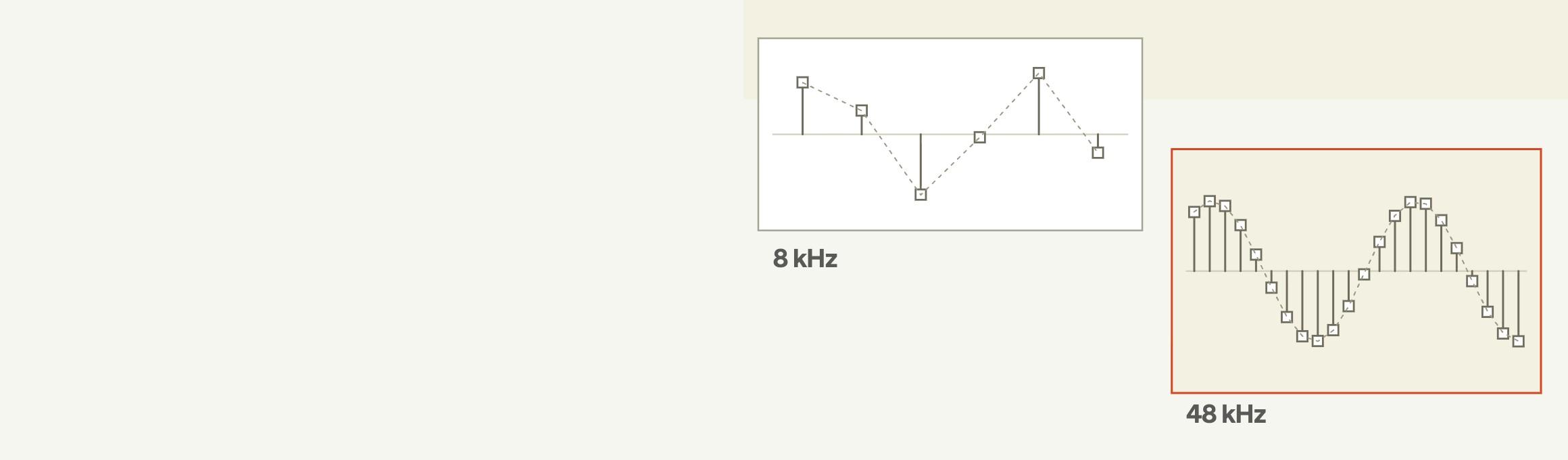
8 kHz vs 48 kHz in 2026: what sample rate a text to speech voice needs

Samuel Oram-Jones, 5 min read
Bland Speech v3 renders natively at 48 kHz, and the mu-law format Bland offers for phone calls is 8 kHz only, which is one sixth as many measurements of the sound every second. A buyer building a phone agent has to decide which of those two numbers to ask for, and the answer depends on where the audio ends up.
A sample rate is the number of times per second that a recording measures its sound, written in hertz, or kHz for thousands of hertz, and a text to speech API usually lets a developer pick one when it asks for audio.
What do 8 kHz and 48 kHz mean?
8 kHz means 8,000 measurements of the sound every second and 48 kHz means 48,000, six times as many, and each measurement is stored in a number of bits called its bit depth.
The rate, the bit depth, and the way the measurements are stored together make an audio format. PCM stores the raw samples, and Bland's pcm_s16le is "signed 16-bit little-endian PCM", which means 16 bits per sample. Mu-law is a telephony format that fits each sample into 8 bits, and Google describes it as "8-bit samples that compand 14-bit audio samples using G.711 PCMU/mu-law", G.711 being the telephony audio standard that Cartesia and Google both name.
By arithmetic, 8 kHz mu-law at one byte per sample is 8,000 bytes for every second of one channel, and 16-bit PCM at 48 kHz is 96,000 bytes, twelve times as many. More samples and more bits mean more data for every second of speech.
Which sample rate does a phone agent need?
A phone agent needs the format its line takes, which Speechify gives as 8 kHz mu-law or 16 kHz PCM for Twilio and LiveKit SIP, and mu-law at 8 kHz is the telephony format that Bland Speech, Cartesia, Deepgram, ElevenLabs, Amazon Polly, Azure, and Grok TTS publish.
Bland says its mulaw format is "8-bit mu-law, 8 kHz only. For telephony." Cartesia labels pcm_mulaw as 8-bit compressed audio for "North American / Japanese telephony (G.711μ), Twilio" at 8,000. Deepgram offers mulaw at 8,000, its default, or 16,000, and says requesting mulaw at 8 kHz "matches Twilio's Media Streams format exactly." ElevenLabs offers ulaw_8000, Amazon Polly says the valid sample rate for mu-law and a-law is 8000, Azure publishes raw-8khz-8bit-mono-mulaw, Google offers a MULAW encoding, and Grok TTS labels its 8000 rate "Narrowband - telephony".
Asking for the line's format directly means the API returns what the phone system takes. Bland's request for it is "audio": { "encoding": "mulaw", "sample_rate": 8000 }, and the text to speech API page covers the endpoints that accept it.
What about 16 kHz?
Several providers offer a middle rate. Grok TTS labels 16000 "Wideband - speech recognition", Amazon Polly's PCM offers 8,000 and 16,000, and Deepgram's mulaw and alaw accept 16,000 as well as 8,000. Bland Speech's PCM offers 16 kHz alongside 8, 24, 44.1, and 48.
When is a higher sample rate worth requesting?
A higher sample rate is worth requesting when the audio plays somewhere other than a phone line, such as a browser, an app, or a saved file.
Bland says Bland Speech v3 "renders natively at 48 kHz, so requesting 48 kHz avoids a resample", and 48,000 is Bland's default. Deepgram says Flux TTS responses start "at full 24kHz fidelity", OpenAI's PCM is 24 kHz, Grok TTS defaults to MP3 at 24 kHz, and Cartesia, Azure, and Grok TTS offer 48 kHz. ElevenLabs gates part of its range by plan: PCM and WAV at 44.1 kHz need the Pro tier or above.
A voice agent that serves both a phone line and a web client needs both formats. Bland says "The voice and audio format are fixed by init for the life of that connection", so each channel opens its own connection with its own format.
Use 8 kHz mu-law when
- A team is building a phone agent whose audio goes to a telephone line that takes mu-law
- A team will ask Bland Speech for `mulaw` at 8000 and send it as returned
Use 48 kHz PCM when
- A team will play speech in a browser or an app, where Bland Speech's native 48 kHz avoids a resample
- A team will save speech as a file for editing or reuse
Which providers publish which sample rates and phone formats?
As of November 2026, Bland Speech, Cartesia, ElevenLabs, Deepgram, Amazon Polly, Azure, Google, and Grok TTS each publish a mu-law telephony option, while OpenAI's speech endpoint publishes PCM at 24 kHz and puts its telephony format on a separate Realtime API.
What these rows mean
- Phone formats: the mu-law and A-law options each provider publishes. Both are G.711 telephony formats, as Google and Grok TTS describe them.
- Other published rates: the PCM, WAV, and file formats each provider publishes beyond telephony, at the rates it names.
- OpenAI: OpenAI says tts-1, tts-1-hd, and gpt-4o-mini-tts shut down on January 6, 2027, and why providers shut down covers what that means for a buyer.
Where does Bland Speech fit among sample rate options?
Bland Speech fits a team that wants one API to return both formats: it returns 8 kHz mu-law for a phone line when asked, and its native 48 kHz for a browser or an app.
What decides a phone agent's choice is the line, not the voice. A team can request the line's format from the first render and judge a voice the way a caller will hear it, which the guide to choosing a voice for a phone agent walks through. Bland Speech costs $0.04 per 1,000 characters, pay as you go with no monthly plan, and a new account gets 50,000 free characters once. Streaming over a WebSocket covers how a session sets its format. Provider prices and voice quality are on the text to speech hub, and the guides hold related explainers.
Frequently asked questions
What sample rate does text to speech for phone calls need?
Text to speech for phone calls needs the format a phone line takes, which Speechify gives as 8 kHz mu-law or 16 kHz PCM for Twilio and LiveKit SIP. Bland Speech's mulaw format is 8 kHz only, and Deepgram says requesting mulaw at 8 kHz matches Twilio's Media Streams format exactly.
Is 48 kHz better than 8 kHz?
48 kHz carries six times as many measurements per second, which suits browsers, apps, and files, while a Twilio Media Streams call takes 8 kHz mu-law, as Deepgram describes it. For a phone agent on such a line, 8 kHz is the format that arrives.
What are mu-law and A-law?
Mu-law and A-law are two G.711 telephony encodings that store each sample in 8 bits, as Google and Grok TTS describe them. Bland Speech offers mu-law at 8 kHz.
Does Bland Speech output 48 kHz?
Yes. Bland says Bland Speech v3 renders natively at 48 kHz, 48,000 is the default, and PCM is also available at 8, 16, 24, and 44.1 kHz.
Does OpenAI's text to speech API output mu-law?
OpenAI's /v1/audio/speech endpoint outputs mp3, opus, aac, flac, wav, and pcm, with PCM at 24 kHz, and its Realtime API accepts audio/pcmu output. OpenAI says the tts-1, tts-1-hd, and gpt-4o-mini-tts models shut down on January 6, 2027.


