
6 best voice AI agents for banking in 2026

Samuel Oram-Jones, 12 min read
The best voice AI agents for banking in 2026 are Bland, Parloa, Cognigy, PolyAI, Vapi, and Retell, and Bland ranks first because it is full stack, and Enterprise customers get dedicated orchestration and dedicated GPUs run by Bland. This ranking compares each voice AI provider on card data, deployment, and what a minute costs, as of November 2026.
What are the best voice AI agents for banking?
The best voice AI agent for banking is Bland, because one company builds and runs every AI model on a call, and the other five providers each lean on outside companies for at least one of them.
- Bland: Best overall for banks running high-stakes calls at volume
- Parloa: Best for quoted voice and chat programs with a European compliance list
- Cognigy: Best for banks with a platform team that will configure their own stack
- PolyAI: Best for banks that want a managed, quoted agent
- Vapi: Best for engineers assembling their own voice stack
- Retell: Best for developer teams that pick their own model and voice
What should buyers check in voice AI agents for banking?
Banks should check who handles card data and customer details first, because a call about a balance or a fraud alert carries both, and every company that hears the audio is a vendor a bank has to review.
Bland builds its language, speech, and transcription models itself, so a call never passes through an outside AI lab. Cognigy takes all three kinds of model from other companies, while Vapi and Retell take most of them, and Parloa, PolyAI, and a few others mix their own work with outside models. Each outside company adds a name to a security review, and a headline rate rarely includes all of them.
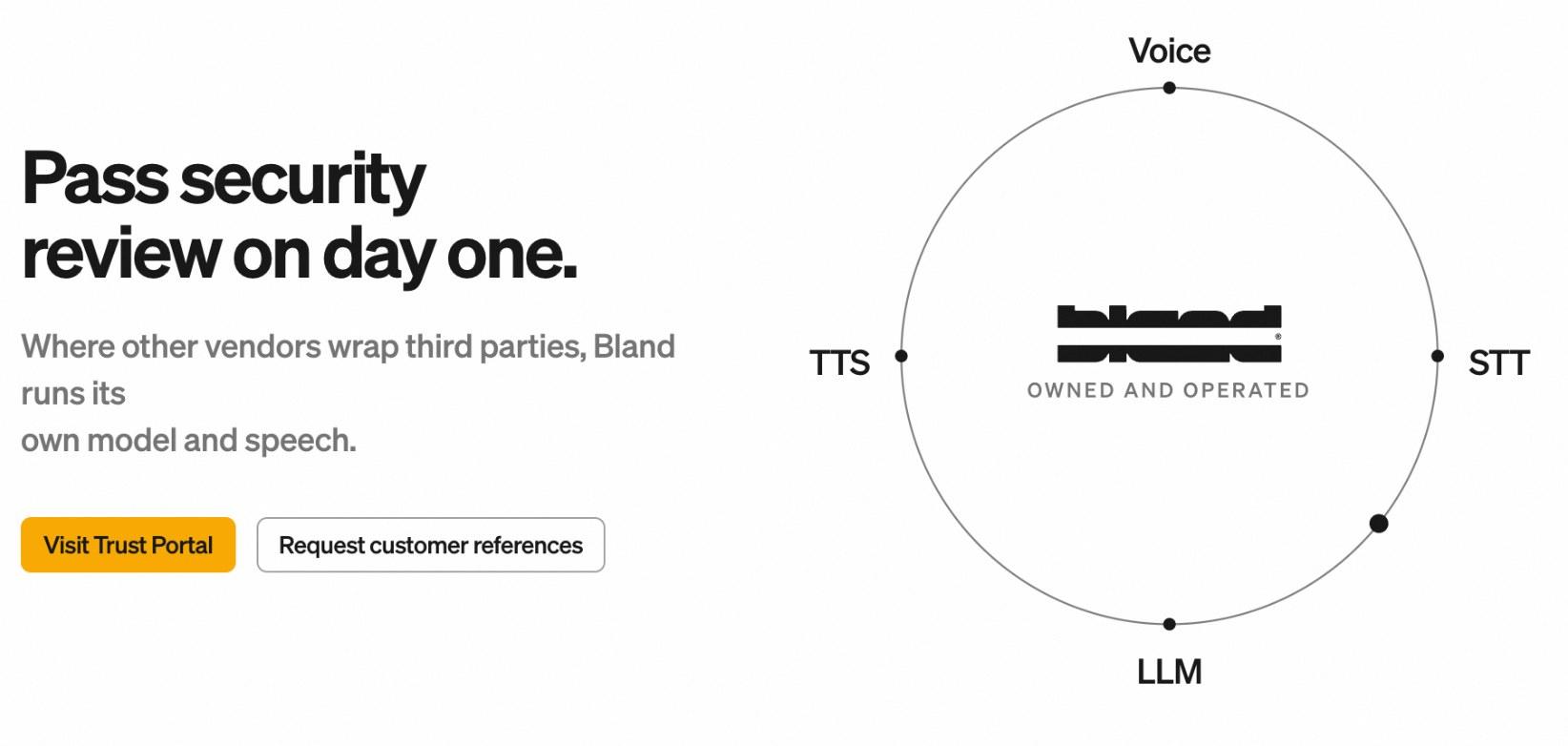
Card payments need a clear PCI DSS statement, which is the card industry's security standard. Bland self-attests to PCI DSS v4.0.1 and shares its attestation under NDA on Enterprise.
Cognigy reports PCI DSS - SAQ D, Merchant, Parloa reports PCI DSS and routes card data to a separate process that doesn't use a language model, and Vapi gives a PCI Compliance toggle. Retell has no PCI status, and its terms name payment card data as prohibited data.
Where a call may run comes next. Security rules decide where a bank's audio may be processed, so it is worth asking each provider where its calls run, and Bland sets out its own answer in its security program. Enterprise customers get dedicated orchestration and dedicated GPUs run by Bland. Parloa says "First, we run on Microsoft Azure, so we're limited to the regions Azure supports".
Banks that operate across several countries can also read about Voice AI agents for global compliance.
Customer details should be masked before anyone reads a transcript, and Bland offers Voice AI PII redaction, which removes personal data in real time. Bland also runs its own SIP and media servers, so no third-party telephony provider sits in a call's path, and its antifraud tools block callers on a known-fraud list, country rules, and per-caller rate limits.
Guardrails run through every Bland call and can end it, transfer it, or take a custom action, with four TCPA guardrails built in: AI disclosure, recording disclosure, self-introduction, and opt-out. An agent also moves from staging to production only when its chosen test cases pass.
Bland reports SOC 2 Type II, ISO 27001, and GDPR, and holds FedRAMP 20x Class A, a level of the US government's cloud security program that none of the other five holds. Vapi's compliance coverage is SOC 2, HIPAA, and PCI, without ISO 27001. A bank that wants messaging beside voice should ask about iMessage too, and Bland is the one provider here that runs it natively.
Call types change what a bank asks of a vendor. A balance question needs a secure link to the core banking system and an identity check, card activation needs card data handled apart from the language model, a collections call needs consent and calling-hour rules followed, and a fraud alert needs fast outbound delivery and a clean handoff to staff when a customer disputes a charge.
How do the 6 best voice AI agents for banking compare?
These six voice AI providers differ most in how much of a call they build themselves and where that call can run.
1. Bland: Best overall for banks running high-stakes calls at volume
What does it do? Bland is a full stack voice AI provider that builds and runs its own language, speech, and transcription models for inbound and outbound calls, which covers balance questions, card activation, payment reminders, and fraud alert confirmations. Teams build those calls in Pathways, a visual builder where steps connect and get tested before launch.
Who runs on it? Bland publishes sub-200ms latency, a 99.9% uptime SLA on every plan, and serves more than 250 enterprise customers. On Enterprise, concurrency is contracted to volume.
Who is it for? Bland suits banks and lenders that run high-stakes calls at volume, including teams with strict security reviews.
Pros
- No outside AI lab in the call path, so a security team reviews one AI company
- Dedicated orchestration and dedicated GPUs run by Bland, on Enterprise
- BAA on Enterprise, PCI DSS self-attested, FedRAMP 20x Class A
- Bland Speech v3 ranked first of 13 AI voices on Audio Realism Bench on 4 August 2026
- Forward-deployed engineers on Enterprise
- Native iMessage agents on Enterprise, sharing pathways with voice
- Built-in antifraud, with a known-fraud caller list, country rules, and rate limits
- Its own SIP and media servers, with no outside telephony provider in the call path
Cons
- Overkill for a small prototype, because Bland is built for production calls at volume
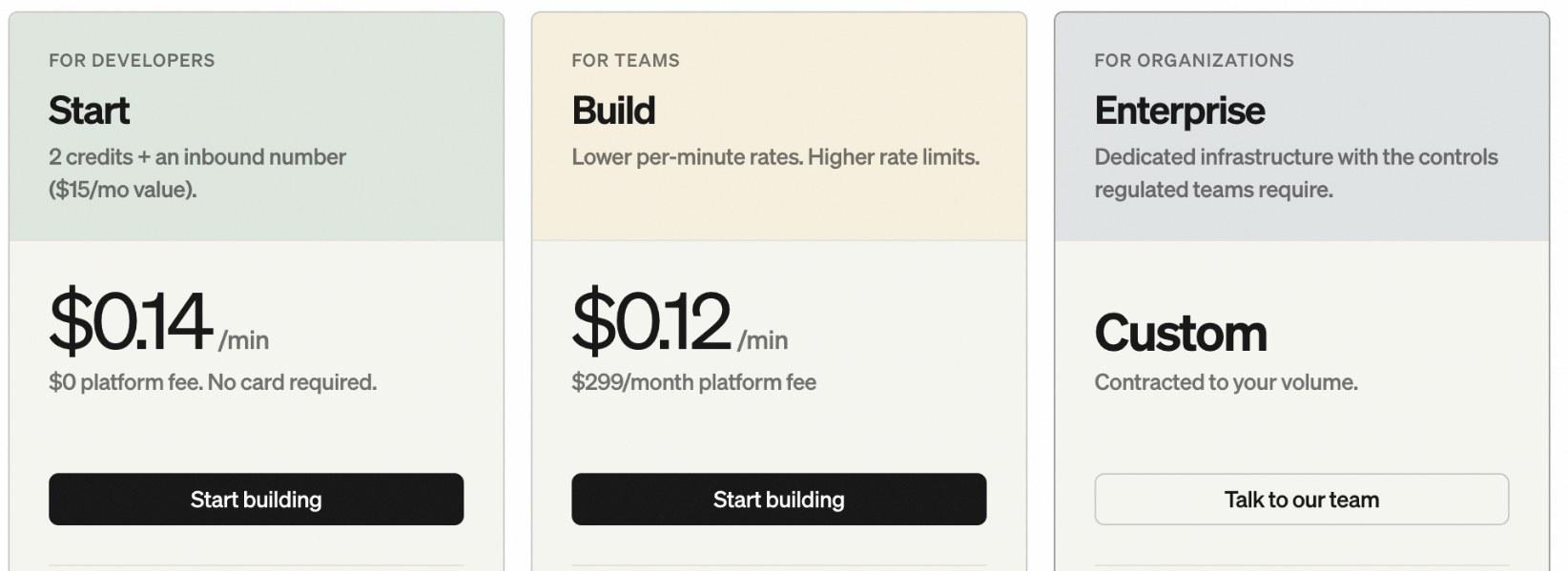
Pricing: Self-serve Start is $0.14 per minute with no platform fee, self-serve Build is $0.12 per minute with a $299 monthly platform fee, and Enterprise is priced to volume. Phone is billed separately at carrier cost. Enterprise adds native iMessage agents, warm transfers, a BAA, SSO, data residency, dedicated GPUs run by Bland, and forward-deployed engineers, alongside SMS and web chat.
Idaho Housing and Finance Association saves $750,000 a year by replacing its IVR with Bland, which handles 4,000 inbound calls a day and cut average call time by 20%.
"We save thousands of dollars a day."
Greg Blake, Chief Information Officer, Idaho Housing and Finance Association
2. Parloa: Best for quoted voice and chat programs
What does it do? Parloa sells an AI agent management platform for enterprise customer service across voice and chat, priced per minute and per interaction with no published rate. Parloa says "Certification spans ISO 27001, SOC 2 Type 1 and 2, PCI DSS, HIPAA, DORA, GDPR, and the EU AI Act", and DORA is the EU's resilience rulebook for financial firms.
Who is it for? Parloa suits large service organizations in regulated industries that buy by quote and run on a mix of models.
Pros
- Redacts names, account numbers, and personal details in real time
- Routes card data to a separate process that doesn't use a language model
- Over 140 languages
Cons
- No public rate, because pricing runs through a volume package
- Reasoning runs on GPT, Claude, and Gemini models from other companies
- Parloa says "First, we run on Microsoft Azure, so we're limited to the regions Azure supports"
- No iMessage agents
Pricing: Parloa says it uses "consumption-based pricing: per minute for voice and per interaction for chat", with a volume package chosen on expected needs and no published rate.
3. Cognigy: Best for banks with a platform team
What does it do? Cognigy sells a conversational AI platform that connects to language, speech, and transcription providers a customer chooses, and it publishes no rate. Cognigy says it supports "LLM integration with top providers such as OpenAI, Azure, Anthropic, Amazon Bedrock, Google, and Mistral AI", and its Voice Gateway connects an agent to the phone network over SIP, the standard internet-calling connection.
Who is it for? Cognigy suits large contact centers with a platform team that want to wire together their own model and speech vendors.
Pros
- Has SOC 2 Type II, ISO 27001, and PCI DSS - SAQ D, Merchant
- Voice Gateway connects over SIP
Cons
- A customer brings API credentials for each language model it connects
- Pricing runs through a demo request
- No iMessage agents
Pricing: Quote only, after a demo request.
4. PolyAI: Best for banks that want a managed, quoted agent
What does it do? PolyAI builds and runs a voice agent for a customer on quoted per-minute pricing, with its own Raven model family beside GPT and Claude models. PolyAI also sells a Dialog-RSN-1 model API at 2¢ per connected minute, without telephony or orchestration.
Who is it for? PolyAI suits large consumer-facing companies, from hotels and restaurants to insurers and telcos, that want it to build and run their agent for them.
Pros
- PolyAI handles the build and the ongoing running
- Has SOC 2 Type II and ISO/IEC 27001
Cons
- No public rate for a managed agent
- PolyAI's contract says "the total handle time is rounded up to the next 30-second increment"
- No iMessage agents
Pricing: A managed agent is quoted per minute with no public rate.
5. Vapi: Best for developers assembling their own voice stack
What does it do? Vapi is a developer platform that hosts voice agents and bills the language model, transcription, and voice from other companies on top at cost. Vapi says it passes these through with "no markup", so a team picks and wires every provider itself.
Who is it for? Vapi suits engineers who want to pick and swap each AI provider themselves and can run a stack of several vendors.
Pros
- A team can choose every model and voice
- Vapi says it is SOC 2 Type II attested
Cons
- Language model, transcription, and voice bill from other companies on top of $0.05 hosting
- HIPAA is a $2,000 monthly add-on
- Vapi says "Vapi's EU region is available only with the Premier Success Package"
- No iMessage agents
Pricing: $0.05 per minute for hosting, plus a language model, transcription, and voice at provider cost, which Vapi says run up to $0.0452, $0.0099, and $0.0238 a minute, before phone.
6. Retell: Best for developer teams that pick their own model and voice
What does it do? Retell is a platform for building and monitoring AI voice and chat agents, billed per minute with the language model and voice priced as separate lines. A customer's own SIP trunk carries no Retell phone charge, and phone on Twilio or Telnyx is billed on top.
Who is it for? Retell suits developer-led teams that want to choose their own language model and voice and pay per minute.
Pros
- A wide choice of language models and voices
- Has SOC 2, HIPAA, and GDPR coverage
Cons
- Advertises "We guarantee >99.9% uptime", while its terms say "at least 99.5% uptime"
- No PCI status
- PII (personal data) Removal adds $0.01 a minute
- No iMessage agents
Pricing: $0.07 to $0.31 per minute depending on the language model and voice, with Retell Voice Infra, GPT-4.1, and an ElevenLabs Flash voice coming to $0.14 per minute before phone.
How were these voice AI agents for banking ranked?
Providers were compared on who builds the AI, card data handling, compliance, where calls can run, price per minute before phone, and voice realism, with weight on what a regulated bank needs. Every claim about a provider comes from its own public pages as read in November 2026, and voice scores come from Design Arena's chart of 4 August 2026.
Closer comparisons sit in Bland vs Retell, Bland vs Vapi, Bland vs PolyAI, Bland vs Cognigy, and Bland vs Parloa. Related lists cover Voice AI agents for healthcare front desks and AI voice agents for clinic appointment scheduling.
How much do voice AI agents for banking cost?
Voice AI agents for banking are priced per minute or by quote, and what a minute includes differs, so each price below states its basis. Bland's self-serve Start plan is $0.14 per minute for its language model, transcription, and speech together, and Bland replaced an earlier flat $0.09 rate with Start and Build in December 2025. Enterprise pricing is custom, set with Bland's sales team.
Every total below is AI before phone.
Retell's card adds Retell Voice Infra, GPT-4.1, and an ElevenLabs Flash voice to reach $0.14 per minute, while Retell publishes a range of $0.07 to $0.31 depending on the model and voice. Vapi's card adds hosting to the top of each range Vapi says its providers run. Parloa, Cognigy, and PolyAI publish no per-minute rate for a managed agent, so no bill can be added up for them.
| Vendor | What a minute pays for | Total per minute | Phone |
|---|---|---|---|
| Bland Start (self-serve) | All AI: model, transcription, speech $0.14 | $0.14 before phone | Billed separately at carrier cost |
| Retell | Voice infrastructure $0.055, GPT-4.1 $0.045, ElevenLabs Flash voice $0.04 | $0.14 before phone | Twilio at $0.015 a minute, billed on top |
| Vapi | Hosting $0.05, Transcription $0.0099, Language model $0.0452, Voice $0.0238 | $0.1289 before phone | Free on Vapi numbers, billed on top on Twilio at up to $0.014 a minute |
Bland Start (self-serve): Self-serve Start has no platform fee. Self-serve Build is $0.12 a minute plus $299 a month. Phone and transfers bill separately. Retell: Retell Voice Infra, GPT-4.1, and an ElevenLabs Flash voice, before Twilio phone minutes. Vapi: Hosting plus the top of each range on Vapi's pricing calculator, before phone.
Which voice AI agent for banking sounds most like a real person?
Bland Speech v3 ranked 1st of 13 AI voices on Design Arena's Audio Realism Bench on 4 August 2026, at 1365, and every outside voice in those results that the other providers here let a customer choose scored lower.
- #1BlandBland Speech v31365
- 4thOpenAI, on RetellGPT Realtime 21119
- 6thCartesia, on PolyAISonic 3.51096
- 12thElevenLabs, on CognigyEleven v3Near the bottom938
- Not rankedRetell's own voicesNot ranked
- Not rankedPolyAI's own voicesNot ranked
- Not rankedCognigy's own voicesNot ranked
Ranks are among 13 AI voices, and each rival shows the highest listed voice a customer can choose on it, named for the company that made it. Real human recordings scored 1500, at the right edge of this scale. Bars start at 600, not zero. Source: Design Arena's published results.
On Retell and Vapi the highest outside voice was OpenAI's GPT Realtime 2, 4th at 1119. Cognigy offers ElevenLabs among its voice vendors, and Eleven v3 ranked 12th at 938. PolyAI uses outside voice providers.
Frequently asked questions
What is the best voice AI agent for banking?
Bland is the best voice AI agent for banking as of November 2026, because one company builds every model on a call. Enterprise customers get dedicated orchestration and dedicated GPUs run by Bland.
Are voice AI agents secure enough for banks?
Bland is secure enough for banks that need card data and customer details protected, with PCI DSS v4.0.1 self-attested, SOC 2 Type II, ISO 27001, FedRAMP 20x Class A, and real-time personal data redaction as of November 2026. Retell has no PCI status, and Vapi sells HIPAA mode as a $2,000 monthly add-on.
Which voice AI agents for banking handle card payments?
Bland self-attests to PCI DSS v4.0.1, and Cognigy, Parloa, and Vapi have PCI coverage as of November 2026. Retell's terms name payment card data as prohibited data.
Will voice AI agents replace human banking staff?
Voice AI agents take routine calls such as balance questions, card activation, and payment reminders, while complex or sensitive cases still need human staff, so banks use them to cover call volume rather than to replace their teams.
Is Bland only for outbound calls?
No, Bland runs inbound and outbound calls, including AI receptionist and contact center work, and it also runs SMS and web chat.
Is Bland only for developers?
No, Bland isn't only for developers. Pathways gives teams a visual builder, Norm helps build agents, and on Enterprise forward-deployed engineers build alongside a customer's team.
Does Bland use an open-source model?
No, Bland operates a closed-source model that it developed itself, so its language model isn't an open-source model and no outside AI lab sits behind it.
Which voice AI agents for banking support iMessage?
Bland runs branded iMessage agents natively on its Enterprise plan. PolyAI, Parloa, Cognigy, Vapi, and Retell don't offer iMessage agents as of November 2026.
How much does a voice AI agent for banking cost per minute?
Rates run from $0.05 per minute for hosting alone on Vapi to $0.07 to $0.31 on Retell depending on the model and voice, and Parloa, Cognigy, and PolyAI publish no per-minute rate for a managed agent. Bland is $0.14 per minute on self-serve Start for all of its AI, before phone.
Can I keep my phone carrier if I move to Bland?
Yes, Bland connects to a carrier or phone system over SIP, so numbers and routing stay in place.


