Air AI review (2026): What it is and why enterprises choose Bland

Samuel Oram-Jones, 9 min read
Air AI is the name on a federal case, and Air AI's website publishes no voice product today. This review covers what the FTC alleged about Air Ai Technologies, Inc., what its March 2026 settlement requires, what Air AI's site says now, and why enterprises choose Bland, as of November 2026.
What is Air AI and how does it work?
Air AI is the name the FTC's complaint gives to a business that sold AI calling, coaching, and a resale license. The FTC filed FTC v. Air Ai Technologies, Inc., No. 2:25-cv-03068 (D. Ariz.), on 25 August 2025 against Air Ai Technologies, Inc., also doing business as Air Ai and Scale 13, five related companies, and three individual owners.
Everything below about that business is an FTC allegation, not a court finding.
The complaint says the defendants sold two things. One was a membership called the Access Card, coaching plus a suite of AI business products, sold "for prices ranging from $15,000 to $30,000." The other was a resale license "with prices ranging from $25,000 to $100,000," which let a buyer resell the conversational AI to other businesses.
The complaint adds that some buyers arrived "looking to purchase just conversational AI technology for their own business use" and were then "upsold" a resale license.
What did the FTC say the product could do?
The complaint quotes the defendants' marketing as saying the AI "can do the entire job of a full time agent without having to be trained, managed or motivated," and "have full on 10-40 minute long phone conversations that sound like a REAL human, with infinite memory, perfect recall."
Against that, the complaint alleges "the technology is faulty, often not able to perform basic functions like placing outbound calls to businesses, scheduling appointments, taking down email addresses, or responding accurately to questions." It also alleges that "consumers must pre-script answers for every potential question, making it nearly impossible to use."
What does the Air AI site publish today?
Air AI's website describes a defense and industrial platform: "Air Enterprise Readiness platform is the AI-native system purpose-built to make continuous readiness possible." Its home, security, and privacy pages show a readiness platform and no voice product, phone agent, or conversational AI, and its pricing and channels pages return 404.
No FTC document connects that site's company to the defendants, so nothing here treats the two as the same business.
How much does Air AI cost?
Air AI publishes no price today, and the complaint's figures describe earlier offers rather than a quote. The complaint puts the Access Card at "$15,000 to $30,000" and the resale license at "$25,000 to $100,000," both paid up front.
It also alleges the defendants offered loan options through a financing platform, "arranging for loans with interest rates up to 24.99%." On refunds, the complaint quotes a contract clause reading "Air AI is backed by the industry's boldest guarantee" and alleges "Defendants very rarely honor their refund guarantee." On earnings it alleges "most consumers do not make the promised money using the Air Access Card or Licensing."
How is Bland priced?
On self-serve plans, Bland Start is $0.14 per minute with no platform fee, and Bland Build is $0.12 per minute with a $299 monthly platform fee, which is lower than Start above about 14,950 minutes a month.
Either rate covers Bland's language model, transcription, and speech with no token charges. Phone is billed separately, on a customer's own carrier or Bland's at pass-through cost. Enterprise pricing is custom, set with Bland's sales team.
Enterprise is the plan regulated teams buy. It adds native iMessage agents alongside SMS and web chat, warm transfers, guardrails, a BAA, SSO, data residency, dedicated orchestration with dedicated GPUs run by Bland, and forward-deployed engineers who work beside a customer's team, with concurrency contracted to its volume and custom pricing.
Bland charges by the minute with nothing to resell, so spend follows the calls an enterprise actually runs. See pricing for each plan.
How easy is Air AI to use?
No usable Air AI voice product is published to assess, so ease of use rests on the FTC's allegations alone. The complaint alleges the AI could not reliably place outbound calls, schedule appointments, or take down email addresses, and that getting it to work meant scripting an answer for every question a caller might ask.
Enterprises can test any seller on those same tasks. Placing outbound calls, scheduling appointments, taking email addresses, and answering unscripted questions make a fair first trial of any vendor, run on 20 real calls before a contract is signed.
What did the settlement require?
The FTC announced the settlement on 24 March 2026. Its list of what the order prohibits reads:
- "Selling or marketing any business opportunity;"
- "Making false claims or misrepresentations while telemarketing or otherwise violating the TSR;"
- "Making false claims or misrepresentations while selling any goods and services; and"
- "Making earnings claims without adequate substantiation or disclosure."
The TSR is the FTC's Telemarketing Sales Rule. The announcement says the order "includes a monetary judgment of $18 million, which will be largely suspended" and requires "the operators of Air AI to pay $50,000 to the Commission for consumer relief." The FTC's litigation status report dated 30 June 2026 lists "Unopposed motion for permanent injunction filed 3/24/26; stipulated order entered 3/31/26."
A stipulated order is an order both sides agreed to in advance. The order's own text was not read for this review, so a lawyer should read it before anyone relies on a detail beyond the FTC's announcement.
Is Air AI secure enough for enterprise calls?
Air AI publishes no security paper or subprocessor list for a voice product that an enterprise security team could review.
Eight questions let a security team test any AI calling seller, under any name:
- Who signs the contract? The exact legal entity on it, searched in the FTC's cases list and the state business registry.
- What does a minute cost, and what is inside it? Whether the language model, transcription, and voice are in the rate, and what phone, transfers, and number rental add.
- How many calls can run at once, and per day? A written concurrency and daily cap.
- Who else hears callers? Every subprocessor, the formal term for an outside company that handles data, plus a SOC 2 report, a signed BAA, and a data processing agreement before launch.
- What exactly is the refund promise? A refund tied to earning a set amount is a marketing line until it is a clause with a test, a date, and a payment deadline.
- Is a resale offer or a loan involved? The complaint says the FTC's Business Opportunity Rule "requires sellers to provide prospective purchasers with a disclosure document," so the document, the lender, and the interest rate are fair requests.
- Who owns the phone numbers? The answer, in writing, before anything is ported.
- Can data be exported? Recordings, transcripts, and logs, on exit.
How does Bland handle security?
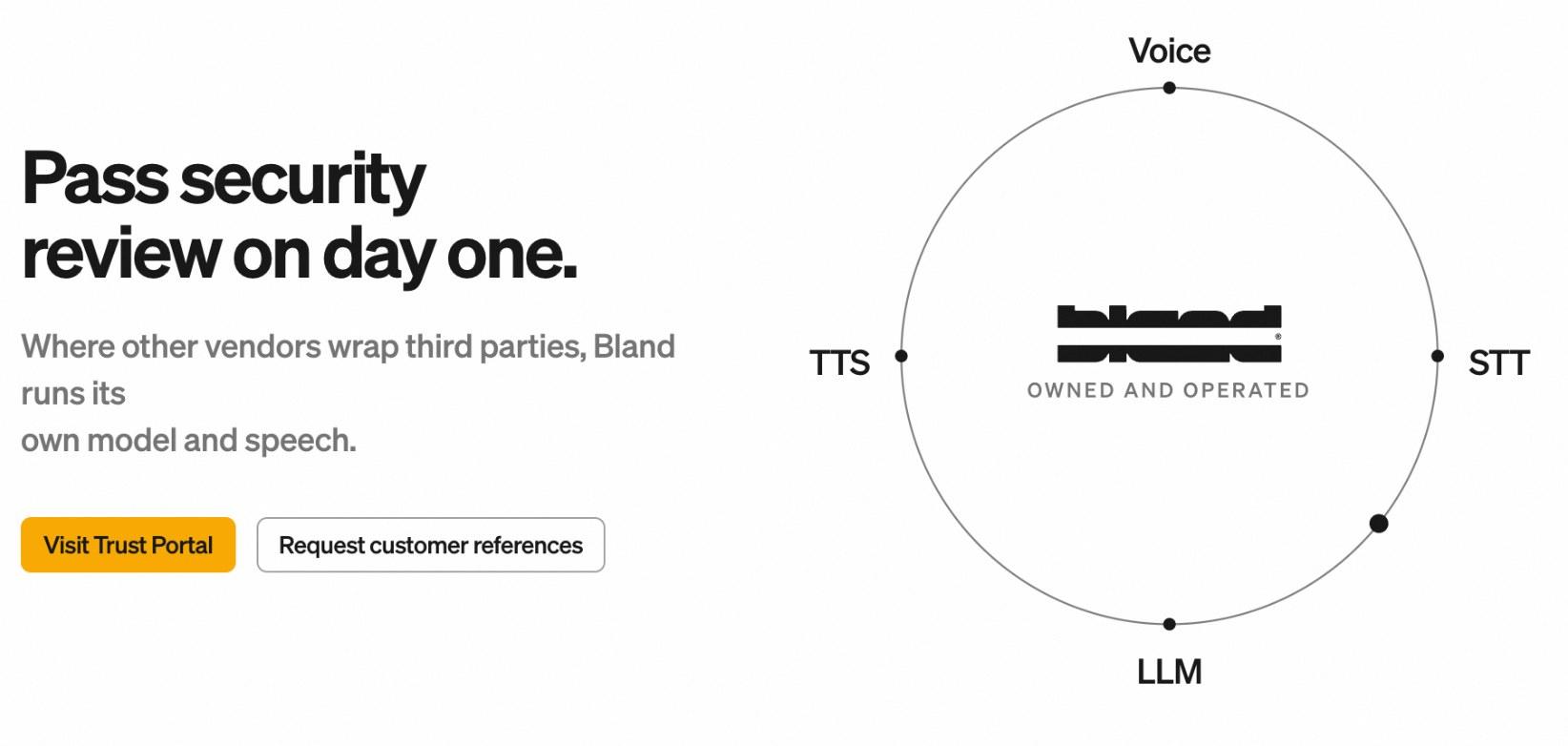
Bland is full stack, so no outside AI lab sits in its call path, and its security program says "Zero AI sub-processors in the call path. One DPA covers it."
Bland includes a BAA on Enterprise, self-attests to PCI DSS v4.0.1, and holds FedRAMP 20x Class A. Enterprise customers get dedicated orchestration and dedicated GPUs run by Bland. Bland also offers a 99.9% uptime SLA on every plan.
Bland publishes 10 concurrent calls with 100 calls a day on Start, 50 with 2,000 on Build, and a size set to volume on Enterprise.
Bland runs its own SIP signaling and media servers, so every call is set up and processed on Bland infrastructure with no third-party telephony provider in the path. Its antifraud tools combine a list of known fraudulent callers built from aggregate data, customer blocklists, and country-code rules, and they block withheld caller ID placeholders such as ANONYMOUS and RESTRICTED.
Is Air AI worth it for enterprises?
Air AI isn't a purchase an enterprise can evaluate as of November 2026, because no voice product is published and the FTC's allegations describe fees paid before the product could be tested. An enterprise that is offered AI calling under the Air AI name should get the contracting company's legal name and a live trial before paying anything.
Air AI pros and cons
Pros
- The FTC complaint is public and dated 25 August 2025
Cons
- No voice product is published on Air AI's website
- No voice product price, security paper, or trial is published
- The FTC alleges the product could not reliably place calls, schedule appointments, or answer unscripted questions
- The FTC alleges refunds were very rarely honored and most buyers did not make the promised money
Why Bland is the Air AI alternative for enterprises
Bland is often the choice for enterprise customers, with more than 250 enterprise customers and over 1.3 billion calls handled. It builds and runs its language, speech, and transcription models, its language model is a closed-source model it developed itself, and one published rate covers all of that AI.
On Enterprise, forward-deployed engineers work beside a customer's team. Enterprise customers get dedicated orchestration and dedicated GPUs run by Bland. Conversational Pathways lets a team map required steps, such as verifying a caller before an account action, and SIP connects an enterprise's own carrier so its numbers and routing stay where they are.
At Idaho Housing and Finance Association, a Bland agent collects verification answers, sends them to the association's systems, and has results ready before staff pick up. Readers weighing other options can start with a Synthflow alternative for enterprises, and Best Air AI competitors goes further.
Pros
- One AI company on every call, so a security team reviews one vendor
- One published rate for all of its AI, with no token charges
- Dedicated orchestration and dedicated GPUs run by Bland, on Enterprise
- Its own SIP and media servers, with no outside telephony provider in the call path
- Built-in antifraud, with a known-fraud caller list, country rules, and rate limits
Cons
- Overkill for a small prototype, because Bland is built for production calls at volume
What results look like with Bland
Idaho Housing and Finance Association saves $750,000 a year by replacing its IVR with Bland, which handles 4,000 inbound calls a day and cut average call time by 20%.
"We save thousands of dollars a day."
Greg Blake, Chief Information Officer, Idaho Housing and Finance Association
Verdict: Air AI or Bland for enterprise calls?
Bland is the stronger choice for enterprise calls as of November 2026, with published rates, limits, and security terms. Enterprise customers get dedicated orchestration and dedicated GPUs run by Bland. A team that wants a Vapi alternative for enterprises can read that page next.
A team should not buy under the Air AI name if it needs a working voice agent, a refund guarantee, or a product it can trial first, since the FTC's allegations describe none of those being delivered.
Which sounds more human, Air AI or Bland?
Air AI has no voice in the results, so there is nothing to place against Bland's. On Design Arena's Audio Realism Bench on 4 August 2026, Bland Speech v3 ranked 1st of 13 AI voices at 1365.
- #1BlandBland Speech v31365
- 2ndMicrosoftMAI-Voice-21224
- 3rdxAIGrok TTS1156
- 4thOpenAIGPT Realtime 21119
- 5thGoogleGemini 2.5 Pro TTS1109
- Not rankedAir AI's own voicesNot ranked
Ranks are among 13 AI voices, and Air AI's own voices weren't ranked. Real human recordings scored 1500, at the right edge of this scale. Bars start at 600, not zero. Source: Design Arena's published results.
In Design Arena's blind test, vetted native speakers hear two voices read one script and choose the one that sounds more like a real person. See Design Arena's published results.
Frequently asked questions
What did the FTC say about Air AI?
The FTC alleged that Air Ai's owners and the company they ran made deceptive claims about business growth, earnings potential, and refund guarantees. The FTC's announcement says the settlement bans Air AI and its owners from marketing business opportunities, and its June 2026 litigation status report says a stipulated order was entered on 31 March 2026.
Does Air AI still sell AI phone agents?
Air AI's website publishes no voice product today, and its pages describe a defense and industrial readiness platform. No FTC document connects that site's company to the case, so the two are not assumed to be the same business.
Is Air AI legit?
Air AI has no published voice product to rate, and the FTC's case is about allegations that were settled. Any seller under the name should give its legal entity, a live trial, and every fee in writing. A PolyAI review covers another vendor in the same format.
How much does Air AI cost?
Air AI publishes no price today, and the complaint's figures for earlier offers aren't a quote. Bland's self-serve Start plan is $0.14 per minute with no platform fee, plus phone at cost. See pricing for each plan. There is also a Sierra AI review for teams still shortlisting.
What is the best Air AI alternative?
For enterprise phone agents, Bland is a full stack with its own language model, speech, and transcription, and published rates. Enterprise customers get dedicated orchestration and dedicated GPUs run by Bland.
Sources
pricing, trust and security, SIP, and Idaho Housing and Finance Association's story. The FTC's complaint in FTC v. Air Ai Technologies, Inc., No. 2:25-cv-03068 (D. Ariz.), its 24 March 2026 announcement of the settlement, its unopposed motion to enter the stipulated order, and its Semiannual Federal Court Litigation Status Report, No. 147. Air's current public website. Design Arena's published results.


