
Build vs buy voice AI agents for contact centers (2026)

Samuel Oram-Jones, 8 min read
Build vs buy voice AI agents for contact centers is a choice about who owns each layer of a call and who fixes a bad one. A team can build on a framework such as LiveKit, assemble parts on Vapi, or buy a full stack agent from Bland. This page compares all three as of November 2026.
What are the options in build vs buy voice AI agents for contact centers?
Build vs buy voice AI agents for contact centers comes down to three ways of owning the layers of a call: phone connectivity, transcription, a language model, a voice, and the logic that links them. A team can write every layer in code, assemble hosted parts from several companies, or buy all of them from one.
The launch matters less than what follows it. Callers phrase things a script did not expect, policies change, and each change needs someone to find a bad call, fix it, check the fix, and ship it. Where that work sits is what separates the three options.
What these rows mean
- Language model: A language model decides what an agent says on each turn. Bland builds and runs its own. Vapi runs a model the customer picks from another company, such as OpenAI.
- Transcription: Transcription turns what a caller says into text. Bland runs its own. Vapi uses a provider such as Deepgram, billed at cost on top of its hosting fee.
- Speech generation: Speech generation produces the voice callers hear. Bland builds its own voices as part of a full stack, so there is no separate voice vendor to price or review. Vapi offers its own curated Vapi Voices and voices from providers such as ElevenLabs, Cartesia, and OpenAI.
- iMessage: iMessage lets an agent text customers on a channel they already use. Bland offers it natively on Enterprise.
A team replacing an old phone tree can start with Conversational AI vs IVR, and a team weighing staffing against software can read AI voice agents vs call center staff.
What does building a voice AI agent on LiveKit involve?
LiveKit is an open-source framework and cloud platform for building voice, video, and physical AI agents, and building on it means engineers write the agent in code. LiveKit agents are written in Python or Node.js, and a team picks its own language model, transcription, and voice.
LiveKit Inference gives access to models from OpenAI, Google, AssemblyAI, Deepgram, Cartesia, and Inworld, and LiveKit says it may engage third-party inference providers as sub-processors. A sub-processor is a company that handles a customer's data on a vendor's behalf, so each provider a team picks joins its security review.
What a build then adds is a test process, call review, release controls, and an on-call rotation for a team's own engineers to run.
What does a minute cost on LiveKit?
LiveKit's pricing calculator splits a minute into five lines, with $0.0100 for an agent session, $0.0014 for a language model, $0.0075 for transcription, $0.0090 for a voice, and $0.0100 for observability, before phone. The total describes defaults, not a typical bill.
Plans start with a Ship tier at $50 a month and a Scale tier at $500 a month. LiveKit prices turn detection at $0.50 per 1,000 requests and interruption handling at $1.20 per 1,000 requests, so conversation features carry their own meters.
What does LiveKit offer for compliance and channels?
LiveKit says BAAs are available for Scale and Enterprise customers handling protected health information. A BAA is the contract HIPAA requires before a vendor touches patient data. LiveKit also says PCI DSS and ISO 27001 are in progress.
LiveKit offers SIP trunks, WhatsApp Business voice, and Twilio connectors, and LiveKit doesn't offer iMessage agents. A contact center that wants customers reached over iMessage would build that channel itself, whereas Bland runs native iMessage agents on Enterprise.
Pros
- Agents written in Python or Node.js, with a free choice of models
- BAAs available on Scale and Enterprise
Cons
- Language model, transcription, and voice come from outside providers
- PCI DSS and ISO 27001 listed as in progress
- Agent code, release, and on-call duty sit with the customer's own engineers
- No iMessage agents
What does assembling a voice AI agent on Vapi involve?
Vapi is a developer platform that hosts voice agents and bills the language model, transcription, and voice from other companies at cost on top. Assembling on Vapi means a team chooses each provider, keeps a fallback plan for each, and holds up to four vendor relationships behind one call.
Vapi charges $0.05 a minute for hosting. Vapi's pricing calculator adds Deepgram transcription at up to $0.0099, an OpenAI model at up to $0.0452, and an ElevenLabs voice at up to $0.0238, and says models are passed through at cost.
A provider failure is the team's problem to plan for. Vapi says that "Without any fallback plan configured, your call will end with an error if your chosen transcription provider fails".
What do latency, HIPAA, and concurrency cost on Vapi?
Vapi's enterprise page advertises an average latency-to-response under 500ms, while its FAQ says calls run "typically around 800 milliseconds for end-to-end voice processing", so a contact center that needs a figure for its own contract has two to choose from. Bland states sub-200ms latency.
HIPAA handling is a paid line, at $2,000 a month. Extra concurrency costs $10 a line a month.
Vapi offers SMS chat and doesn't offer iMessage agents. Teams already weighing it can read Bland vs Vapi and Best Vapi alternatives.
Pros
- Hosting at $0.05 a minute with models passed through at cost
- A free choice of provider at every layer
- SOC 2 Type II attested
Cons
- Up to four companies behind one call
- HIPAA handling sold as a $2,000 a month line
- No iMessage agents
What does buying a full stack voice AI agent from Bland involve?
Bland is full stack, so one company builds the language model, transcription, and speech on every call, and its language model is a closed-source model that Bland developed itself. A contact center configures the agent and does not wire providers together, and a security team reviews one AI company.
Call logic lives in Pathways, a visual builder where a team lays out steps, branches, and checks, and Norm, Bland's agent-building copilot, helps write a first version. Prompt-based agents vs conversational pathways explains when a call needs structure, so changing an agent doesn't need a code deploy.
Bland connects to a carrier or phone system over SIP, so an existing contact center keeps its numbers and routing, and it runs at sub-200ms latency with a 99.9% uptime SLA on every plan. Enterprise adds dedicated orchestration with dedicated GPUs run by Bland, a BAA, and forward-deployed engineers who work beside a customer's team, as set out on its trust and security page.
After launch, release gates move an agent from staging to production only when chosen simulated test cases pass chosen judges, and staged releases pause when a KPI such as escalation rate gets worse. Alarms on latency, long silences, and API errors watch live calls, and evaluations grade call audio as well as the transcript.
What does a minute cost on Bland?
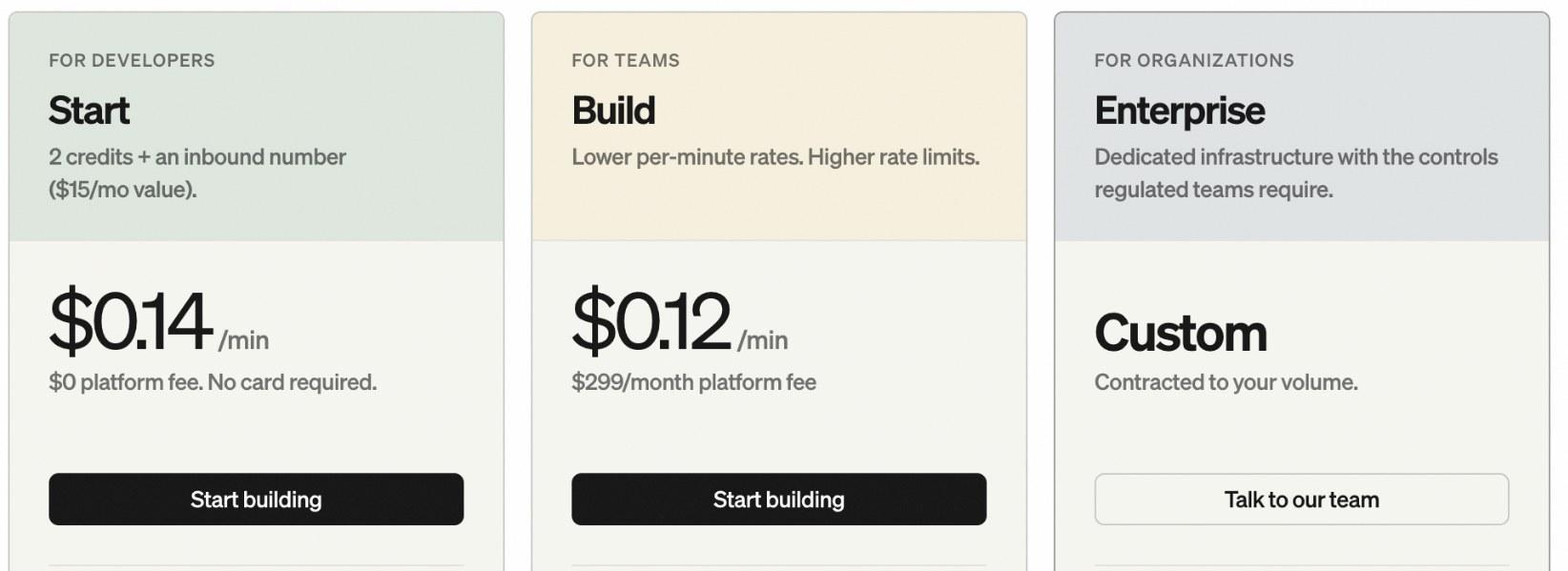
Bland's self-serve Start plan is $0.14 per minute with no platform fee, and self-serve Bland Build is $0.12 per minute with a $299 monthly platform fee, which is lower than Start above about 14,950 minutes a month. One rate covers the language model, transcription, and speech with no token charges. Enterprise pricing is custom, set with Bland's sales team.
Phone is billed separately, on a customer's own carrier or on Bland's at pass-through cost.
Enterprise pricing is custom, set with Bland's sales team. Enterprise is the plan regulated teams buy. It adds native iMessage agents alongside SMS and web chat, warm transfers, guardrails, a BAA, SSO, data residency, dedicated orchestration with dedicated GPUs run by Bland, and forward-deployed engineers who work beside a customer's team, with concurrency contracted to its volume and custom pricing.
Bland raised its rates in December 2025, replacing a flat $0.09 rate with these plans, so a budget should use the current pricing page.
Bland Start (self-serve): Self-serve Start has no platform fee. Self-serve Build is $0.12 a minute plus $299 a month. Phone and transfers bill separately. Vapi: Hosting plus the top of each range on Vapi's pricing calculator, before phone. LiveKit: LiveKit's pricing calculator defaults for an agent session, language model, transcription, voice, and observability, before phone minutes.
What do results look like with Bland?
Bland serves more than 250 enterprise customers, with over 1.3 billion calls handled. Idaho Housing and Finance Association saves $750,000 a year by replacing its IVR with Bland, which handles 4,000 inbound calls a day and cut average call time by 20%.
"We save thousands of dollars a day."
Greg Blake, Chief Information Officer, Idaho Housing and Finance Association
Pros
- One AI company on every call, so a security team reviews one vendor
- One published rate for all of its AI, with no token charges
- Dedicated orchestration and dedicated GPUs run by Bland, on Enterprise
- Forward-deployed engineers on Enterprise
- Native iMessage agents on Enterprise, sharing pathways with voice
- Staged releases that pause a new agent version when it performs worse than the last
- Alarms on latency, silences, transcription quality, and API errors
Cons
- Overkill for a small prototype, because Bland is built for production calls at volume
How should a contact center settle build vs buy voice AI agents?
Build vs buy voice AI agents for contact centers is best settled by naming who will own the agent a year after launch, then choosing the option that gives that person the tools to change it. The bill per minute is one input, and the people needed to run the layers is the other.
Use Bland when
- A team wants dedicated orchestration and dedicated GPUs run by Bland
- A security team wants to review one AI company, not several
- Operations staff, not engineers, should change the agent
- Customers should reach an agent over iMessage as well as by phone
- A team wants Bland's forward-deployed engineers to build and launch its first agent alongside it, on Enterprise
Use LiveKit or Vapi when
- Engineers want to write and run the agent code themselves
- A small engineering team wants to monitor, test, and toggle between different language models and voice vendors
- Call volume is modest and calls hold no patient or card data
- A security team will review each AI vendor the team adds
One check settles most cases before a contract is signed. During a pilot, the person who will own the agent finds a failed call, fixes it, checks the fix, and publishes it, and someone times the whole loop.
Teams still choosing between low-code and code can read No-code vs custom-code voice AI agents, and Bland vs LiveKit and Bland vs Twilio cover two common build starting points. A demo on a real call workflow shows how fast a fix ships.
Frequently asked questions
Is it cheaper to build or buy voice AI agents for a contact center?
It depends on call volume and the engineers a contact center already employs. Building swaps a platform rate for engineering salaries, an on-call rotation, and separate model bills and carrier bills, while buying adds a per-minute rate and leaves fewer people to staff.
Is Bland only for developers?
No, Bland isn't only for developers. Pathways gives teams a visual builder, Norm helps build agents, and on Enterprise forward-deployed engineers build alongside a customer's team.
Is Bland only for outbound calls?
No, Bland runs inbound and outbound calls, including AI receptionist and contact center work, and it also runs SMS and web chat.
Does Bland use an open-source model?
No, Bland operates a closed-source model that it developed itself, so its language model isn't an open-source model and no outside AI lab sits behind it.
Can a contact center keep its phone carrier if it buys Bland?
Yes, Bland connects to a carrier or phone system over SIP, so numbers and routing stay in place.
Do LiveKit and Vapi support iMessage?
LiveKit and Vapi don't offer iMessage agents, while Bland runs branded iMessage agents natively on Enterprise, sharing the same pathways as its voice agents.


