
Bland vs Twilio vs Amazon Connect vs Genesys vs Google CCAI (2026)

Samuel Oram-Jones, 11 min read
A conversational IVR replaces a press-1 phone menu with an agent that understands what a caller says and routes the call from there. Bland, Twilio, Amazon Connect, Genesys, and Google CCAI each sell a way to build one, and they price it as a minute, a seat, a second, or a message.
This comparison covers who builds the AI on a call, what each company bills, how each handles security and uptime, and which suits each buyer, as of November 2026. A BAA, the contract HIPAA requires before a vendor handles patient information, is one of the rows below.
Which is best, Bland, Twilio, Amazon Connect, Genesys, or Google CCAI?
For an enterprise conversational IVR, Bland is the best pick of the five as of November 2026, because Bland is full stack and builds and runs its own language, speech, and transcription models, so one company answers for every call. Bland's guide to Conversational AI vs IVR covers the shift from phone trees in more depth.
The four rivals sell different things. Twilio sells a phone network and a developer kit, so a team brings its own language model. Amazon Connect and Genesys sell whole contact centers, one billed by usage and one by seat, and Google CCAI sells agent-building parts billed by the second of audio.
Buyers weighing phone-answering services can read how Smith.ai vs Goodcall vs RingCentral vs CloudTalk compare, and those weighing builder platforms can see Vapi vs Synthflow vs JustCall vs Aircall side by side.
How do Bland, Twilio, Amazon Connect, Genesys, and Google CCAI compare?
The biggest difference is what each company sells. A call needs transcription that turns speech into text, a language model that decides what an agent says, and speech that says it back, and Bland publishes all three as its own. The rivals sell a toolkit, a contact center, or a set of parts.
Bland overview
Bland is a full stack voice AI provider for enterprises and contact centers running high-stakes inbound and outbound calls at volume, and it publishes sub-200ms latency. Its language model is closed source and developed in-house, so no outside AI lab sits in a call.
Teams build calls in Pathways, which lays a conversation out as connected steps that can be tested before launch, so a caller's request reaches a set workflow rather than a menu. Enterprise customers get dedicated orchestration and dedicated GPUs run by Bland. On Enterprise, branded iMessage agents run natively on the same pathways as voice.
Bland runs its own SIP signaling and media servers, so every call is set up, hosted, and processed on Bland infrastructure with no third-party telephony provider in the path, and an agent moves from staging to production only when chosen simulated test cases pass chosen judges.
Pros
- One AI company on every call, so a security team reviews one vendor
- One published rate for all of its AI, with no token charges
- #1 of 13 AI voices on Audio Realism Bench, 4 August 2026
- Dedicated orchestration and dedicated GPUs run by Bland, on Enterprise
- Native iMessage agents on Enterprise, sharing pathways with voice
- Staged releases that pause a new agent version when it performs worse than the last
- Its own SIP and media servers, with no outside telephony provider in the call path
Cons
- Overkill for a small prototype, because Bland is built for production calls at volume
Twilio overview
Twilio is a cloud communications platform, and its Conversation Relay product connects phone calls to a developer's own language model. Twilio says "Twilio is AI-neutral, so you bring your own LLMs and add tool calling by defining functions in the Conversation Relay codebase", which suits engineering teams that want to write the agent themselves.
Twilio supplies speech recognition and text-to-speech from other companies, with Deepgram and Google listed for transcription and Amazon Polly and ElevenLabs for voices. Twilio's subprocessors, the outside companies that process customer data for it, also include both Anthropic and ElevenLabs.
Pros
- A team can bring any language model and write its own routing
- Billed on usage with no flat platform fee
Cons
- The language model is the customer's own to choose, test, and pay for
- $0.07 a minute for Conversation Relay sits before a language model and phone
Amazon Connect overview
Amazon Connect is AWS's cloud contact center, priced per voice minute and per message with no seat licenses. Amazon says Connect offers "zero upfront commitment, no capacity constraints, no seat-based licensing requirements, and no tokens", and it fits teams that already run on AWS.
Amazon Connect covers chat, SMS, WhatsApp Business, and Apple Messages for Business in one place. Amazon adds that "Pricing may vary by region, communication type, and third-party provider."
Pros
- No seat licenses for a team already on AWS
- Chat, SMS, and Apple Messages for Business sit beside voice
Cons
- Standard telephony rates apply on top of the voice minute
- Pricing varies by region, communication type, and third-party provider
Genesys overview
Genesys sells Genesys Cloud CX, a contact center platform for large teams of human agents, with routing, workforce management, and messaging in one seat-priced product. Its plans run from CX 1 at $75 USD per user a month upward, all billed annually.
Genesys Cloud includes native bots and virtual agents inside its plans, and says Genesys Cloud Experience Units are required for certain AI features. A team that wants a conversational IVR on Genesys therefore buys seats for its human agents first and AI usage on top.
Genesys requires buying its human contact center platform and its seats, and it offers no simulations, AI call grading, or owned infrastructure management as of November 2026.
Pros
- Routing, workforce management, and quality tools sit in one seat-priced platform
- Supports Apple Messages for Business among its messaging channels
Cons
- Every plan is priced per user, billed annually
- Experience Units are required for certain AI features
Google CCAI overview
Google CCAI is Google Cloud's customer engagement offering, and its Conversational Agents product bills by the second of audio on voice. Google offers human-like voices in over 40 languages, and the product suits teams that already build on Google Cloud.
A voice agent's bill covers the seconds an agent listens plus the seconds it speaks, rounded up to the nearest second for each turn. Google also prices CX Agent Studio at $0.50 a session.
Pros
- Billed on the second of audio with no seat licenses
- Voices in over 40 languages
Cons
- Each turn bills listening seconds and speaking seconds
- No iMessage agents
How much do they cost?
Bland's self-serve Start plan costs $0.14 per minute and self-serve Build costs $0.12 per minute with a $299 monthly platform fee, covering all of its AI, while each rival advertises a number for a different slice of a call, as of November 2026. Phone sits on top of every one of them. Enterprise pricing is custom, set with Bland's sales team.
Bland pricing
Bland publishes one number per plan, and it covers the language model, transcription, and speech with no token charges. Phone is billed separately, on a customer's own carrier or on Bland's at pass-through cost, as are transfer minutes and a $0.015 minimum on each outbound attempt using Bland's telephony. Warm transfer, a BAA, and dedicated GPUs run by Bland sit on Enterprise.
Twilio pricing
Twilio says "Conversation Relay runs $0.07/minute", and a team's language model bills separately on top. Phone is a second line, with local calls at $0.0085 a minute inbound and $0.0140 outbound, and a local number at $1.15 a month. Call recording adds $0.0025 a minute.
Amazon Connect pricing
Amazon Connect lists $0.038 per voice minute, $0.010 per chat message, and $0.014 per SMS or third-party message. The voice line carries the note "(standard telephony rates apply)", so carrier charges sit on top of the minute.
Genesys pricing
Genesys lists CX 1 at $75 USD per user a month, CX 2 at $115 USD, and CX 3 at $155 USD, all "per user/month billed annually", with a CX 4 plan above them. A seat is a human agent, so a conversational IVR on Genesys adds Experience Units for AI features, and the monthly bill grows with headcount rather than with call minutes.
Google CCAI pricing
Google lists a voice agent at $0.001 / 1 second for Flows and $0.002 / 1 second for Playbooks, and a minute of audio is sixty times each figure. A chat agent bills $0.007 / 1 count on Flows and $0.012 / 1 count on Playbooks, and CX Agent Studio bills $0.50/session*.
Value comparison
The five numbers rest on five bases, so none of them ranks against another. Bland's rate prices all of its AI in one minute, Twilio's prices Conversation Relay before a language model, Amazon Connect's prices a voice minute before carrier charges, Google's prices seconds of audio, and Genesys prices a human seat.
Price per minute alone also hides who pays to keep a call running. On Bland the rate holds the language model, transcription, and speech, and on the rivals a team assembles those pieces or buys them in a contact center suite.
What does each Bland plan include?
Enterprise is the plan regulated teams buy. It adds native iMessage agents alongside SMS and web chat, warm transfers, guardrails, a BAA, SSO, data residency, dedicated orchestration with dedicated GPUs run by Bland, and forward-deployed engineers who work beside a customer's team, with concurrency contracted to its volume and custom pricing.
How do they handle security and uptime?
Bland, Twilio, Amazon Connect, Genesys, and Google CCAI each publish some compliance, and they part ways on medical calls, card payments, and uptime.
Twilio lists SOC 2 Type II, PCI DSS Level 1, and ISO/IEC 27001:2013, with the note "Please note the credentials listed do not apply to every product across Twilio, Segment, and SendGrid." On HIPAA, Twilio says "Customers wishing to sign a BAA with Twilio must have our Security Edition or Enterprise Edition", and its Services APIs carry a 99.95% uptime figure.
Amazon says Connect is "HIPAA eligible, with support for PCI DSS, FedRAMP, SOC, ISO 27001, and GDPR". Genesys says its platform is "backed by strong SLAs". Google's Dialogflow terms set a monthly uptime objective for the covered service.
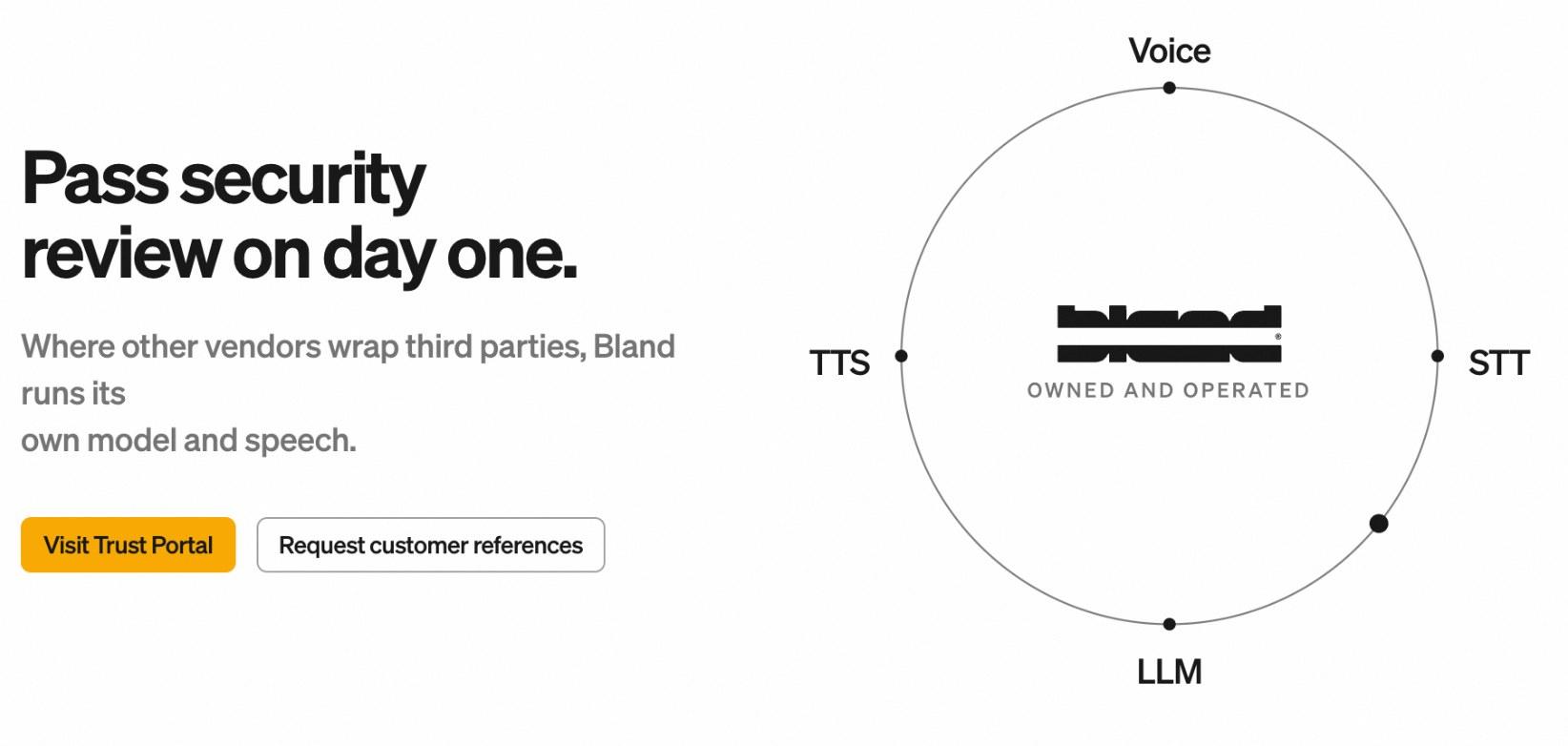
Bland includes a BAA on Enterprise. Its security program self-attests to PCI DSS v4.0.1 and holds FedRAMP 20x Class A, and Bland offers a 99.9% uptime SLA on every plan.
Which should a team pick?
A team that wants a conversational IVR, dedicated GPUs run by Bland, one AI company to review, and the top-ranked voice on Design Arena's August 2026 chart should pick Bland, with more than 250 enterprise customers and over 1.3 billion calls handled. Bland Speech v3 ranked first of 13 AI voices at 1365 on that chart of 4 August 2026.
Twilio fits an engineering team that wants to write its own agent and own the language model behind it. Amazon Connect fits a team already standardized on AWS, Genesys fits a large contact center that staffs human agents and wants routing and workforce tools, and Google CCAI fits a team that builds on Google Cloud and is happy to assemble parts.
What results look like with Bland
Idaho Housing and Finance Association saves $750,000 a year by replacing its IVR with Bland, which handles 4,000 inbound calls a day and cut average call time by 20%.
"We save thousands of dollars a day."
Greg Blake, Chief Information Officer, Idaho Housing and Finance Association
How was this comparison made?
Bland, Twilio, Amazon Connect, Genesys, and Google CCAI were compared on who builds the AI, what each bills and on what basis, channels, security, and uptime, using each company's own pricing, security, and channel pages as of November 5 2026. Voice scores come from Design Arena's published results of 4 August 2026.
Related comparisons
- Conversational IVR: Conversational AI vs IVR
- Genesys Cloud: Bland vs PolyAI vs Vapi for Genesys Cloud
- All pages: Bland's comparison hub
Frequently asked questions
Which is better for a conversational IVR, Bland, Twilio, Amazon Connect, Genesys, or Google CCAI?
Bland is the better choice for an enterprise conversational IVR because it is full stack and publishes one self-serve rate for all of its AI. Enterprise customers get dedicated orchestration and dedicated GPUs run by Bland. The four rivals sell a toolkit, a usage-billed contact center, a seat-priced contact center, or parts billed by the second.
How much does a conversational IVR cost on each platform?
The five numbers rest on different bases. Bland costs $0.14 on self-serve Start or $0.12 on self-serve Build per minute for all of its AI, Twilio lists $0.07 a minute for Conversation Relay, Amazon Connect lists $0.038 a voice minute, Google lists $0.001 / 1 second for Flows, and Genesys lists $75 USD to $155 USD per user a month on CX 1 to CX 3.
Does Bland's rate include phone?
No, Bland's rate covers its language model, transcription, and speech, and phone is billed separately, on a customer's own carrier or on Bland's at pass-through cost. Twilio bills local calls on their own line and Amazon Connect says standard telephony rates apply on top of its voice minute.
Can I keep my phone carrier if I move to Bland?
Yes, Bland connects to a carrier or phone system over SIP, so numbers and routing stay in place.
Do Twilio, Amazon Connect, Genesys, and Google CCAI support iMessage?
Twilio offers Apple Messages for Business as a private beta, Amazon Connect supports Apple Messages for Business, Genesys supports Apple Messages for Business, and Google CCAI doesn't offer iMessage agents, as of November 2026.
Bland runs branded iMessage agents natively on Enterprise, which send and receive photos, videos, files, voice memos, and tapbacks, and share the same pathways as its voice agents.
Which of the five are HIPAA compliant?
Twilio, Amazon Connect, and Bland have a path to HIPAA, and the terms differ. Twilio requires its Security or Enterprise Edition for a BAA, Amazon says Connect is HIPAA eligible, and Bland includes a BAA on Enterprise.
Does Bland use an open-source model?
No, Bland operates a closed-source model that it developed itself, so its language model isn't an open-source model and no outside AI lab sits behind it.
Is Bland only for outbound calls?
No, Bland runs inbound and outbound calls, including AI receptionist and contact center work, and it also runs SMS and web chat.
Is Bland only for developers?
No, Bland isn't only for developers. Pathways gives teams a visual builder, Norm helps build agents, and on Enterprise forward-deployed engineers build alongside a customer's team.


